





AI Smart Nail Lamp for US Buyers: FCC, UL 859 and the Battery File
The United States has no single “nail lamp approval”. It has three documents that three different people ask for at three different moments: the customs broker and the marketplace want an FCC file, the landlord or the insurer wants an NRTL mark, and the air freight desk wants a UN38.3 report the moment a battery is inside the box. Buyers who confuse the three lose weeks.
A US order is not blocked by the lamp. It is blocked by three files written by three different parties — only one of which is the factory.
The largest nail market, counted three ways
Every US sourcing conversation starts with a number, and the numbers disagree because the definitions do. A local-business database counted 78,602 nail salon locations in September 2026 (CUFinder); a company-registry dataset counted 81,491 manicurists and nail salons in October 2026, of which 97% have one to four staff and 49% are corporations or LLCs (CompanyData); a third estimate puts the US at roughly 56,000 salons and North America at 36.4% of global nail care service revenue in 2025 (Dataintelo, 2026 edition). One counts storefronts, one counts registered entities, one counts service businesses.
All three agree on the shape of the buyer: small rooms, owner-operated, one to four chairs, high volume per chair. That profile rewards a lamp with fewer redos, because in a room that bills by the set, a redo is not a warranty cost — it is a lost slot.
78,602
US nail salon locations counted in September 2026 (CUFinder local-business database)
97%
Share of US nail businesses with one to four staff — the buyer is usually the owner (CompanyData, 2026)
3 files
FCC, an NRTL listing and — only for the battery version — UN38.3. They are not interchangeable
File one: FCC Part 15 Subpart B
The AI Smart Nail Lamp is an electronic product with digital circuitry: a camera sensor, on-board vision processing, a touchscreen controller and a switching LED driver. That makes it an unintentional radiator under FCC Part 15 Subpart B, and the route is a Supplier’s Declaration of Conformity (SDoC), not a certificate: emissions testing at an ISO/IEC 17025 laboratory — conducted from 150 kHz to 30 MHz on the mains lead, radiated from 30 MHz to 1 GHz — to the Class B limits, a declaration signed by a responsible party located in the United States, and a technical file kept for inspection. There is no FCC certificate and no filing number, which is why some buyers assume the file does not exist.
Two details set the timeline. The responsible party must be a US entity — typically your importer or your brand’s US arm — and its name must match the declaration. And the moment a radio is added, the route changes: Wi-Fi or Bluetooth firmware makes the product an intentional radiator under Part 15 Subpart C and requires an FCC ID, with a TCB review and a permanently marked ID on the housing. A camera and on-device compute do not make a radio; a Bluetooth chip does. Settle that before tooling, because it is a housing change, not a label change.
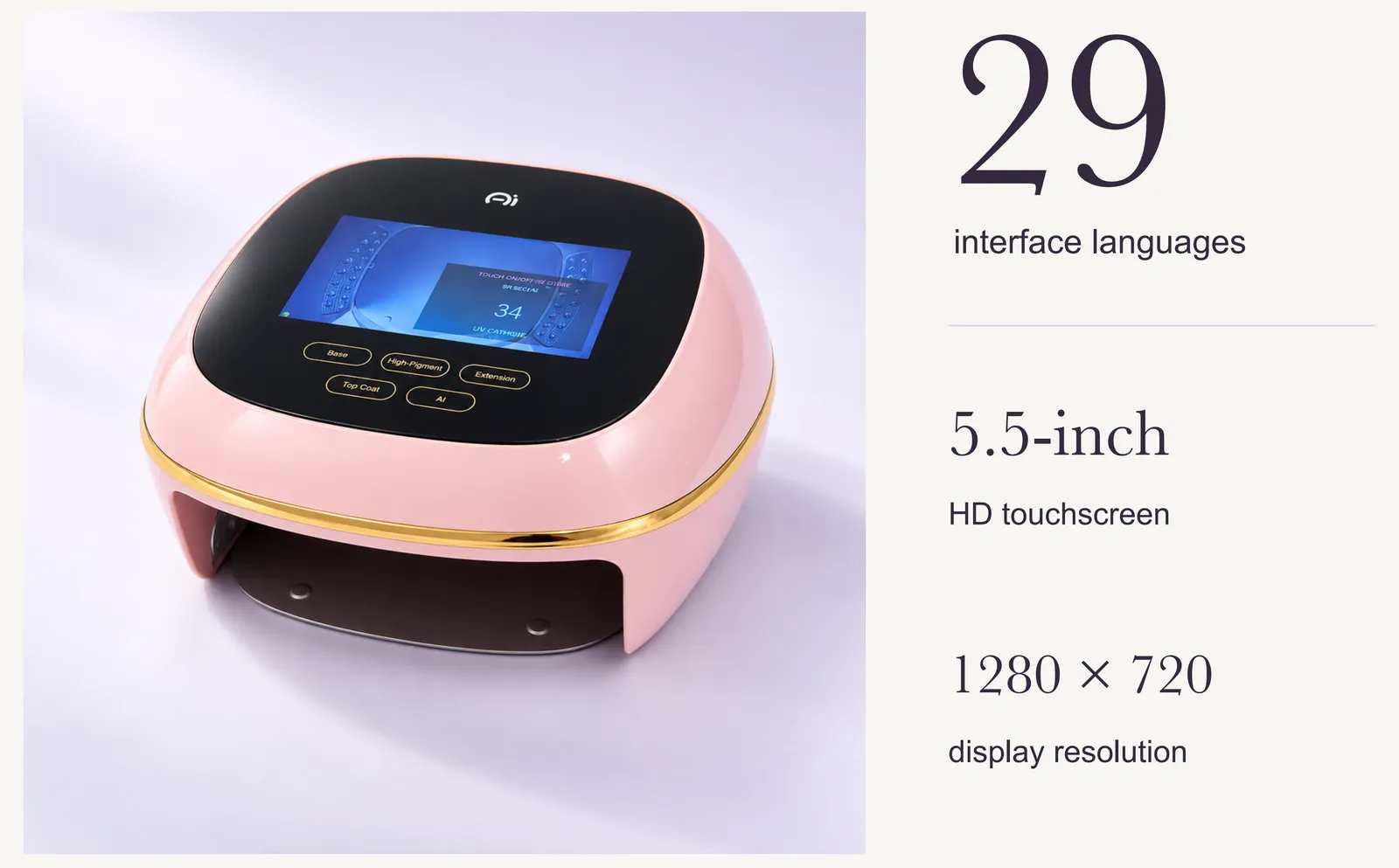
The touchscreen, camera and driver put the lamp in scope for Part 15 Subpart B — and the same assembly is where a radio would change the whole route.
File two: UL 859, UL 1727, and the difference between a report and a listing
Safety certification is not a federal mandate for this category; it is a market requirement enforced by the people who carry risk. That produces two artifacts buyers routinely conflate:
- A test report to UL 859, the standard for household electric personal grooming appliances, which covers nail lamps: leakage current, dielectric strength, temperature rise, abnormal operation, enclosure flammability. A report from an ISO/IEC 17025 laboratory is what a marketplace such as Amazon asks for when it gates the beauty category.
- An NRTL listing — the UL, ETL or CSA mark from a nationally recognized testing laboratory under OSHA’s NRTL program, with follow-up factory inspections. This is what a landlord, commercial insurer, franchise system or electrical inspector looks for, because it is a mark they can verify.
The classification question sits underneath both. UL 859 is written for household personal-care appliances; UL 1727 is written for commercial salon equipment and is stricter. A portable lamp sold to technicians and salons through distribution normally travels on UL 859; a lamp specified into a chain’s fit-out and described as commercial equipment can be argued into UL 1727 — and the test program, sample count and cost all change. The standard follows intended use and marketing claim, so agree the classification in writing with the laboratory before samples ship.
File three: UN38.3, but only for the battery version
The standard build is AC-powered with no battery. That removes an entire transport file: no lithium battery, no Class 9 entry, no dangerous-goods surcharge on air freight. The 6,000 mAh version is optional and built on request, and it brings UN38.3 with it — the eight-test transport package (altitude simulation, thermal cycling, vibration, shock, external short circuit, impact, overcharge, forced discharge) that airlines treat as the entry ticket. A 6,000 mAh pack at roughly 3.7 V nominal is well under the 100 Wh threshold, so it travels as battery packed with equipment rather than as a standalone dangerous-goods shipment — but the paperwork still applies.
One point changed recently and belongs in the purchase order: lithium-ion cells and batteries shipped above 30% state of charge face additional approval, so shipments are expected to leave the factory at or below 30%, with a discharge record available if the airline asks. A supplier that has never shipped battery units to the US will not have that record. Ask before the sample, and ask whether the UN38.3 report covers the exact cell in the current bill of materials — a silent cell substitution invalidates it.
120 V, 60 Hz, and the circuit behind the chair
The electrical side is easy, provided it is specified rather than assumed. US commercial rooms run 120 V at 60 Hz on NEMA 5-15 receptacles, on 15 A or 20 A branch circuits. A 15 A circuit is 1,800 W of theoretical capacity; continuous loads are conventionally planned at 80%, about 1,440 W — which is why a room running two warmers, a sterilizer and a dust extractor on one circuit is a room that trips. A curing lamp draws a small fraction of that, so the lamp is never the constraint; the cord, the power strip and the daisy chain are. Order the 120 V/60 Hz nameplate, the moulded NEMA 5-15 cord and a spare cord per ten units — and specify a driver tested at 60 Hz, because a report written for a 230 V/50 Hz build does not answer a US inspector’s question.
What the lamp does in a room that bills by the set
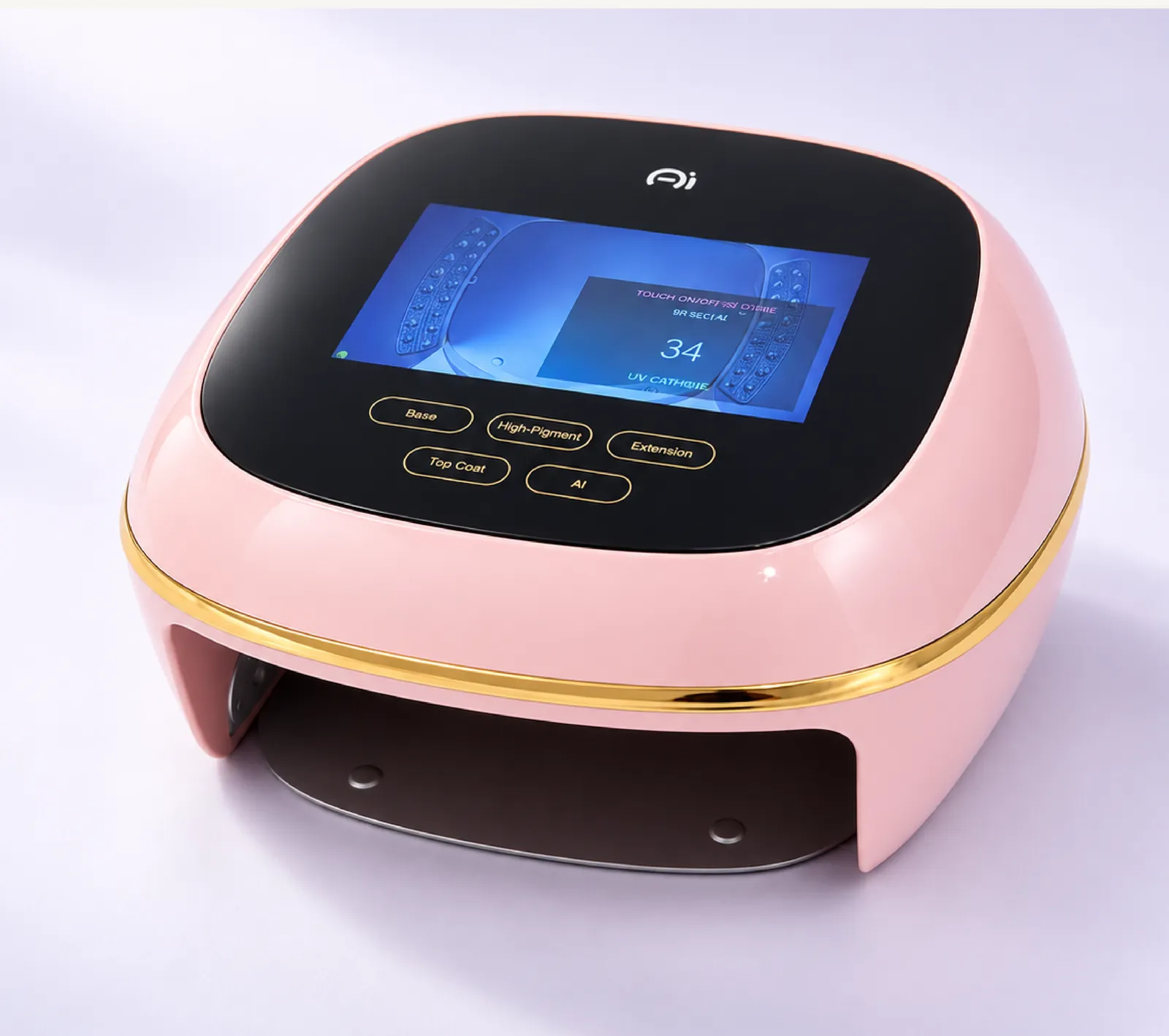
Underneath the paperwork, the commercial argument is throughput without redos. The AI Smart Nail Lamp uses a 2 MP camera and on-board AI processing to locate the nails in about 0.2 seconds, then fires its 136 dual-band LEDs — 365–370 nm and 395–400 nm — only over the detected zones. The curing principle is the same as any modern gel lamp, LED diodes emitting long-wave UV to set the product; what differs is the control layer. Because the light lands on the nail rather than flooding the hand, the skin around it receives far less unnecessary exposure — the mechanism behind the “dark hands” complaint long-term gel clients raise, and a claim you can make without pretending the lamp emits nothing.
Two features matter to a US operator specifically. Smart heat control addresses the exotherm spike that makes clients flinch and technicians slow down, and the light-decay warning turns a gradual output drop into a service prompt instead of a month of sets that cure short. The 5.5-inch console ships in 29 languages and can be locked — in the US that is less about translation than staffing, since a room with Vietnamese, Korean or Spanish-speaking technicians can run one interface across every chair. The 24 × 24 × 11.5 cm housing with rear cable entry fits the compact stations that dominate US salon suites.
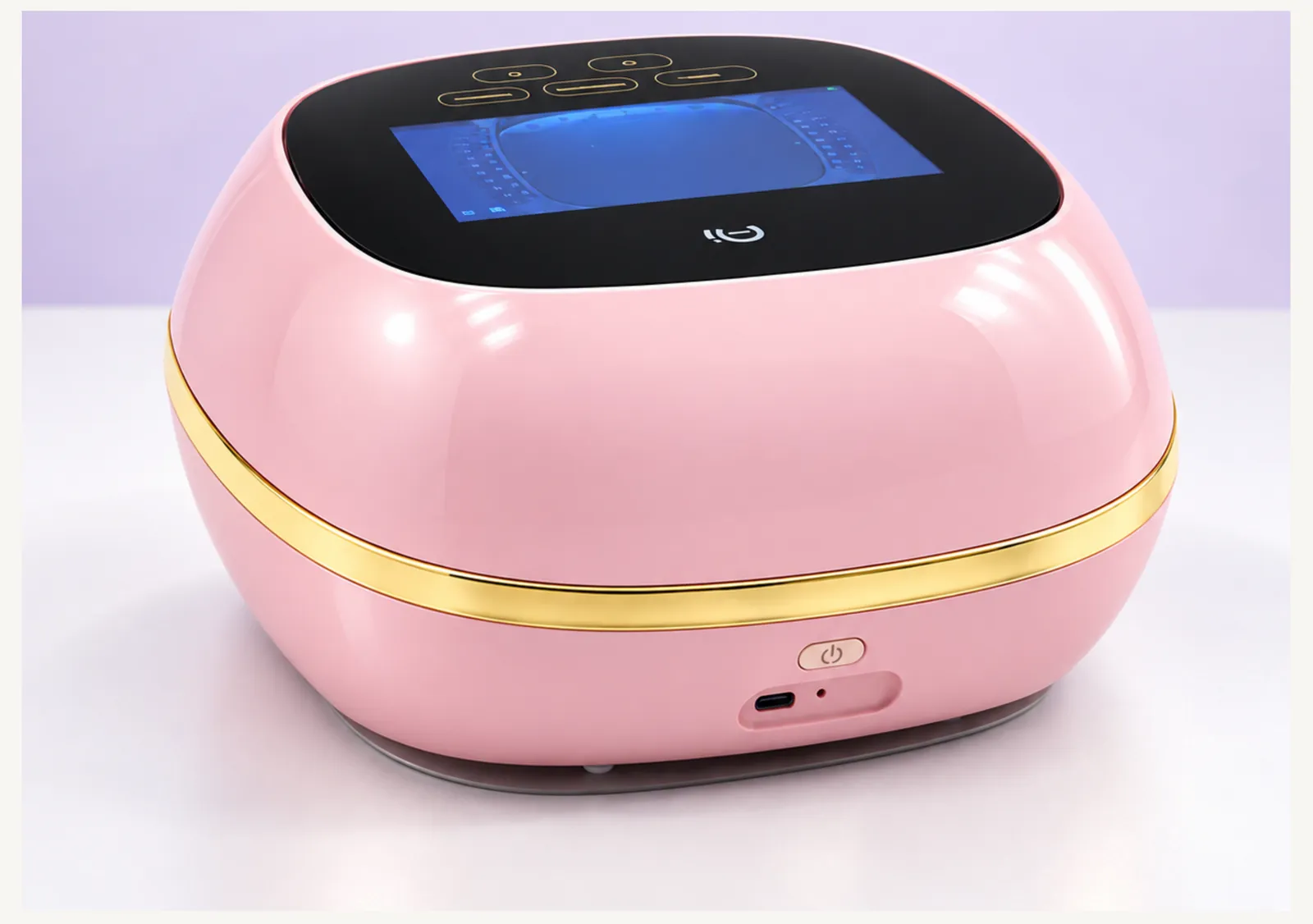
Rear cable entry, compact footprint, AC standard — and a 6,000 mAh battery only when a buyer asks, because the battery is the file, not the feature.
From evaluation unit to private label
The commercial ladder is built for a market of small rooms. White-label units with no branding start at three to five pieces, and a single evaluation unit can ship before any commitment — the usual pattern is a two-week trial in a group’s busiest room, measured against the redo count. Full custom branding — logo, colorway, retail packaging — starts at 300–500 units. The purchase order should carry seven lines: model and quantity, voltage and frequency, cord type, the three compliance artifacts and who holds each one, the 29-language console list, the spares ratio, and the private-label artwork schedule. The specification is on the AI Smart Nail Lamp page, the branding ladder under OEM and ODM, and the curing background in this comparison.
Quick FAQ
Does the lamp need an FCC certificate to enter the US?
Is a UL 859 test report the same as a UL listing?
Do we have to ship the battery version?
Next step
Tell us the channel — distribution, salon group or marketplace — and whether the order is AC or battery, and we will return a quotation naming which compliance artifacts ship with the container and which belong to your entity. For a quotation, contact Miro Wu, Dedicated Account Manager — email miro.wu@beautome.com or WhatsApp +86 188 1393 3019.