





Reading a Nail Lamp’s Light Safety Report: IEC 62471-6, Risk Groups and the AI Smart Nail Lamp
A European or North American buyer now receives two kinds of question about a curing lamp. The first is commercial: how many sets per hour. The second is quieter and much harder to answer with a brochure — what does the optical radiation report say? An LVD or EMC certificate does not answer it, and neither does the phrase “CE marked.” This is what a photobiological safety report contains, which clauses actually apply to a nail curing lamp, and the four numbers a distributor should refuse to sign a purchase order without.
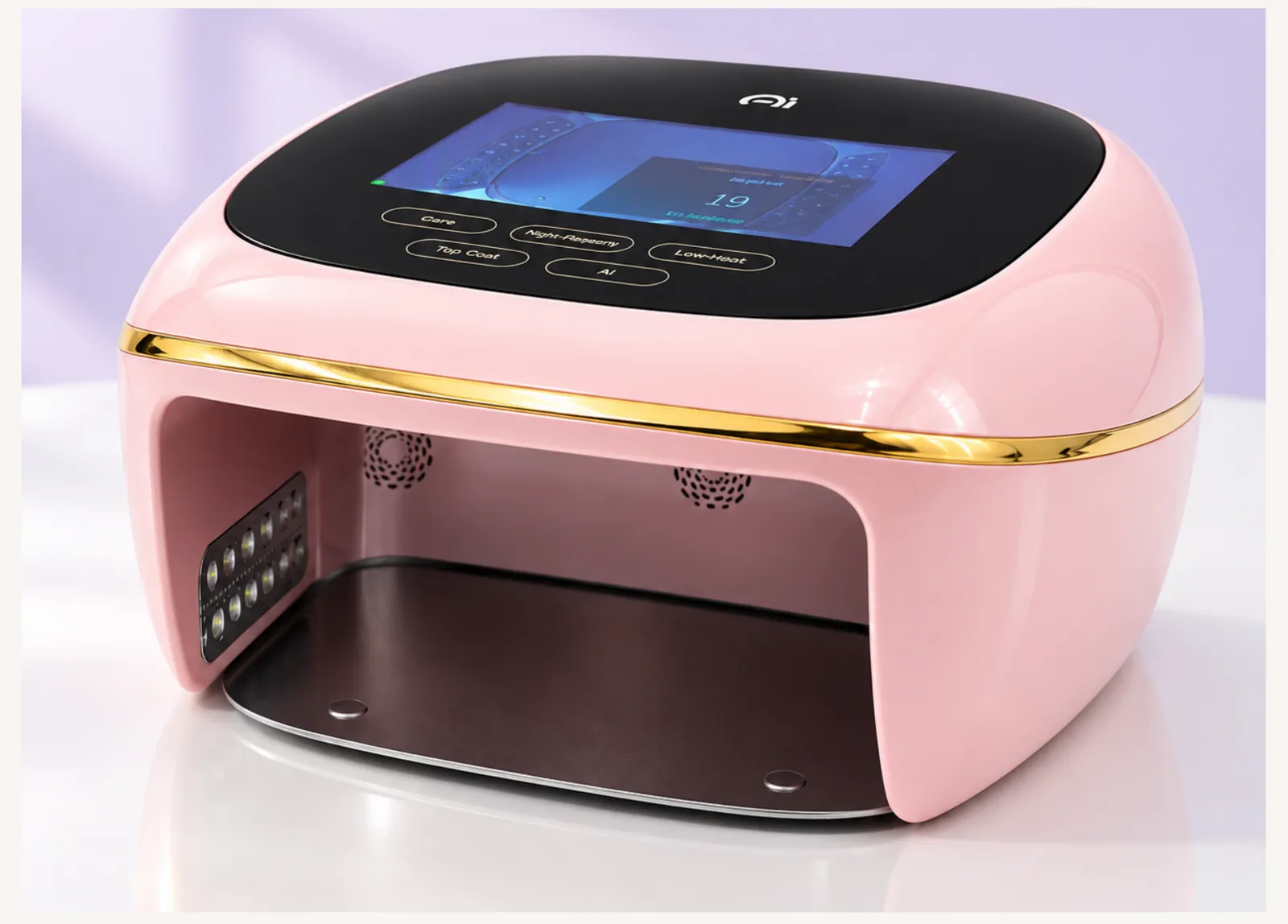
136 dual-band LEDs at 365–370 nm and 395–400 nm: the emitter array is the object of the safety assessment, not the housing.
Why the question arrives with the tender, not the brochure
Nail curing lamps emit ultraviolet radiation by design. Every lamp in the category does — the “UV lamp” and the “LED lamp” sold on the same shelf are, in the overwhelming majority of cases, LED chips emitting long-wave ultraviolet (UVA) at slightly different bands. The curing principle is the same across the industry, and any supplier who claims otherwise is describing marketing, not physics. What differs between products is control: which wavelengths, at what irradiance, onto which square centimetres, for how long.
That is precisely why optical radiation is regulated separately from electrical safety. A CE declaration covering the Low Voltage Directive and EMC tells a buyer that the product will not electrocute a client and will not disturb a neighbour’s radio. It says nothing about the skin and eyes of the person sitting at the table. Photobiological safety is assessed under a different standard family, and in tenders, insurance questionnaires and retail vendor forms it is now asked for by name.
What IEC 62471-6 covers, and what it leaves outside
The base standard, IEC 62471, classifies the photobiological safety of lamps and lamp systems across the 200–3000 nm range and sorts products into risk groups. In 2022 the IEC published IEC 62471-6, a vertical part titled Ultraviolet lamp products, written for products whose principal output is ultraviolet. Its scope test is explicit: when ultraviolet radiation in the 180–400 nm band makes up more than half of a product’s total radiant power between 180 and 3000 nm, the product is assessed under Part 6 rather than the generic standard. Nail curing equipment is named among the products in scope.
The same part draws boundaries that matter when a buyer reads a report from an unfamiliar laboratory. Sun-tanning ultraviolet lamps are excluded and handled under the household-appliance standard for skin exposure (IEC 60335-2-27) and IEC 61228; ultraviolet therapy equipment belongs to IEC 60601-2-57; ordinary lighting, and products whose output is mostly visible or infrared, fall back to the general standard. A report that cites the wrong part for a nail lamp is not a stricter report — it is a report written by someone who did not read the scope.
Part 6 also changes the assessment logic in a way buyers should notice. Instead of a fixed close-range worst case, it weights exposure by how the product is actually used: expected working distance, single-session duration, and a time-weighted average of the effective irradiance. A curing lamp is a short-exposure product used at a known distance, and the standard says so. The output of that assessment is a risk group.
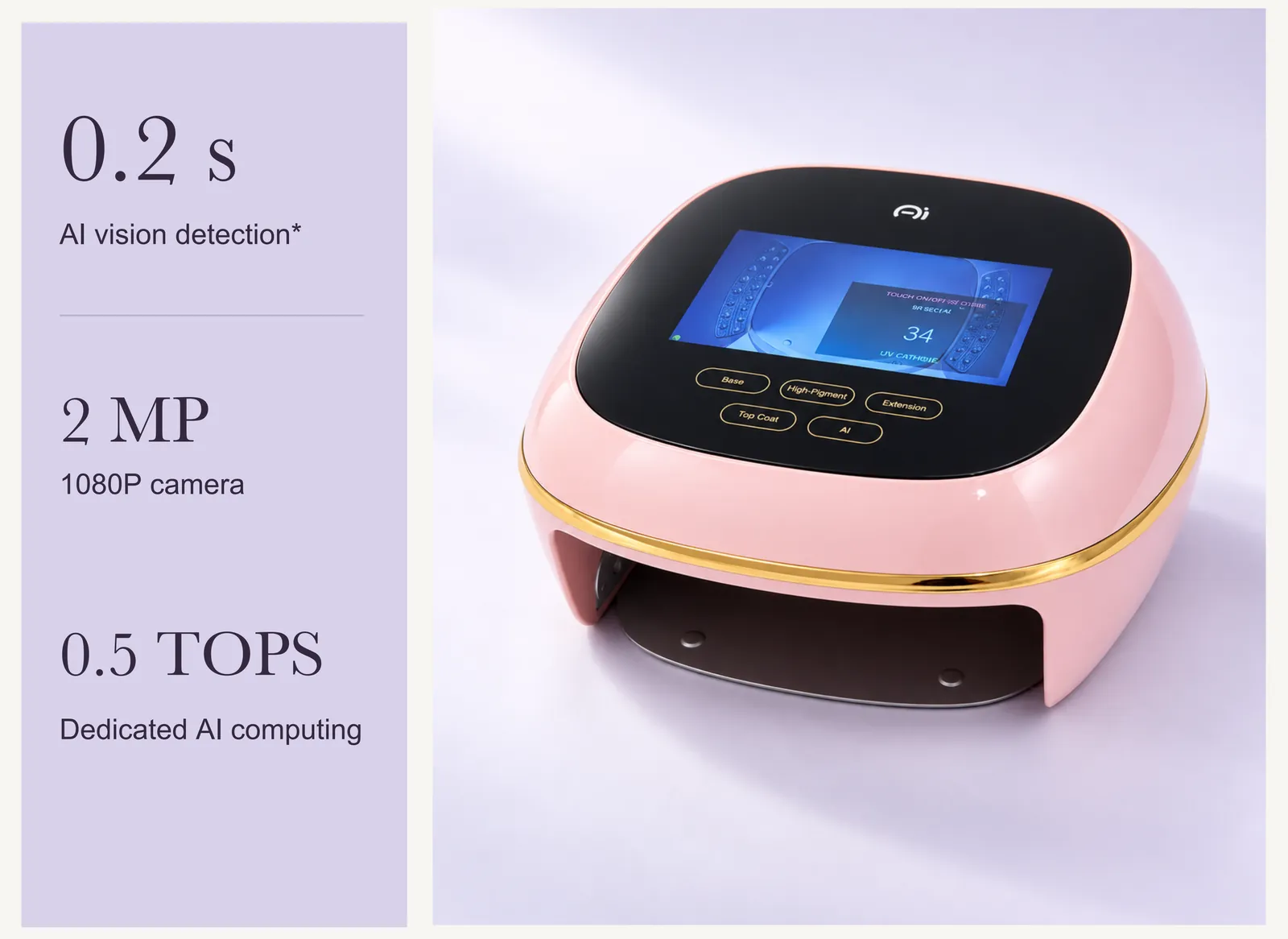
Regional illumination: the camera locates the nails in about 0.2 s and the array lights that area — the exposed surface is smaller by design.
Four numbers to read before signing
Risk groups run from RG0 (exempt) through RG1 (low risk), RG2 (moderate, requires warning and behavioural limits) to RG3 (high risk even for brief exposure). For a professional curing lamp the commercial target in the category is RG1, with RG2 acceptable only when the labelling and instructions carry the corresponding warnings. What a buyer should extract from the document is not the headline grade but these four items:
One: the standard, the part and the edition. “IEC 62471” alone is not enough. Ask for 62471-6 with the publication year, because the 2022 part-6 logic differs from the generic approach, and a 2010-era generic report may not address ultraviolet products on their own terms at all.
Two: the measurement distance and the averaging basis. An irradiance figure without a distance is meaningless. The report should state where the detector sat relative to the emitting surface, whether the value is time-weighted, and at which output setting — maximum, not a nominal mid-point. If the distance in the report is 200 mm and the salon’s hand sits at 40 mm, the buyer is holding a number that does not describe the use.
Three: the hazards actually quantified. For an ultraviolet product the actinic ultraviolet hazard to skin and eye is the central one; blue-light hazard is also reported because operators and clients do glance at the array. A report that lists a single aggregated grade without the underlying effective irradiance values gives the buyer nothing to compare against a second supplier.
Four: the model and the bill of materials. A report is valid for the configuration tested. Change the LED supplier, the drive current, the array count or the optical window, and the assessment no longer describes the product being shipped. This is also where private-label programs trip: a buyer who re-brands the housing is fine, a buyer who asks the factory to swap emitters is commissioning a new assessment.
What the lamp itself does about exposure
Compliance is a floor, not a feature. The more useful question for a salon buyer is what the product does, mechanically, to keep light off skin that does not need it. On the AI Smart Nail Lamp the answer is regional illumination: a 2 MP camera with 0.5 TOPS of on-device compute locates the five nails in roughly 0.2 s, and the array — 136 dual-band LEDs at 365–370 nm and 395–400 nm — lights the nail area rather than the whole hand.
Two consequences follow, and both are worth stating precisely rather than dramatically. First, the curing dose lands where the gel is, including the free edge and sidewalls that a fixed front-facing array tends to under-serve, which is where under-cure actually shows up eight to twelve days later. Second, the area of skin inside the beam is smaller than on a lamp that floods the whole hand, so unnecessary ultraviolet exposure of the surrounding skin is reduced — the mechanism behind the “no dark hands” concern that clients raise at the table. It is a reduction in incidental exposure, not an elimination of ultraviolet, and any supplier who promises the latter is selling a claim that will not survive a lab report.
Around that core the product carries the controls a professional buyer expects: smart thermal management with light-decay warning (an LED array that has drifted is an under-curing lamp long before it fails), a 5.5-inch touchscreen with 29 interface languages for multilingual teams, a 24×24×11.5 cm footprint with rear cable entry so the cord stays off the work surface, and standard AC power with no battery. A 6000 mAh lithium pack is available on request for mobile technicians, and it changes the shipping documentation, so quote it in the same message as the freight.
The conversation at the table
Risk-group paperwork also gives a salon something concrete to say when a client asks whether the lamp is safe. Three practices cover most of it, and none of them require the technician to give medical advice:
Screen, do not diagnose. Some clients arrive on medication whose own patient leaflet lists photosensitivity, and some have a diagnosed photodermatosis. The salon’s job is to ask a neutral question at consultation, note the answer, and refer the client to their physician or pharmacist rather than adjudicate. A one-line consent record is enough; the technician is not the decision-maker.
Protect the parts that are not being cured. Fingerless gloves, a folded towel over the wrist, and a lamp whose beam is already restricted to the nail area do more than any aftercare product.
Do not stare into the array. It is the cheapest control available and the one most often skipped during training, because the array is at table height and the technician leans in to check the free edge.
For distributors, the same three practices are the backbone of a launch training session — and the reason a light-safety report belongs in the sales folder, not the compliance archive.
Quick FAQ
Does a CE mark cover the ultraviolet output of a nail lamp?
Which risk group should a professional curing lamp be in?
Is a lower-power lamp automatically the safer choice?
Next step
Send us the tender clause or the retailer’s vendor form and we will return the model-specific IEC 62471-6 report reference, the risk group with its measurement basis, the LED and drive configuration it covers, and a quotation — white-label from 3–5 units with single-unit samples available for evaluation, custom branding from 300–500 units. Contact Miro Wu, Dedicated Account Manager — email miro.wu@beautome.com or WhatsApp +86 188 1393 3019.
Related: the same curing principle, a different control layer, the full AI Smart Nail Lamp specification, and the OEM/ODM process for private-label programs.