






Heat Spikes in Thick Gels: What Distributors Should Specify in an AI Smart Nail Lamp
Most lamp specifications are written for the buying committee and read by nobody in the treatment room. Then a client pulls her hand out of the lamp, and the technician blames the gel, the client blames the lamp, and the distributor inherits a return, a replacement unit and a salon that will not reorder. This article is about that one moment — the heat spike — and about the four numbers on a data sheet that predict it before you place the order.
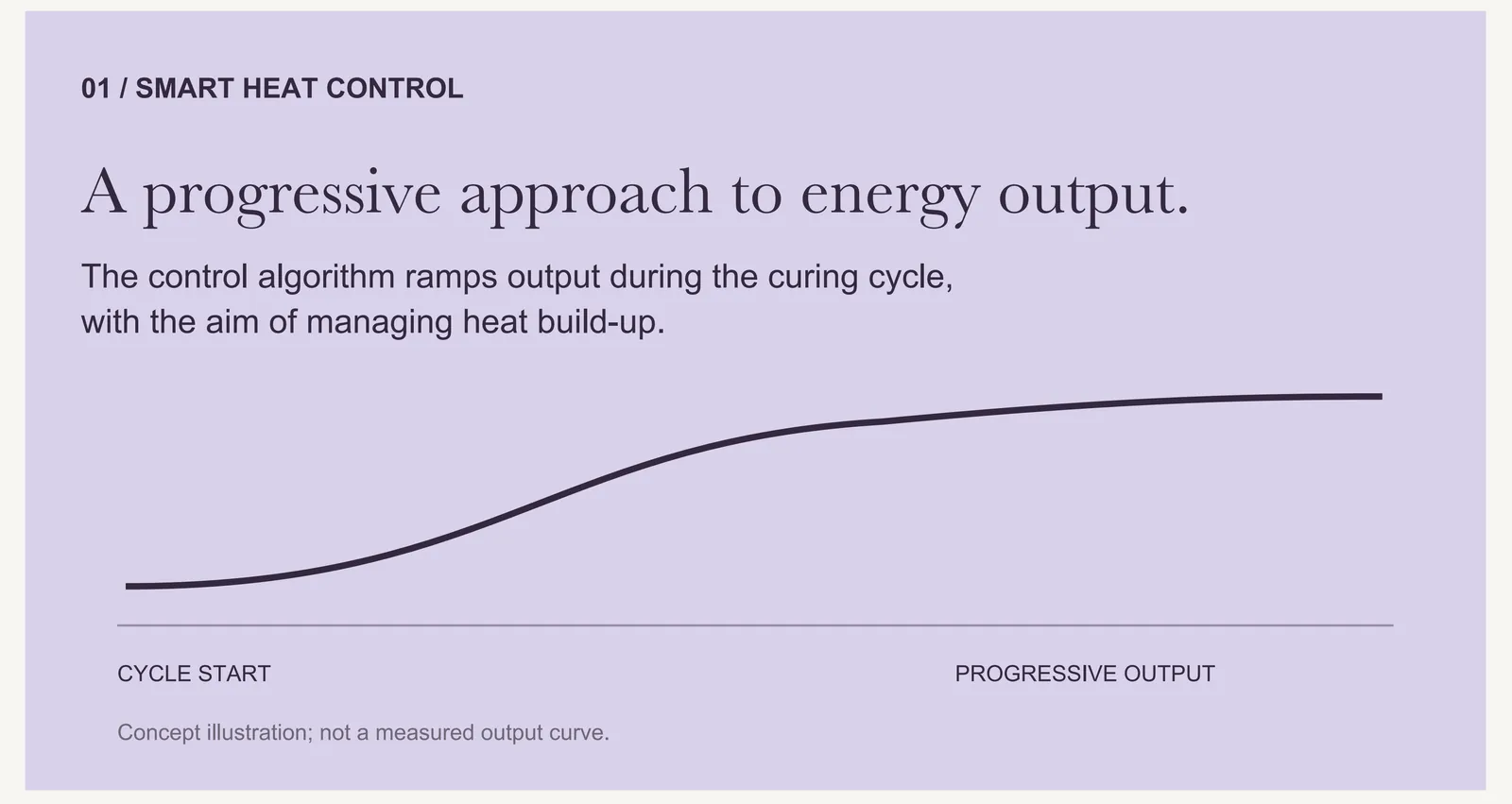
Smart heat control and a light-decay warning on the console — the two features buyers ask about only after the first complaint.
The complaint that decides the reorder
In a salon, a lamp has one job that the client can feel: curing the gel without hurting her. Everything else — the camera, the screen, the language pack, the industrial design — is invisible once the hand goes in. That asymmetry is why the heat complaint is the most expensive thing a distributor can inherit. It rarely arrives as a warranty claim. It arrives as a technician quietly switching back to the old lamp, a chain buyer asking why two of twelve stores returned units, or a one-star review that says the lamp “burns” even though nothing is mechanically wrong with it.
The uncomfortable part: in most of those cases the lamp is not defective. It is doing exactly what its data sheet promised — delivering a high dose of ultraviolet light in a short time — and the gel is doing exactly what its chemistry dictates. The problem sits in the pairing, and the pairing is something a distributor can specify, document and train. That is the commercial argument for caring about this: heat complaints are a specification gap, not a service failure, and specification gaps are cheaper to close than warranty cycles.
Why a heat spike happens, in one paragraph
Gel is a mixture of monomers, oligomers and photoinitiators. The initiators absorb light in the ultraviolet-A range and start a chain reaction that links the molecules into a polymer network. That reaction is exothermic — it releases heat — and the heat is produced faster when three things happen at once: a thick layer (more material reacting, and clear builder gels let light travel deeper), a highly reactive formula (more initiator, or a photoinitiator system tuned to the exact band your lamp emits), and a high peak irradiance (more photons per second arriving in the first few seconds).
The nail plate is the last variable. It is an insulator over a dense bed of nerve endings; a thin, over-filed or previously damaged plate conducts that heat to the client far more sharply than a healthy one. So the same lamp and the same gel produce a comfortable cure on one client and a yelp on the next. That is normal, and it is why the fix is never a single feature — it is a lamp that does not over-deliver in the first seconds, plus a technique that gives the heat somewhere to go.
Four numbers on the data sheet, and one that is usually missing
Wattage is the number everyone quotes and the one that says least. It is input power, not delivered dose. What matters for both cure and comfort is irradiance (milliwatts per square centimeter at the nail) multiplied by time, which gives the energy dose. A 48 W lamp and a 72 W lamp can deliver the same dose if the second one spreads its emitters wider. Ask for irradiance, and ask at what distance.
The second number is spectral output. Our lamp runs 136 dual-band LEDs at 365–370 nm and 395–400 nm. The short band drives the photoinitiators that need deeper penetration; the long band drives the faster surface systems that most modern gel lines are built around. A lamp that publishes only one figure, or publishes it as “UV” without a band, is telling you it has not been measured properly. This is also where the industry language needs care: the curing principle is the same across professional lamps — LED emitters producing UVA — so the useful question is never “UV or LED” but “which band, at what irradiance, for how long.”
The third is output behavior over the first thirty seconds. Some lamps ramp; most do not. If a supplier cannot tell you whether output is constant from second one or eased in, assume constant and train for it.
The fourth is decay. LED output falls gradually long before anything visibly fails, and a lamp that compensates by pushing the array harder runs hotter while curing less predictably. Our console carries a light-decay warning for exactly this reason: it moves an invisible failure mode into a message the technician can act on.
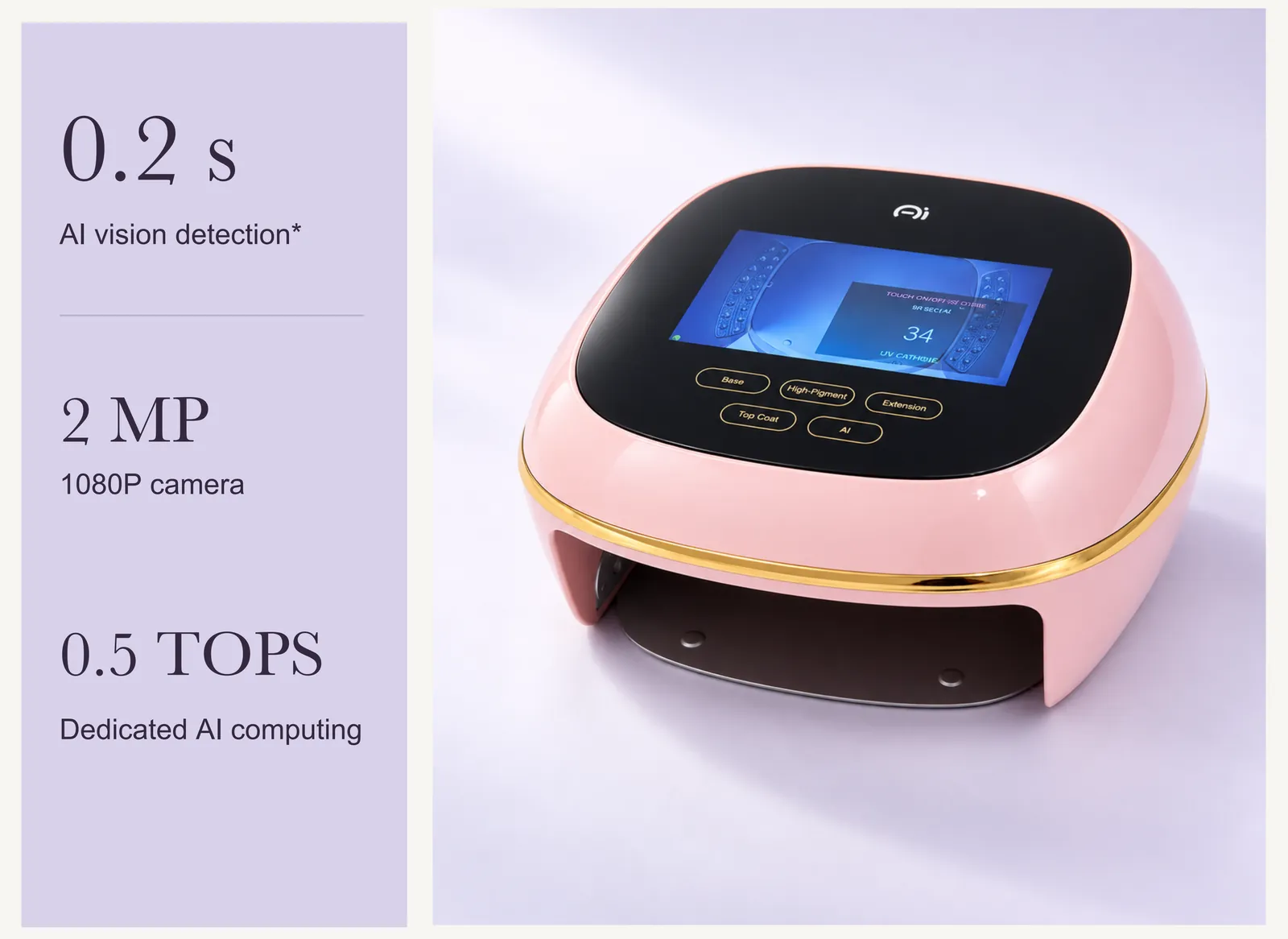
A 2 MP camera and 0.5 TOPS of on-device compute locate the nails in about 0.2 seconds — the input that makes zone-by-zone emission possible.
What zoning changes about the exposure question
A conventional lamp illuminates the whole hand because it cannot tell where the hand is. That is not a gel problem or a comfort problem in the first instance — it is a geometry problem. Our approach adds a 2 MP camera and 0.5 TOPS of on-device compute that identify nail positions in about 0.2 seconds, then emit only over the nails, zone by zone. Two practical consequences follow.
First, the skin between the fingers, the sides of the hand and the wrist are no longer sitting under the array for the whole cure. That is the mechanism behind the effect clients actually notice: less unnecessary ultraviolet exposure of the surrounding skin, which is what keeps hands from darkening over a season of monthly appointments. It is a statement about where the light goes, not a claim about emitting no ultraviolet light — the curing principle is unchanged.
Second, the technician gets a visible confirmation that the lamp has seen the hand. With a 5.5-inch touchscreen in 29 languages, the state of the cure is on screen rather than inferred, which matters in a chain where a new hire is running the lamp in week one. Photobiological safety is a separate question and belongs on the data sheet too: buyers increasingly ask for the lamp’s IEC/EN 62471 classification and for the warning language that goes with it.
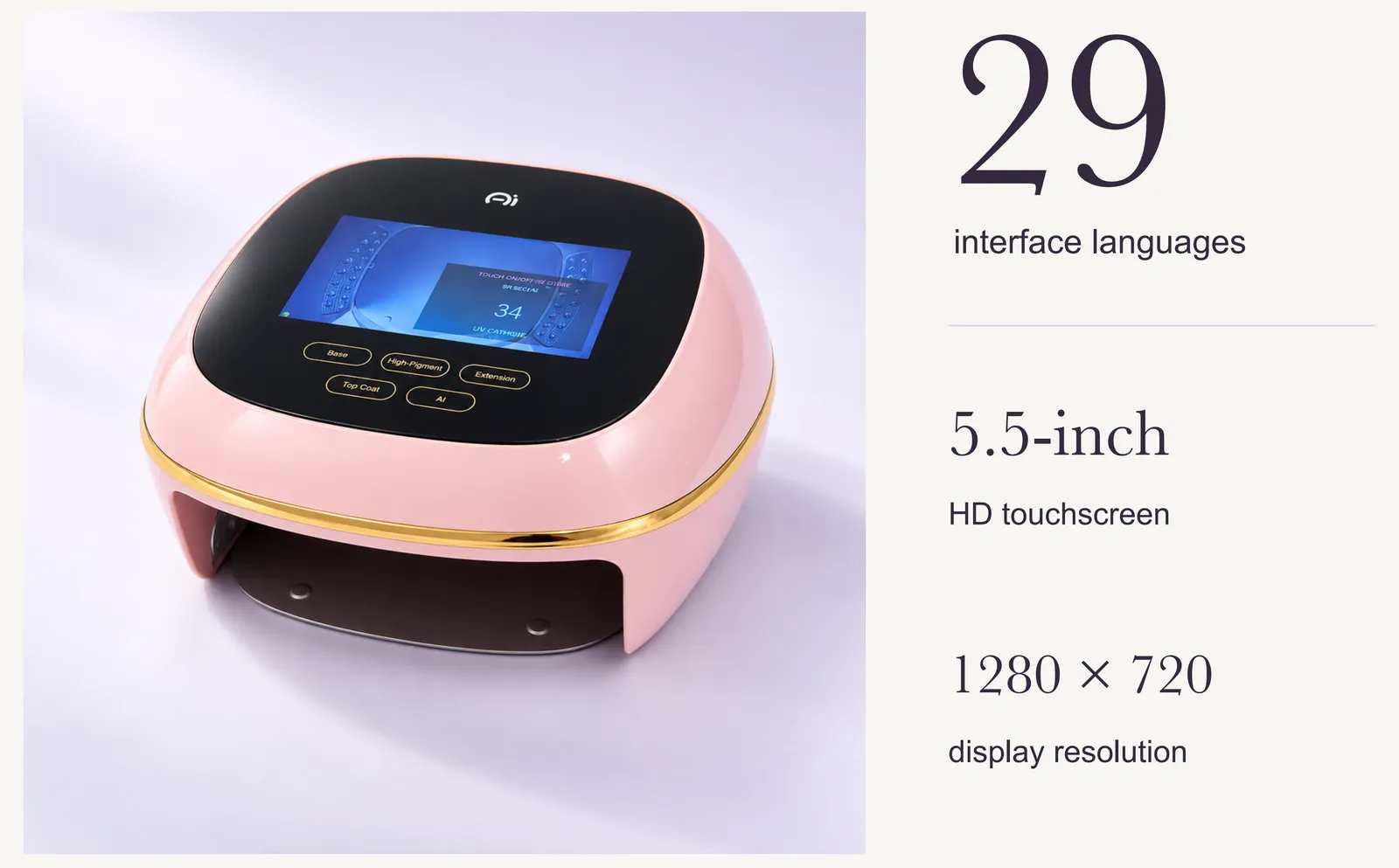
The 5.5-inch console in 29 languages — where the cure state and the decay warning become something a new hire can read.
A one-page protocol your salons can follow
Write this on a card and laminate it. It solves more heat complaints than any feature upgrade:
1. Build in stages, not in one bead. A slip layer first, cured, then structure added in two medium passes. Two small exotherms are comfortable; one large one is not. 2. Flash cure the first ten seconds. Five to ten seconds in, five seconds out, then finish the cycle. The initial burst — the part the client feels — is over by then. 3. Never chase an apex in one hit. The thickest part of the build is the hottest part of the cure. 4. Check the hand position. Pushing the hand deeper into the cavity raises irradiance at the nail; some clients do it instinctively and then complain. 5. Stop, do not endure. If it burns, the hand comes out. A client who is told to hold on becomes a client who books elsewhere.
For the buying committee, the same logic becomes a line in the tender: supplier to state irradiance at the nail plane, spectral bands, output behavior in the first 30 seconds, decay policy and the IEC/EN 62471 classification, and to supply a written curing protocol for thick builder gels. A supplier who cannot answer in writing has not measured anything.
Where the compliance conversation sits
None of the above replaces market access. For the EU, the CE route runs through the Low Voltage Directive, the EMC Directive and RoHS, with (EU) 2019/1020 requiring an economic operator established in the Union and its details on the product or packaging; for the United States, a lamp with a camera and touchscreen is an unintentional radiator and travels on an FCC Part 15 Subpart B supplier’s declaration of conformity, with an FCC ID only if you add Wi-Fi or Bluetooth. Battery versions add transport documents that the standard AC unit does not need. Scope questions — which standard family the lamp is assessed against, whether a regional add-on applies — should be settled in writing with your laboratory and importer before artwork is printed.
Quick FAQ
Is a heat spike a sign that the lamp is too powerful?
Does zone-by-zone emission cure more slowly than a full-hand lamp?
Can we private-label the lamp without changing its certification?
Next step
Tell us the gels your salons actually use — builder, rubber base, hard gel, color — and we will send the irradiance and spectral data for the AI Smart Nail Lamp together with a one-page curing protocol you can put in every treatment room. Contact Miro Wu, Dedicated Account Manager — email miro.wu@beautome.com or WhatsApp +86 188 1393 3019.
Related: how the curing principle compares across lamp types, the parameter-by-parameter comparison sheet, and the OEM/ODM process for private-label programs.