







Wax Heaters for Saudi Salons: Duty Cycle, Ambient Heat and the SABER File
Most wax heater specifications are written for a five-minute demonstration. A Riyadh salon runs eight pots for twelve hours, in a room that is already hot before the first client arrives, and it replaces a pot the week it fails rather than the quarter it was budgeted for. That gap — between a demonstration and a duty cycle — is where a Saudi order is won or lost, and it has almost nothing to do with millilitres.
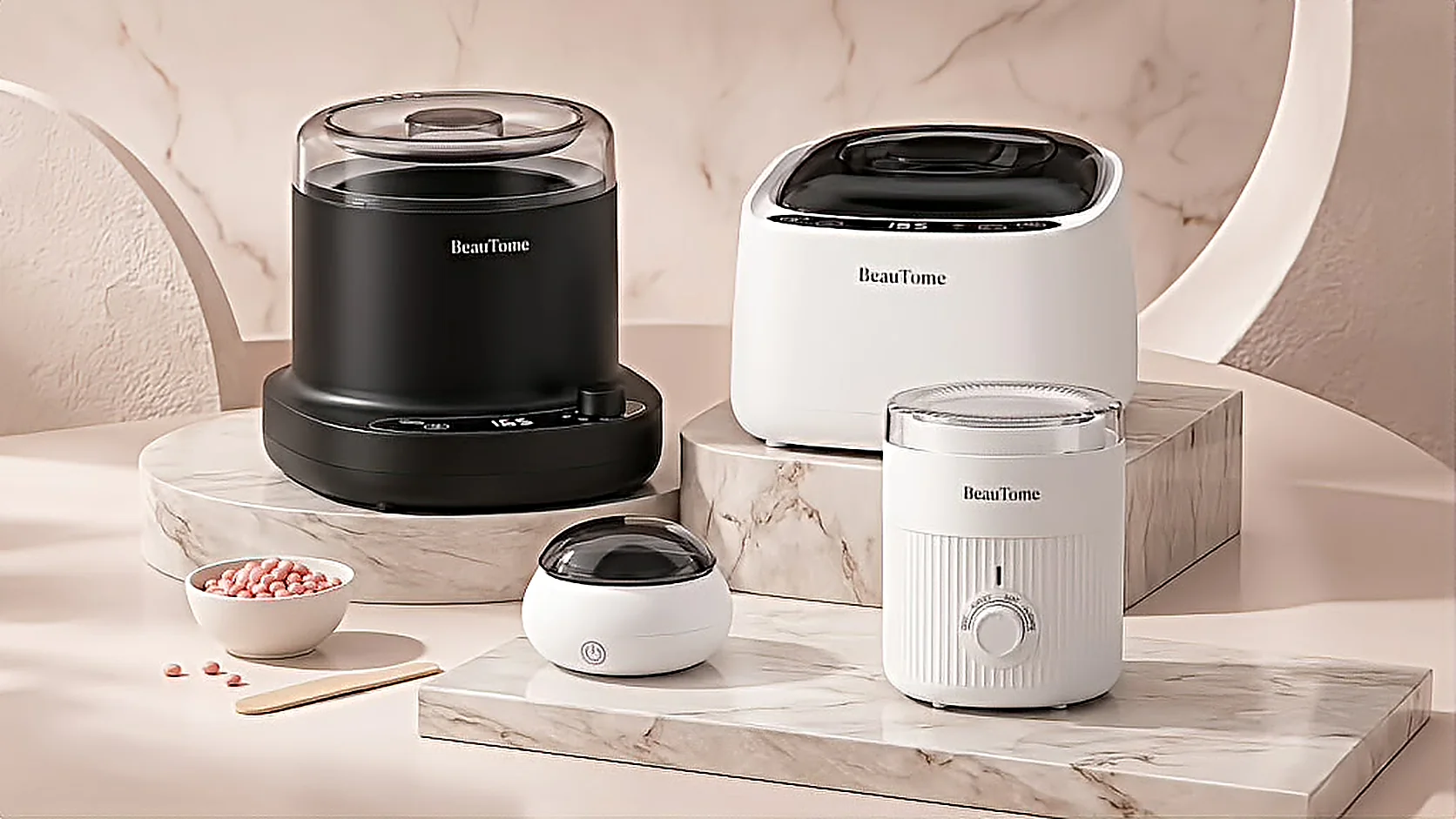
Ten models from 20 ml to 800 ml — the ladder a Saudi distributor needs, provided each rung is rated for the hours the salon actually keeps.
A market of small rooms that open for a long time
The shape of the buyer matters before the specification does. Rentech’s business database counted 3,626 beauty salons in Saudi Arabia as of 1 April 2026, up 7.68% on 2023, with 82.38% single-owner businesses and an average business age of three years and five months. The three densest regions — Eastern Province at 982, Makkah at 784 and Riyadh at 622 — are also the three where a distributor will place most of its first hundred units. Global Market Insights puts Saudi salon services at USD 3.2 billion in 2025 with an 8.5% CAGR through 2035, driven by formalization and premium formats rather than by population alone.
Two things follow. First, the buyer is usually the owner of one or two rooms, not a procurement department, which means the decision is made on the technician’s experience and on the day the old pot dies. Second, mall and hotel-adjacent salons in those three regions keep long hours with appointment books that run back to back — and a pot that is switched on at nine in the morning and off at ten at night is a very different object from the one in a catalogue photograph.
Duty cycle: what eight hours at temperature actually does
Wax is not boiled and used; it is held molten for the whole working day and topped up. That steady state is harder on hardware than a heating cycle, and it produces three distinct failure modes that a buyer should be able to name.
Wax degradation. Held hot for long periods, wax oxidizes: color drifts, the smell turns, and the film behavior changes before anything visible fails. A narrow hold band and a lid delay this; a wide band accelerates it. Heater and controller stress. A band heater or element that cycles constantly at the top of its range ages faster than one modulating around a set point, and a controller that drifts leaves the technician compensating with the knob. Thermal protection. A thermal fuse that trips at hour nine and resets at hour ten is not a fault in the salon’s eyes — it is a dead pot, and it will be returned.
So the specification question is not “how fast does it heat” but “what is the temperature band after eight hours, measured in wax, not in air?” Ask for that number, ask at what ambient it was measured, and ask for the recovery time after four consecutive services with the lid open. A supplier who can answer in writing has tested a duty cycle. One who answers with wattage has tested a heating element.
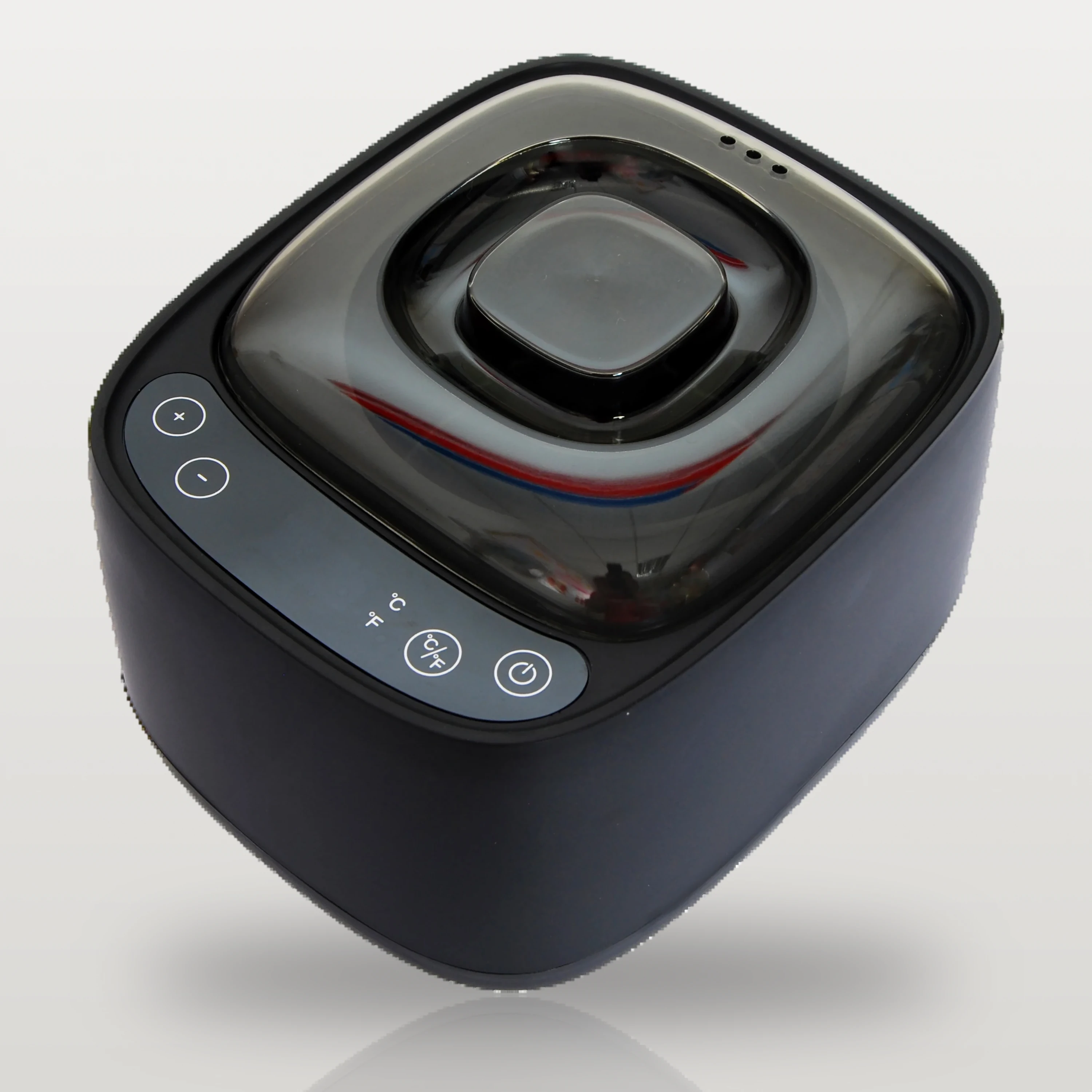
The 450 ml working pot: roughly 400 g of beads, about one technician’s day — and the volume most Saudi rooms buy first.
The room is 45 °C before the pot is switched on
Every electrical appliance has an ambient rating, and in the Gulf it stops being a footnote. Summer room temperatures in Riyadh and Jeddah sit far above the 20–25 °C assumed by most laboratory test conditions, and a treatment room with the air conditioning working hard still accumulates heat from bodies, lamps and eight pots in a small footprint.
Three practical consequences. Derating: a heater rated for continuous operation at 25 °C will run hotter and cycle differently at 40 °C, so the “hold band” figure quoted in a mild climate is optimistic in yours — ask whether the rating is stated at 40 °C. Ventilation clearance: the clearance figure in the manual is a minimum for airflow, and it is routinely ignored when a pot is pushed against a wall to save bench space. Surface temperature: with ambient already high, an outer surface that is merely warm in Europe becomes uncomfortable to touch, which matters in a room where clients rest their arms on the bench.
None of this is exotic engineering. It is the difference between a specification written for a showroom and one written for a room where the air conditioning is losing.
230 V, 60 Hz, and a plug that only goes in one way
Saudi Arabia runs 230 V at 60 Hz on the British type G socket — three rectangular pins, 13 A, with a fuse in the plug. Two notes for the purchase order. The frequency is irrelevant to a resistive heating element, but it is not irrelevant to an AC fan or to any controller that derives its timing from the mains, so a 50 Hz-tested unit should not be assumed identical. And the plug is a molded assembly, not an adapter: put it on its own line in the PO with the voltage and frequency string exactly as it will appear on the nameplate, and keep a 1:10 spare cord set with the distributor rather than at the factory.
Circuit arithmetic is not the constraint. A 100 W pot on a 230 V circuit draws well under half an amp; a room with eight pots, two lamps and an air conditioner is limited by the air conditioner. What does matter is that every unit in the container carries the same nameplate string, because the conformity file will be checked against it.
Two working temperatures, two pots
The single most common equipment mistake in a waxing room is expecting one pot to serve two formulas. A rosin-free hard wax works in the 45–50 °C range; a film wax for legs and arms works at 55–60 °C. Those are not two settings on one dial — they are two thermal environments, and switching a pot between them costs fifteen to twenty minutes plus a temperature overshoot that the technician then has to wait out.
So the range has to be sold as a set of working volumes, not as a list. A 450 ml pot holds roughly 400 g of beads, which is close to one technician’s day of hard wax work — the anchor number for everything else. Below it, 180 ml and 250 ml cover a second formula or a second service; above it, 500 ml with a digital display is the model you write into a chain’s SOP because the temperature is readable rather than inferred; 800 ml serves a high-volume back-and-chest station. And where the room genuinely runs two temperatures, a double-pot station on one base does the job without consuming two bench positions — which in a 12 m² treatment room is the real currency.
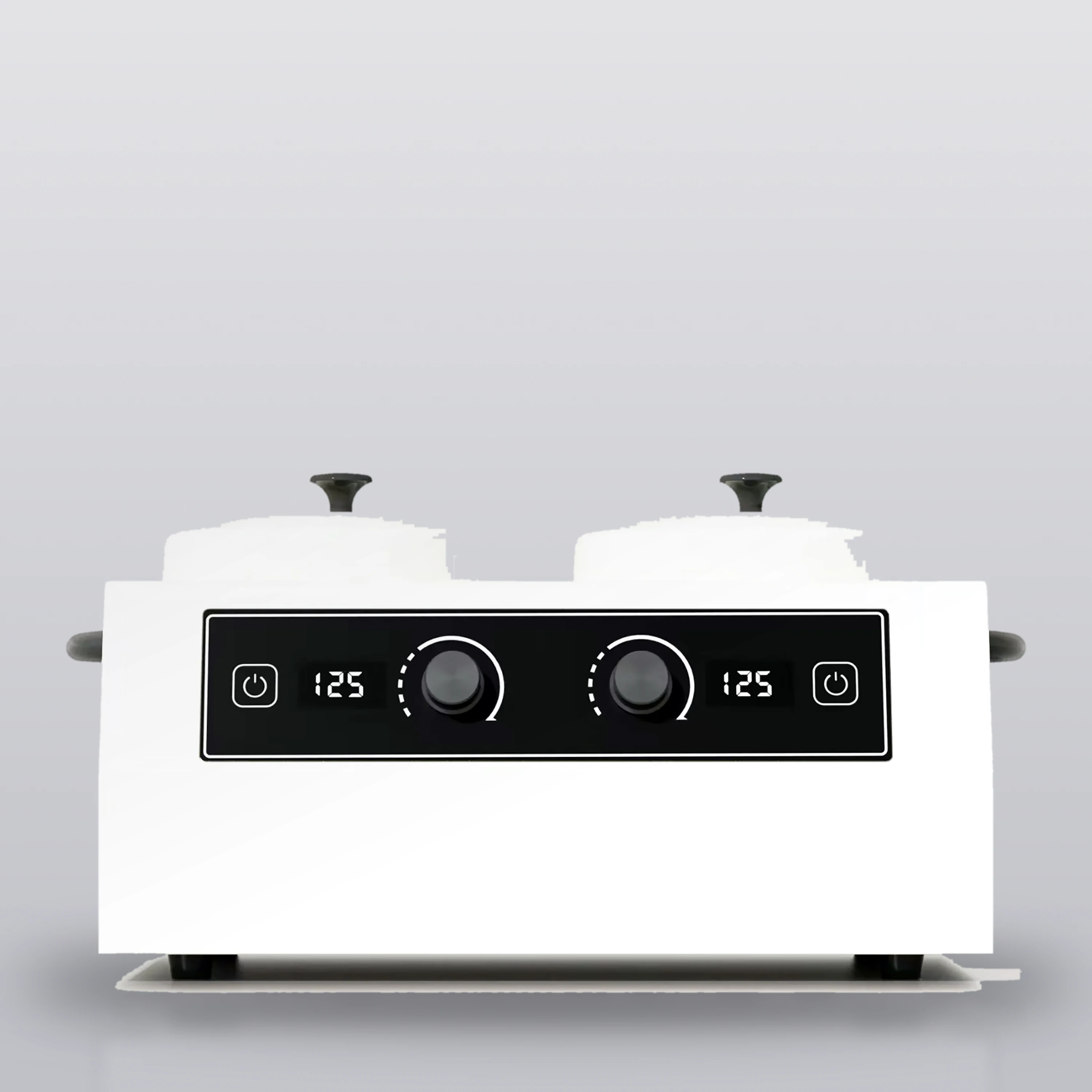
A double-pot station: two working temperatures in one footprint, which is what a small treatment room can actually accommodate.
The SABER file: a product certificate, then a shipment certificate
Market access in Saudi Arabia runs through SABER, and it is two documents rather than one. The PCoC is a product-level certificate of conformity issued against the technical file and test reports, typically valid for one year and tied to the model. The SCoC is issued per consignment and must be in place before the goods arrive — it is the document a customs broker will ask for, not the PCoC.
Three practical points that decide whether a first container clears on schedule. The application must be initiated by the Saudi importer through its SABER account, so the importer is a participant in the process rather than a recipient of it. The safety reference is the SASO technical regulation for low-voltage electrical appliances, assessed against the SASO adoption of the IEC 60335 household appliance series, which is where the question of whether a wax heater is assessed as a heating appliance or something else should be settled in writing with the conformity body. And from 1 January 2026 SABER moved to HS codes synchronized with ZATCA, the customs authority; applications quoting an old code are rejected by the system, a detail worth confirming with your certification partner before the first filing rather than after.
Labeling follows the same logic: Arabic alongside English, with the importer identified, the model string matching the PCoC, and the rating exactly as tested. A private label changes the brand on the housing, not the model identity — change the mold, the controller or the element and you have a new model and a new certificate.
A first hundred units, and the parts that keep them alive
A defensible opening mix for a distributor serving those three regions: 55 units of 450 ml as the working standard, 15 of 180 ml for a second formula or a small room, 10 of 250 ml, 12 of 800 ml for high-volume stations, 8 of the 500 ml digital for chains that need a readable set point, and 6 double-pot stations. Alongside it, the 1:10 spare kit — heating element, inner pot, controller, knob, lid and cord set — held in the distributor’s own warehouse, because in a market where a replacement takes weeks by air and the salon cannot work without it, the distributor who can repair this week is the one who gets the second order.
Quick FAQ
Do we need a different heater for 60 Hz in Saudi Arabia?
Is one 800 ml pot better than two 450 ml pots?
How long does the SABER process take for a first order?
Next step
Tell us the rooms you are fitting — how many technicians, which formulas, which services — and we will send a capacity and duty-cycle specification for the Wax Heaters & Warmers range, together with the spare parts list and the conformity documents your importer will need for SABER. Contact Miro Wu, Dedicated Account Manager — email miro.wu@beautome.com or WhatsApp +86 188 1393 3019.
Related: auditing a wax heater range before the next container, standardizing heaters across Gulf salon chains, and the hard wax and soft wax formulas these pots are built to run.