







Curing Through the Tip: What Soft Gel and Overlay Services Ask of an AI Smart Nail Lamp
For years the nail lamp question was simple: does it cure a coat of gel polish in under a minute? Extension work changed the question. Soft gel tips, builder-gel overlays and structured manicures now sit on the standard menu of most salons that buy professional equipment — and they ask the light to do something harder than harden a thin film on top of a nail. They ask it to cure a bonding layer that is partly hidden, through material that was not designed to be transparent.
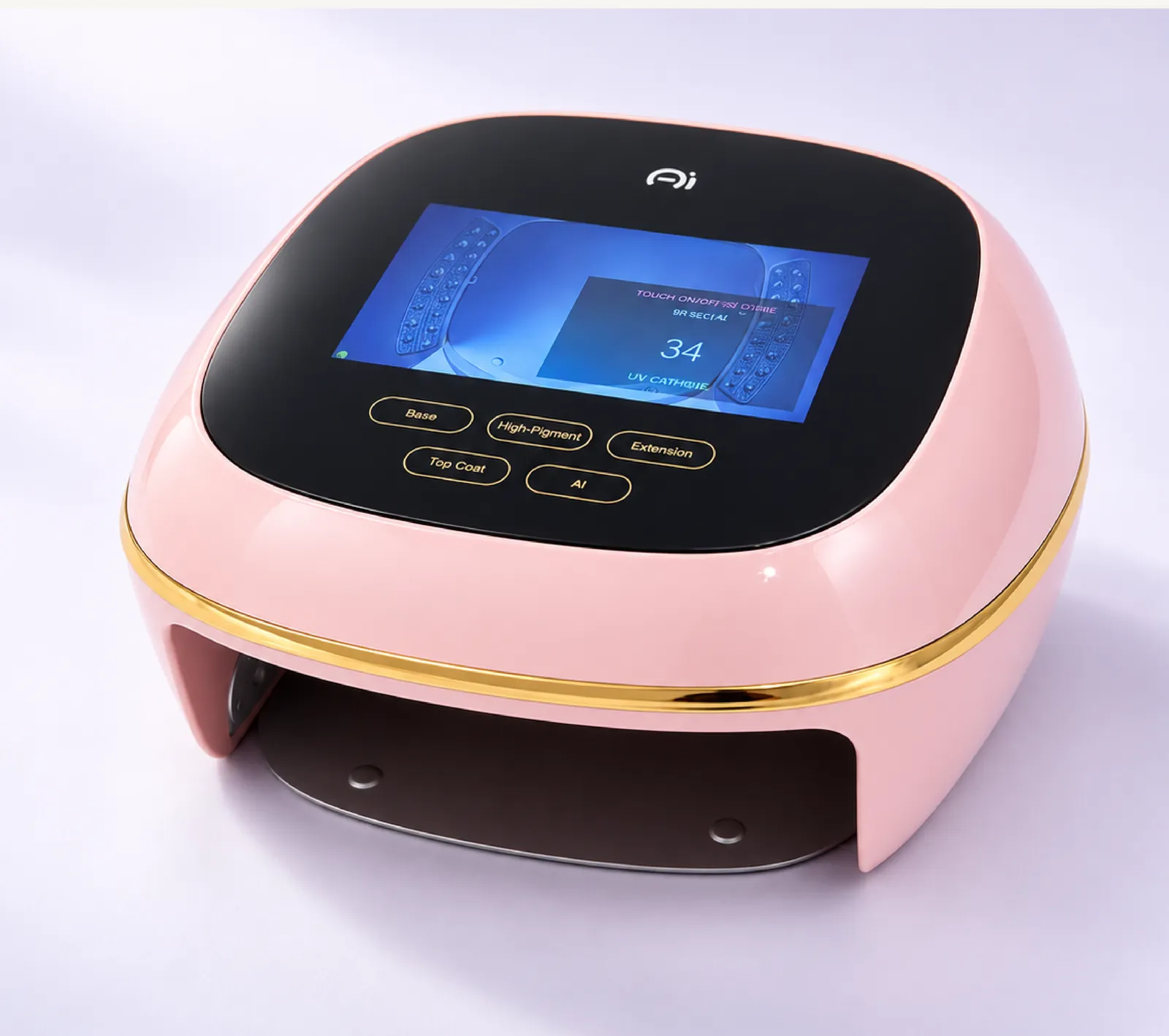
Five nails at once is the easy case. The hard case is the bonding layer under a pre-shaped tip, where the light has to arrive from an angle as well as from above.
An extension is not a polish service with a longer timer
Gel polish is forgiving by design. Three to five thin coats, each 30 to 60 seconds, each thin enough that almost any lamp with a clean reflector will cure it. When it fails, it fails visibly — a wrinkle, a dull patch, a smear on the second hand.
Extension work fails quietly. The bonding layer sits between the natural nail plate and a pre-shaped tip, and at the apex a structured overlay is three to five times the thickness of a polish coat. Two failure modes matter, and they pull in opposite directions:
Under-cure at the bonding layer. The set looks perfect when the client leaves. Eight to twelve days later the tip lifts at one sidewall, or pops off in one piece. The salon blames the technician first, the product second, and the lamp last — which is exactly why a distributor should be able to rule the lamp out with a number instead of an opinion.
Over-heating at the free edge. The same thick layer that needs more light also generates more exotherm when it polymerizes, and the free edge has the least nail plate underneath to absorb it. The client feels a sting, flinches, and the salon concludes the lamp is “too strong.” It is not too strong; the exposure is being delivered in one block instead of in steps.
The two bands are doing two different jobs
Gel systems cure because photoinitiators in the formula absorb light in a specific range and start the polymer chain. Shorter wavelengths are absorbed close to the surface; longer wavelengths travel further into a filled, pigmented or partly obscured layer before they are absorbed. That is the whole reason a professional lamp carries two bands rather than one.
The AI Smart Nail Lamp runs 136 LEDs split across 365–370 nm and 395–400 nm. The short band drives the surface and the top layer; the long band carries into the bonding layer and the body of a built apex. The first-generation AI lamp that defined this category publishes 109 LEDs at 365 nm and 405 nm — which is why the band split is a better question than the diode count. Ask for both numbers, and ask what irradiance the lamp produces at the nail plane in each band, not at the lens.
None of this is a different curing principle. It is the same UVA delivered by LED chips that every UV/LED gel lamp on the market uses. What changes is where the light is aimed and how much of it lands on skin that is not being serviced.
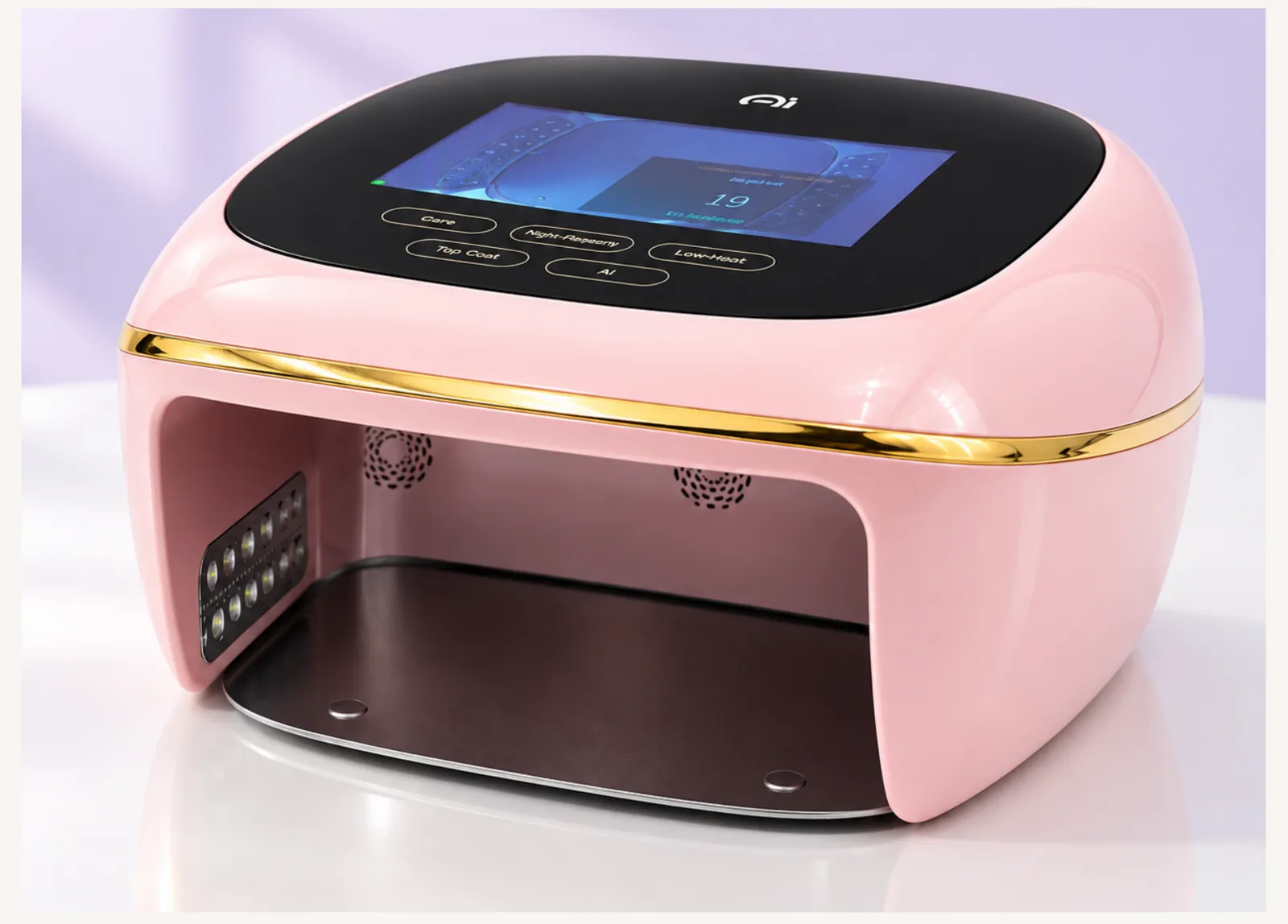
136 diodes across two bands, arranged around the hand rather than in a single strip above it.
Three tests on a real set, before you commit to a container
Every one of these can be run in an afternoon with product the buyer already stocks. They are the tests we suggest to distributors who are being asked to prove a lamp on extension work.
1. The tip transmission test. Take the three tip types the salon actually uses: clear, natural or translucent, and any colored or fully opaque style. Cure an identical bead of bonding gel under each for the same time, then peel it off the natural nail. If the gel releases cleanly from the nail while staying stuck to the tip, the layer facing the nail was under-cured. The practical answer is rarely a stronger lamp: it is curing the bond before the tip goes down, or using a longer preset on the styles that block light.
2. The apex heat test. Build the structure to the thickness the salon really builds — not a test nail. Ask the technician what the client feels in the first thirty seconds. Heat is the only honest signal here, because a spec sheet cannot tell you how a formula behaves at 2 mm of build.
3. The edge coverage test. Cure a full hand at once, then look at the thumbs and the little fingers. They sit at the outer edge of the array, and they are where under-cure shows first: a lifted sidewall on the pinky, a thumb that feels tacky at the corner. If a lamp only cures well in the middle, the salon will start curing fingers one at a time — and pay for that in minutes per client for the rest of the unit’s life.
Where the camera and the zoning earn their place
The 2 MP camera and the 0.5 TOPS onboard processor do one job: in about 0.2 seconds they establish where the nails are in the working area. The array then lights in zones rather than flooding the whole hand.
That produces two outcomes a buyer can actually sell. First, light lands on the free edge and the sidewalls — where extension failure begins — instead of on knuckles and cuticles. Second, the surrounding skin receives less unnecessary light exposure, which is the mechanism behind the “my hands are getting darker” complaint clients raise in every market where gel services are routine. We make no claim of eliminating UV exposure, and we would not trust a supplier who did: the lamp reduces unnecessary light exposure of surrounding skin by lighting only the areas being serviced.
The 5.5-inch console matters here too, for an unglamorous reason: it stores presets. A salon running two extension systems — say a soft gel tip line and a builder-gel overlay line — can keep a preset for each, in one of 29 languages, instead of asking staff to remember which button means “longer.”
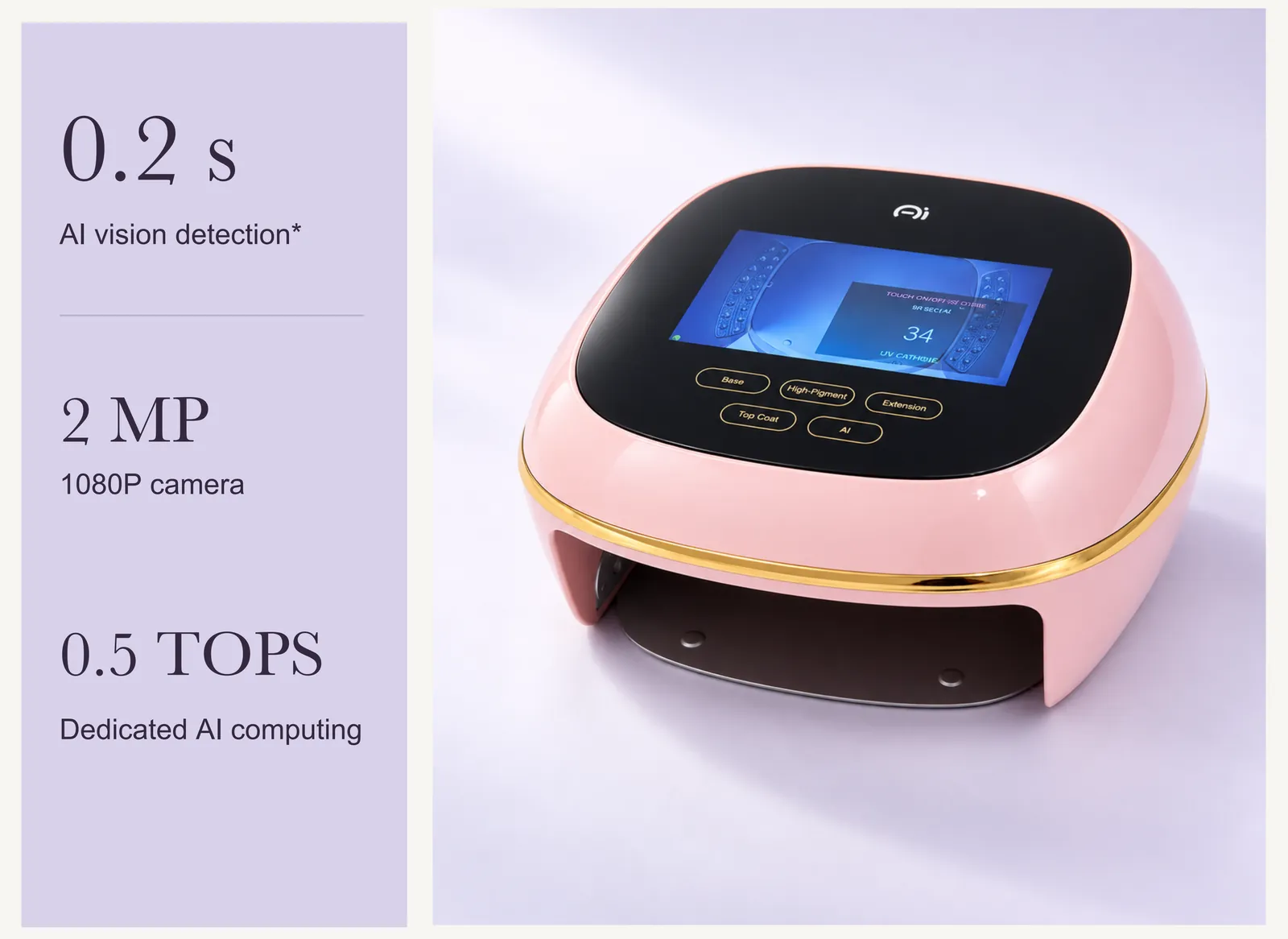
Detection happens before the light does: the camera maps nail positions, then the array lights only those zones.
Five lines for the specification sheet
If a buyer is comparing three lamps for an extension-heavy menu, these are the lines that separate them — and the ones most catalogs leave out:
Irradiance at the nail plane in mW/cm², per band, at the working distance — not the wattage of the lamp. The band split with diode count per band. Editable presets and how many. Clearance height — whether a hand with a built apex fits without touching the lens. And behavior in the first thirty seconds, including what the console does when it detects a heat condition.
The physical envelope matters as much as the optics on a real table: 24 × 24 × 11.5 cm, with the power inlet at the rear so the cord stays out of the working zone. The standard configuration is AC powered with no battery; the 6,000 mAh pack is an option requested per order, and it is worth having only if the salon also runs mobile or event work.
Buying routes
For a salon testing the category, neutral white-label units ship from three to five pieces, and a single unit can go out as an evaluation sample. A fully branded program — logo, colorway and retail packaging on the existing mold — starts at 300 to 500 units. Nothing about the optics changes between those routes; what changes is the label, the packaging and the documentation language.
Extension work is the fastest way to find out whether a lamp is actually good, because it punishes a weak lamp within two weeks. Run the three tests, then decide.
Quick FAQ
Can the same lamp cure hard gel and acrylic?
Do colored or opaque tips cure under the lamp?
Is more irradiance always better for extensions?
Next step
Send us the extension systems your market sells and the languages your staff read, and we will return a preset sheet plus the irradiance figures per band for your comparison table. Contact Miro Wu, Dedicated Account Manager — email miro.wu@beautome.com or WhatsApp +86 188 1393 3019.
Related: the curing principle compared with conventional UV/LED lamps, and the full article index for buyers.