




AI Smart Nail Lamps for Hotel and Resort Spas: One Console, Every Property
A city salon buys a lamp for one room and one team. A hotel spa buys it for a menu that has to read the same in Abu Dhabi, the Maldives and the Alps — run by managers who rotate, therapists who were hired last month, and a brand standard audited by head office. That difference in buyer changes everything about what “a good curing lamp” means. This brief walks through the hotel and resort spa channel from the supplier side: what the numbers say about the channel, which specifications actually matter when the buyer is a spa director instead of a salon owner, and how the private-label ladder works when the brand on the lamp is the hotel’s.
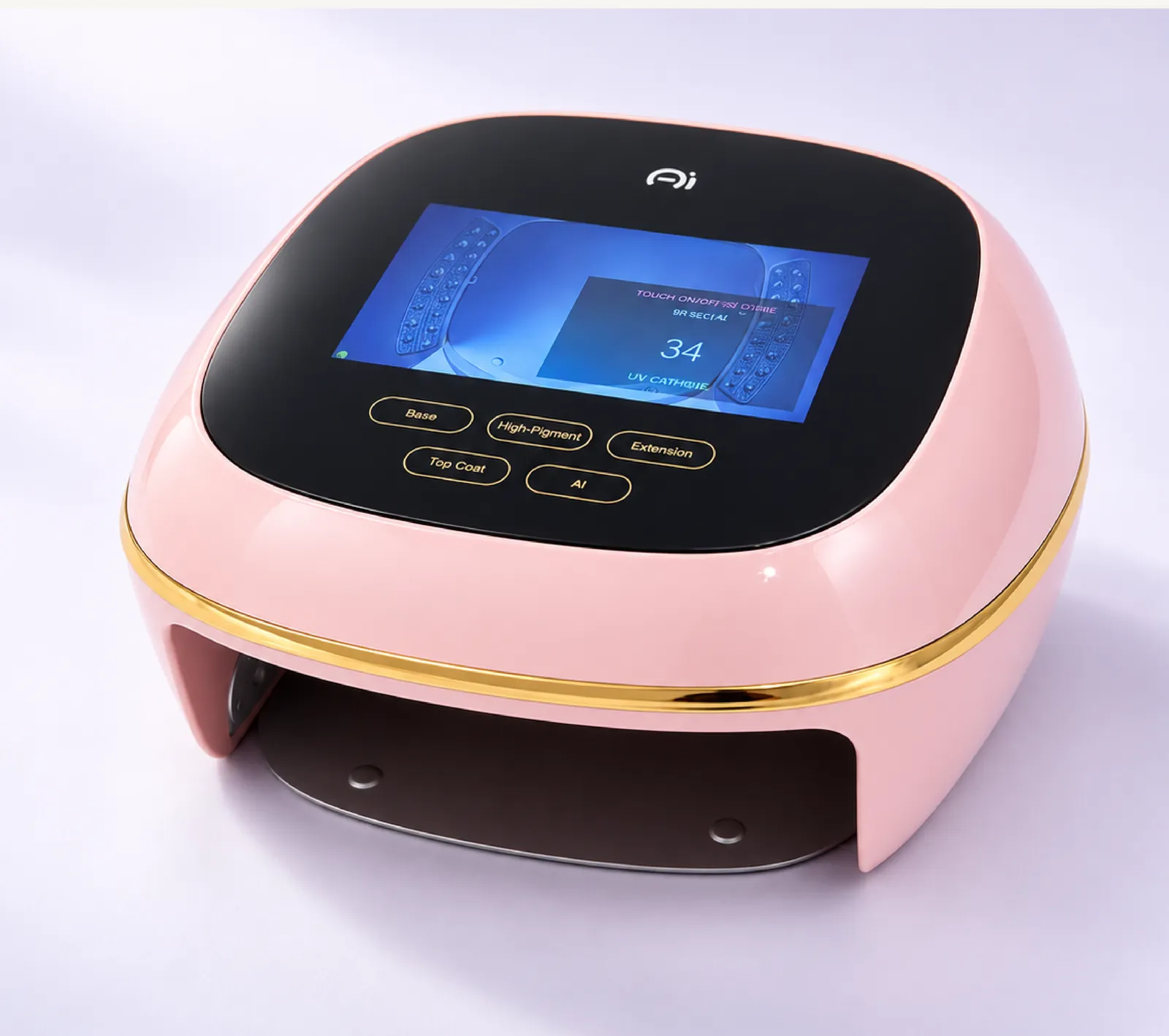
The unit that has to survive rotation, audits and renovation plans — not just one technician’s taste.
The channel behind the treatment menu
Spa services have outgrown their reputation as an airport-layover indulgence. The global spa market reached an estimated USD 169.5 billion in 2025 and is projected to grow to USD 332.8 billion by 2035 at a 6.9% CAGR (Global Market Insights, 2026). Within that, the spa-hotel segment specifically — properties where the spa is an operating department rather than an amenity — was estimated at USD 5.52 billion in 2025, heading toward USD 8.47 billion by 2032 at 6.4% a year (QYResearch, 2026). The same research notes the shift in consumer demand: from occasional pampering toward appearance-focused and preventive services built around hotel and resort experiences.
For equipment buyers the implication is structural, not seasonal. A resort spa that adds nail services to a wellness package is not buying one lamp; it is defining a line item that will be replicated across renovations, refits and sister properties. Global Wellness Institute data cited in the same market analysis puts global per-capita wellness spending at USD 831 in 2024 — above per-capita healthcare spending, and above USD 5,000 in tourism-driven high-end destinations such as Aruba, Seychelles and Iceland. Properties in exactly those destinations are the ones whose spa menus guests photograph, compare and review.
USD 169.5B
Global spa market, 2025, projected to USD 332.8B by 2035 at 6.9% CAGR (Global Market Insights, 2026)
USD 5.52B
Global spa-hotel segment, 2025, projected to USD 8.47B by 2032 at 6.4% CAGR (QYResearch, 2026)
USD 831
Global per-capita wellness spending in 2024, above per-capita healthcare spending (Global Wellness Institute data cited by GMI, 2026)
What changes when the buyer is a spa director
The salon owner asks how fast the lamp cures. The spa director asks a different set of questions, in a different order:
Can a therapist hired this month use it correctly today? Resort staffing is seasonal and international. The 5.5-inch console runs 29 languages, so the same one-page quick card and the same three-minute training video work in every property regardless of who is on shift. Language becomes a training-document decision, not a nice-to-have.
Will it pass the next brand audit? Consistency is the product a hotel chain buys. Every unit must behave identically: same detection, same output, same behavior after a cleaning cycle. The 2 MP camera with on-device inference locates the nail in about 0.2 seconds and drives the 136 dual-band LEDs — 365–370 nm and 395–400 nm — only over the detected nail area. The curing principle is the same as every LED gel lamp on the market: LED diodes producing long-wave UVA to set the product. What the vision system changes is control — light lands on the nail, surrounding skin receives far less unnecessary light exposure, and the result looks the same whether the treatment happens in the flagship or the franchise resort. Smart heat control and the light-decay warning complete the audit story: output drift becomes a logged maintenance prompt instead of a guest complaint discovered mid-vacation.
Does it complicate the IT or facilities picture? It should not. Standard units are AC-powered appliances with no wireless module and no cloud account — nothing to register on the guest network, nothing that touches guest data, nothing that a Wi-Fi outage can interrupt mid-service. The compact 24 × 24 × 11.5 cm footprint drops into a treatment room designed years ago for facials, and the rear power inlet keeps the counter line clean for photography, which matters in a channel where the treatment room doubles as marketing content.
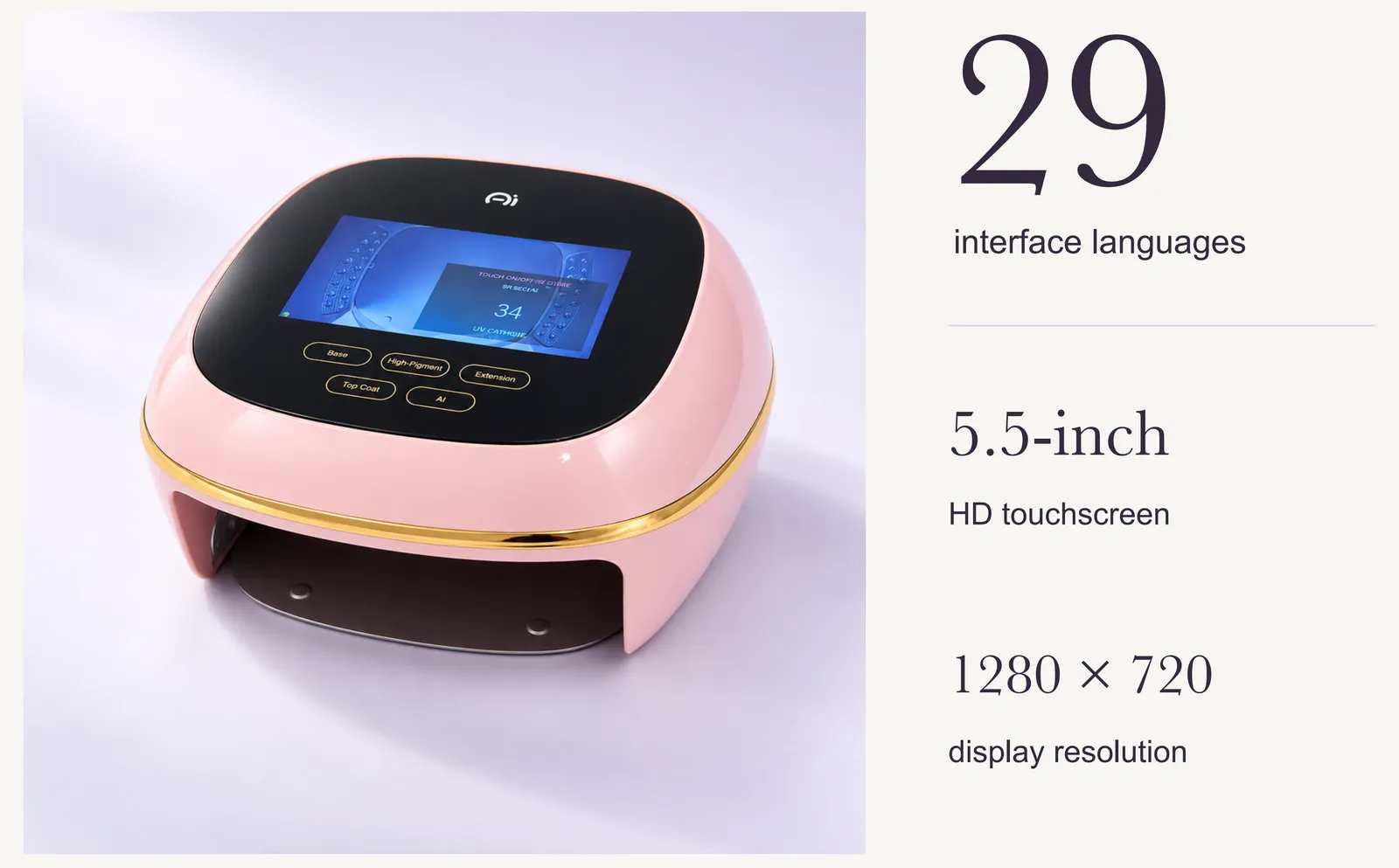
One console, 29 languages: the training deck written in January works in the December seasonal intake.
Private label: the lamp that carries the hotel’s name
Here is where the hotel channel differs most from retail distribution. A resort brand does not want “whoever makes a good lamp” in its treatment rooms; it wants its own name on the equipment its guests touch — the same instinct that puts the logo on bathrobes. The route runs through a conventional OEM process: white-label evaluation units first, then logo, colorway and packaging matched to the brand book. The commercial ladder has three rungs, and each one maps to a stage of the hotel conversation:
A single evaluation unit ships for the pilot property — no commitment, real machine, so the spa director can run it through a month of services before the fit-out meeting. White-label, unbranded units start at three to five pieces, which covers a single property’s treatment rooms plus a house spare. Full custom branding begins at 300–500 units, which in this channel usually means a group rolling the branded unit across its portfolio rather than one hotel buying alone. Standard configuration ships AC-powered without a battery; a 6,000 mAh battery version is available on request for beach clubs, pop-ups and cabana service where outlets do not reach.
The conformity file travels with the lamp in either configuration — LVD, EMC and RoHS in the EU, plus the photobiological safety classification under IEC/EN 62471 — which is the paperwork a group procurement team asks for in the tender, not after it.
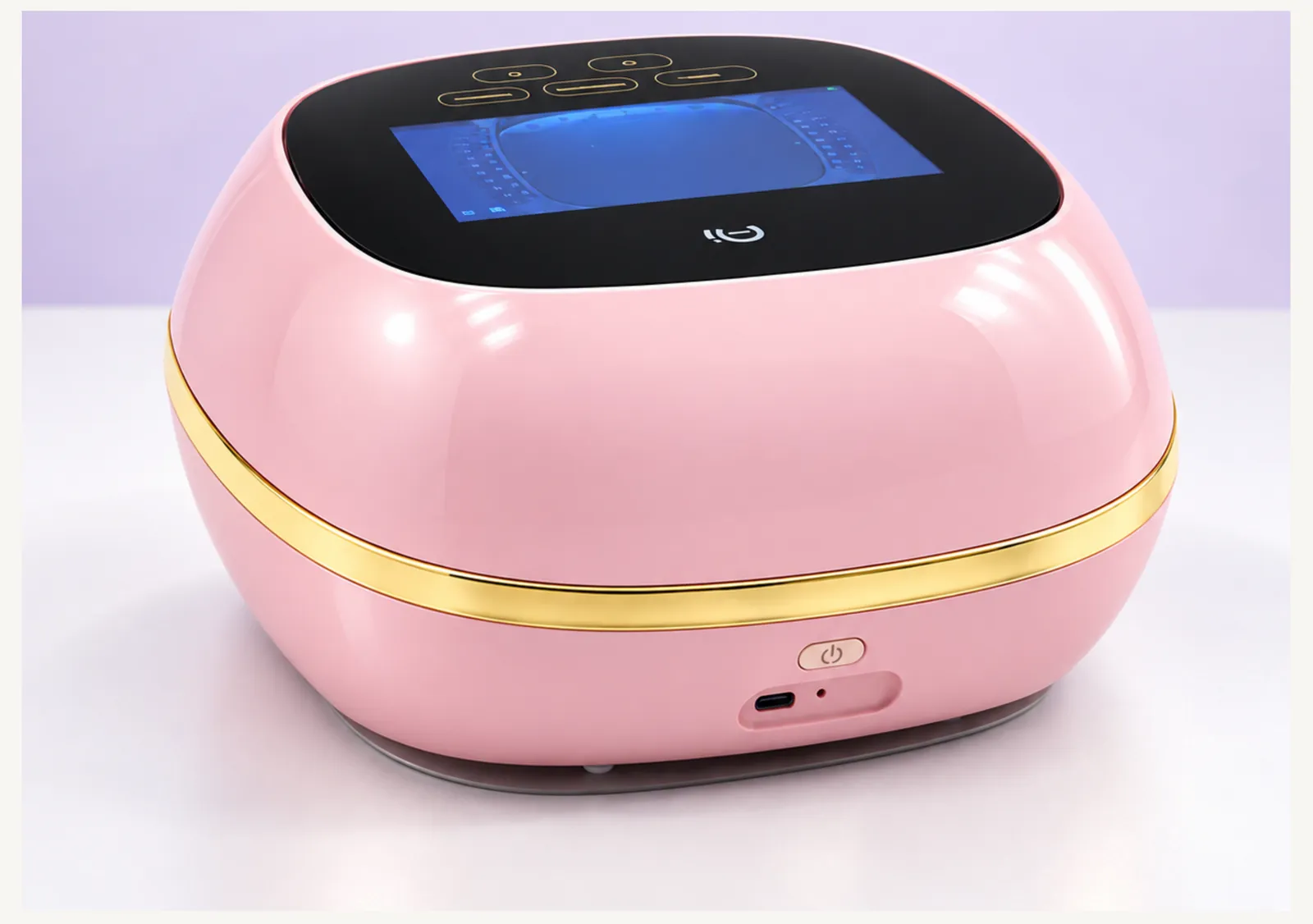
24 × 24 × 11.5 cm, rear power inlet, no wireless module: designed to disappear into an existing treatment room.
Six lines to put in the spa fit-out specification
Whether the lamp is ours or a competitor’s, a group procurement team should see these in writing before the purchase order: output behavior after a full cleaning cycle (a spa-grade appliance gets wiped down far more than a salon unit); language list on the console, locked per region; on-device processing and absence of network interfaces, one line that closes the guest-data conversation; thermal behavior across a full-day schedule, because resort rooms run back-to-back bookings in hot climates; the conformity file, named standard by standard; and spare-parts availability, because a property that is eleven flight hours from the supplier still needs a working lamp on Saturday.
Quick FAQ
Can we run a pilot in one property before a group-wide order?
Does the lamp need to connect to the hotel Wi-Fi for updates or reporting?
We want our logo and brand colors, but each property orders separately. How does that work?
Next step
Send us the property list and the treatment-menu plan, and we will return a specification sheet, the conformity file and a sample quotation at your stage of the ladder. Contact Miro Wu, Dedicated Account Manager — email miro.wu@beautome.com or WhatsApp +86 188 1393 3019.
Related: the OEM/ODM process for branded fleets, what changes when the lamp travels to the client, the cleaning-cycle hygiene routine, and the AI Smart Nail Lamp product page.