



AI Smart Nail Lamp for French Studios: The French File, Type E Cords and the Smallest Orders in Europe
France is Europe’s most famous beauty market, but its nail sector is not built out of big chains. It is built out of micro-studios — roughly four thousand of them, most run by one technician. That shape produces the smallest first orders in Europe: not a tender for forty chairs, but a distributor building a dealer network one studio at a time. The order is small. The paperwork, however, is thoroughly French — and France has a language law with its own name on it.
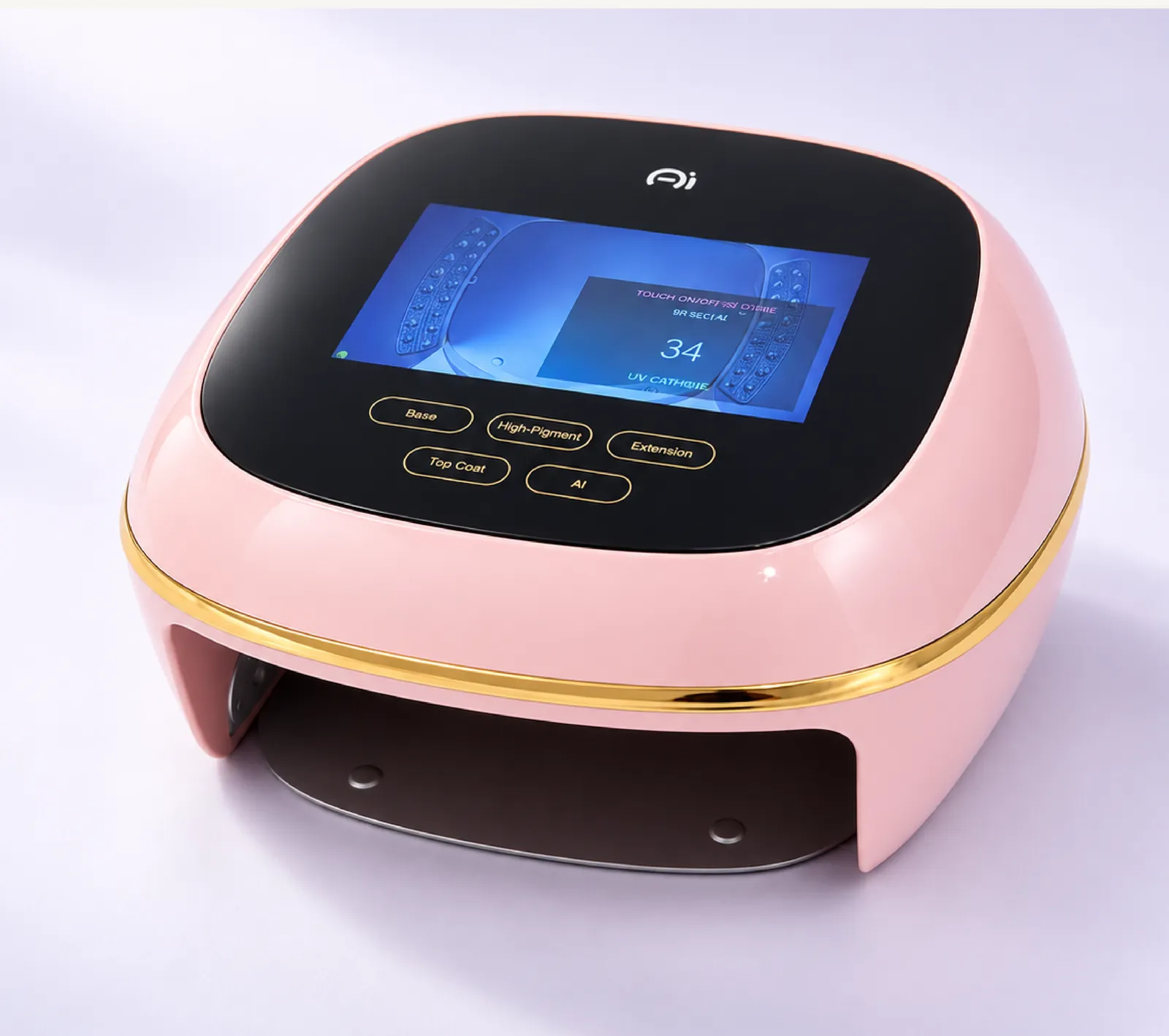
A 24 × 24 × 11.5 cm lamp for a studio that often has exactly one chair. Everything French about it — console language, manual, cord, operator details — is a line on the order.
A market of four thousand micro-studios
Two registry-style counts describe the same country from slightly different angles, and the difference is worth stating rather than hiding. One put France at 4,428 nail salons as of 1 April 2026, up 3.37% from 2023, with 71.61% single-owner operations and an average business age of five years (Rentech Digital, 2026). A second, drawn from the SIRENE register, counted 3,716 nail-stylist firms on 21 October 2026 — 91% single-site, and 97% of the firms with known headcount employing one to four people (BoldData, 2026). Two-thirds are sole traders. Around 205 new firms entered the register in 2026 by late October, on top of 328 in 2025.
The geography concentrates the demand. Île-de-France holds 978 of the Rentech count, Provence-Alpes-Côte d’Azur 680 and Occitania 585. For context on how young the professional nail sector still is next to hairdressing, the same SIRENE-based reading finds about 16 hairdressers for every nail salon in France. The nail studio market is a young, fragmented layer sitting on top of a very large beauty economy — which is exactly the shape a distributor-model works for.
4,428
Nail salons in France, 1 April 2026, up 3.37% from 2023 (Rentech Digital)
97%
Share of French nail-stylist firms with one to four staff (BoldData, SIRENE data, 2026)
205
New nail-stylist firms registered in France in 2026 through late October (BoldData)
The smallest orders in Europe — and why they still work
A French first order is rarely a container. It is one evaluation unit, then a handful of dealer units, then reorders. That is a business our configuration supports by design: a single evaluation unit ships before any commitment, and the white-label, unbranded configuration starts at three to five pieces. Full custom branding — logo, colorway, retail packaging — begins at 300–500 units, which in France is not one salon’s decision; it is a distributor’s decision, spread across a dealer network of dozens of micro-studios.
So the real question for a French buyer is not “how many units in year one.” It is whether the lamp can be sold door-to-door by a rep who has ten minutes per studio. That rep needs four things: a demo unit that cures the studio’s own gel brand reliably, a console the technician never has to re-explain, a French manual, and a spec line — 136 dual-band LEDs, 2 MP camera, 0.2-second nail detection — that can be repeated in one sentence. Everything else in this article exists to protect that ten-minute demo.
The French file: the law with a name
France is the one EU market where the language requirement has a household name: Law No. 94-665 of 4 August 1994, the “Loi Toubon.” Its Article 2 requires that instructions for use and notices accompanying products marketed in France be written in French. The consumer-institute reading of the rule (INC, 2026) adds the practical detail: a French-language notice can be supplemented with other languages, but the French presentation must be as legible and intelligible as any foreign-language version — and a digital manual is acceptable as long as the French text is provided. Missing or non-French notices are enforceable, with administrative fines of up to €3,000 for an individual and €15,000 for a company (Article L. 241-8 of the Code de la consommation).
The lamp-side translation is short. The 5.5-inch console ships in 29 languages and is locked to French at the factory, so the on-screen words and the printed manual can be checked word-for-word against each other before shipment. The EU document set stays the standard one — Low Voltage Directive 2014/35/EU, EMC Directive 2014/30/EU, RoHS 2011/65/EU, plus Regulation (EU) 2019/1020, which requires an economic operator established in the EU with details on the product or packaging. For a French order that operator is normally the importer or the brand’s French entity, and it should be appointed in writing before the carton is printed. Do not argue the language law with your importer; the €15,000 ceiling is theirs to explain to you, not the other way around.
Type E, and the cord line nobody prices
France runs 230 V / 50 Hz on type E sockets (CEE 7/5 — the socket with the projecting earth pin). A hybrid CEE 7/7 plug — Schuko body with the hole for the French earth pin — works in both French and German-style sockets, which is why most multi-country EU orders use it. Specify the cord as its own purchase-order line: moulded assembly, hybrid CEE 7/7 or pure type E by destination, with spares at roughly one per ten units. Write the input rating as a range on the nameplate rather than a single nominal figure, and confirm the test report covers 50 Hz operation.
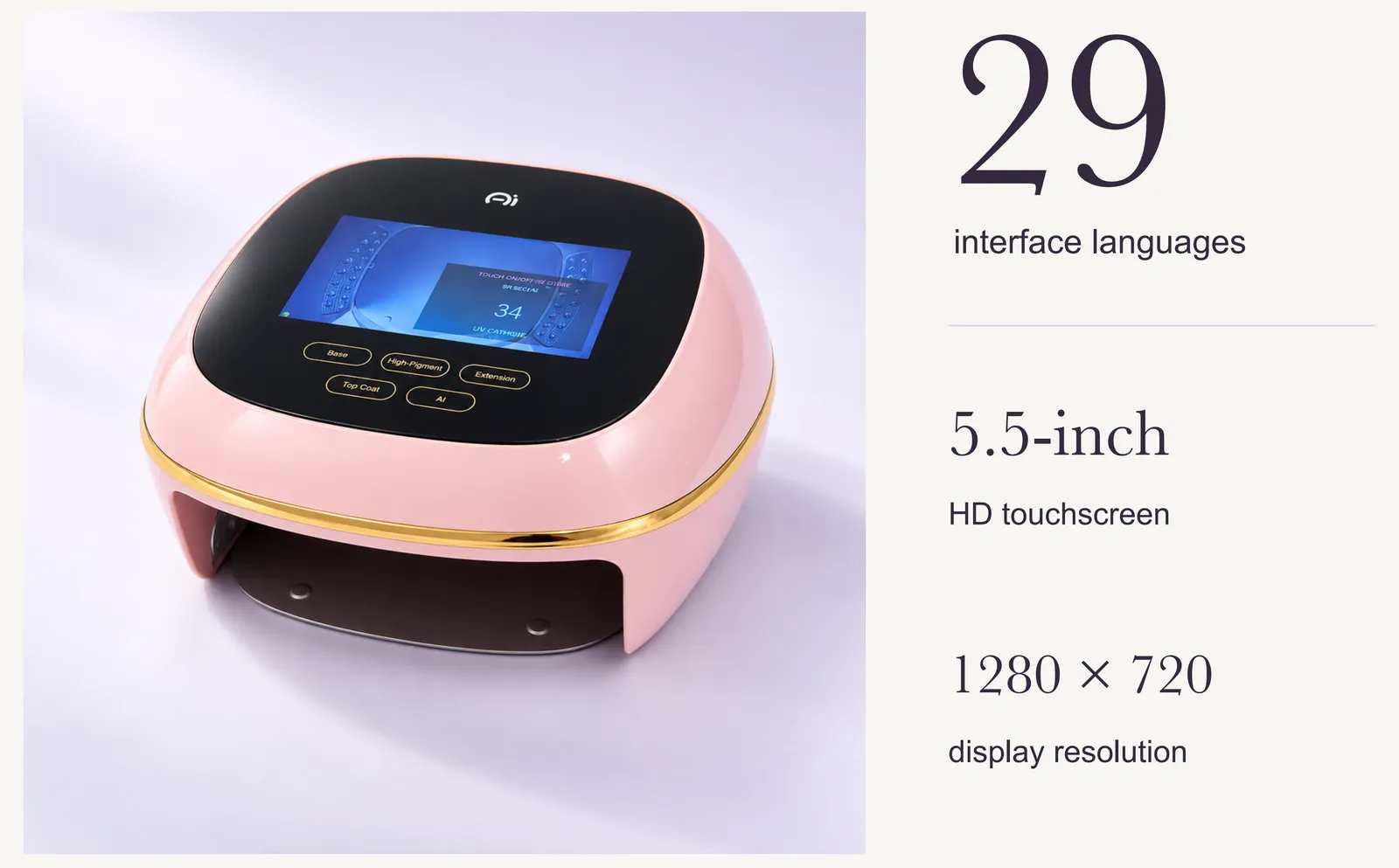
The console is locked to French before it leaves the factory, so the screen and the Toubon-compliant manual say the same thing.
What the lamp does in a one-chair studio
The AI Smart Nail Lamp uses a 2 MP camera with 0.5 TOPS of on-board processing to locate the nails in about 0.2 seconds, then drives its 136 dual-band LEDs — 365–370 nm and 395–400 nm — only over the detected zones. The curing principle is the same as any modern gel lamp: LED diodes emitting long-wave UVA to set the product. What differs is control. Because the light lands on the nail instead of flooding the whole hand, the surrounding skin receives far less unnecessary light exposure — the mechanism behind the “dark hands” complaint long-term gel clients raise, and a demonstration a rep can show rather than claim.
Smart heat control softens the exotherm spike that makes clients flinch, and the light-decay warning turns a slow output drop into a maintenance prompt instead of a month of under-cured sets. In a studio where the owner is also the technician, that second point matters more than any brochure: there is no second pair of hands to notice the lamp drifting.
Quick FAQ
Can a French buyer really start with one lamp?
Does the manual genuinely have to be in French?
Is a French brand name a new model?
Next step
Tell us how many studios your dealer network expects to demo in the first quarter and whether the program starts white label or custom, and we will return a quotation with the French lines itemized — console locked to French, type E or hybrid cords, the manual, and which documents ship with the goods. Contact Miro Wu, Dedicated Account Manager — email miro.wu@beautome.com or WhatsApp +86 188 1393 3019.
Related: the AI Smart Nail Lamp specification, the OEM and ODM program, and the curing-principle comparison that answers the question every French technician asks first.