






The Camera in an AI Smart Nail Lamp: What It Sees, What It Misses, and What to Ask
Every AI lamp brochure now says “camera.” Almost none of them say what the camera does when it is wrong. That silence is where distributor margin goes: a vision system that works on a demo hand at a trade fair and hesitates on a client with dark polish, long extensions or a hand pushed too deep into the cavity turns a premium feature into a support ticket. This is a buyer’s guide to the detection layer — how it works, what genuinely confuses it, and the four answers you should insist on in writing before you print a catalogue page.
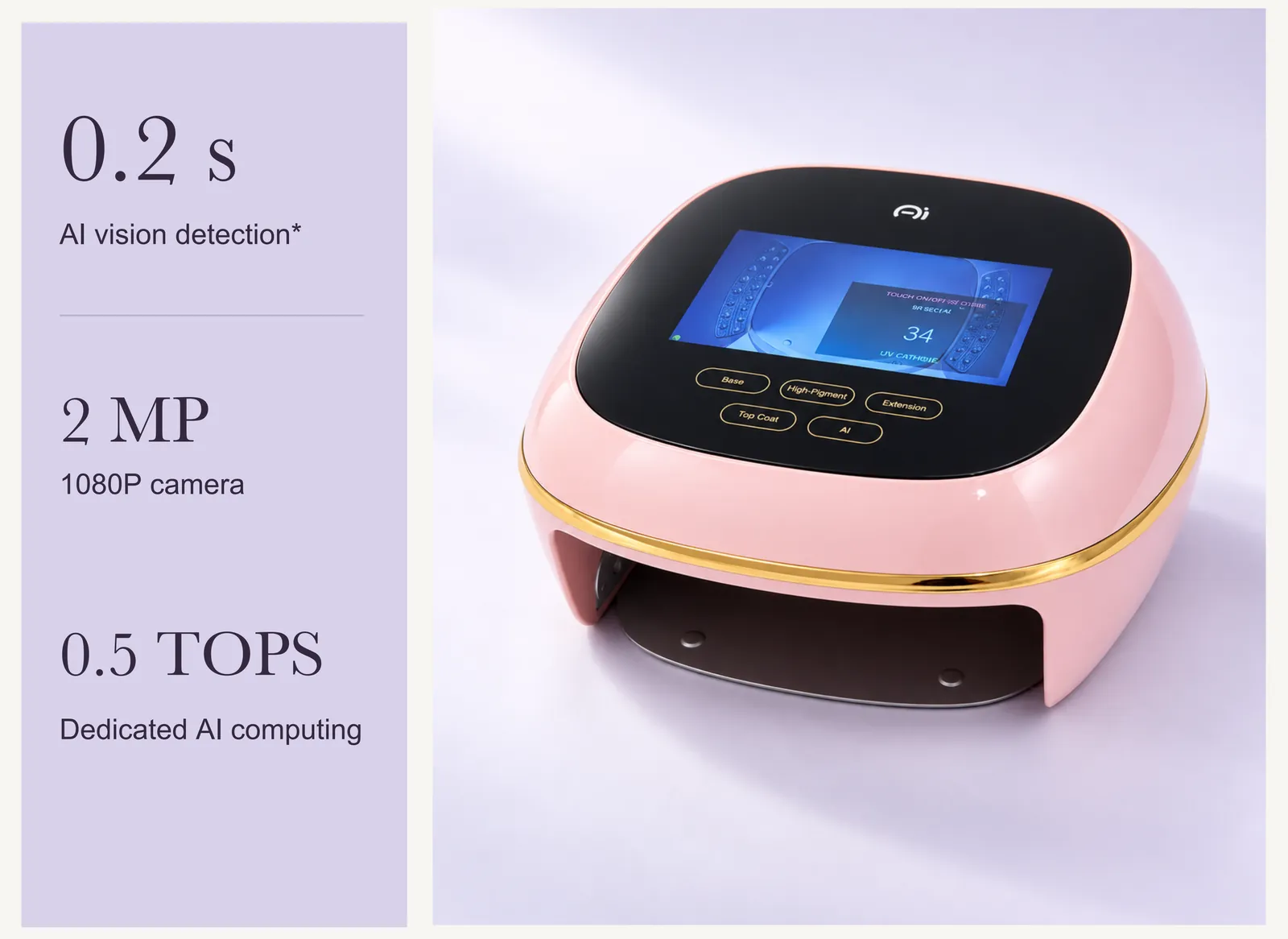
A 2 MP camera and 0.5 TOPS of on-device compute — the part of an AI Smart Nail Lamp that decides where the light goes.
Why a lamp needs to see at all
A conventional lamp illuminates the whole hand because it has no way of knowing where the hand is. That is not a chemistry problem or a comfort problem in the first instance — it is a geometry problem. Light is emitted over a fixed aperture, so the fingers, the webbing, the sides of the hand and often the wrist all sit under the array for the full cycle whether they need it or not.
Detection changes only one variable: where the light is allowed to go. Our AI Smart Nail Lamp runs 136 dual-band LEDs at 365–370 nm and 395–400 nm. The curing principle is the same one every professional lamp uses — LED emitters producing UVA to set the photoinitiators in the gel — so the honest differentiator is not the light source, it is the control layer on top of it. A 2 MP camera and 0.5 TOPS of compute locate the nails in roughly 0.2 seconds, and the array then emits over the nails, zone by zone.
Two consequences follow, and both are things a distributor can sell. The first is clinical: the skin between the fingers and around the nail is no longer under the array for the whole cure, which is the mechanism behind the result clients actually notice — less unnecessary ultraviolet exposure of the surrounding skin, which is what keeps hands from darkening across a season of monthly appointments. That is a statement about where the light goes, not a claim about emitting no ultraviolet light. The second is operational: the console can show whether the hand has been seen, which matters more than any specification in a chain that hires in waves.
The pipeline, in four steps
It helps to describe the system the way an engineer would, because the questions you ask follow directly from it.
1. Capture. A 2 MP frame of the cavity. Resolution sets the smallest feature the model can resolve — the free edge of a narrow nail, the gap between two fingers. 2. Inference. An on-device model of roughly 0.5 TOPS classifies the image into nail and non-nail regions. On-device matters: nothing leaves the lamp. 3. Mapping. The regions become a zone map for the driver, which is where the “only the nails” behavior is actually enforced. 4. Feedback. The 5.5-inch console, in 29 languages, tells the technician what the lamp believes it is looking at.
Step four is the one buyers undervalue. A vision system that is silent when it is unsure is worse than one that is honest about it, because the technician has no way to correct a bad hand position before the cycle starts.
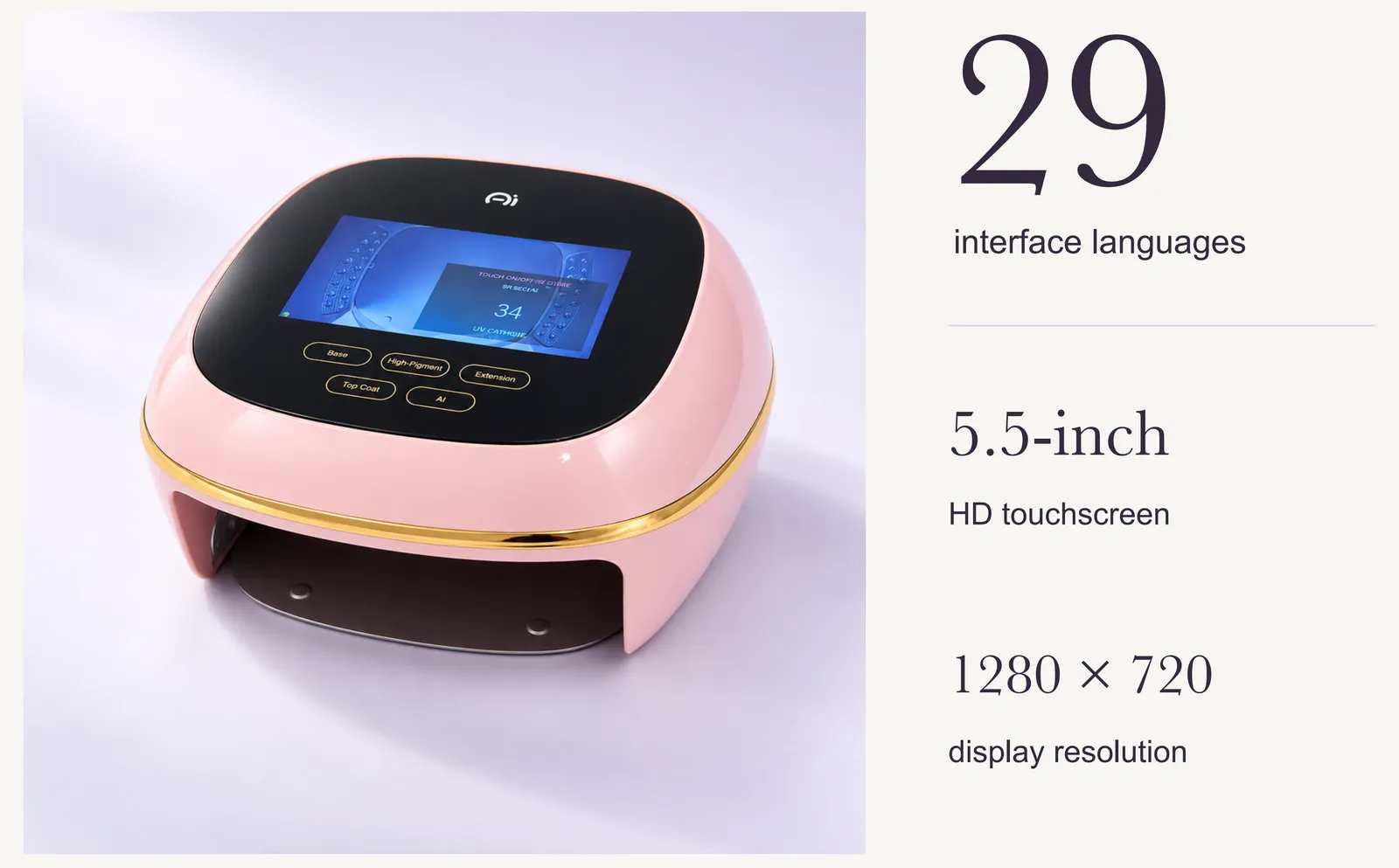
The console is where detection becomes visible: a technician can see whether the lamp has found the hand before the gel starts to set.
Six things that genuinely confuse a vision system
None of these are hypothetical. Every one of them appears in a real salon on a normal Tuesday.
Hand depth. Push the hand deeper into the cavity and the nail plane moves out of the calibrated focal window; pull it back and the nails shrink in frame. Both change the geometry the model was trained on. Polish color and finish. A white or nude gel reflects more light than a black or deep burgundy one; a high-gloss top coat creates specular highlights that read as edges. Contrast between nail and skin is what the model works with, and that contrast swings widely across a client list. Extensions and length. A long apex or a sculpted tip extends the nail silhouette well beyond the natural plate, and the free edge can sit outside the zone the model expects. Finger spacing. Four fingers spread and four fingers relaxed side by side produce different separations between nail regions; a closed hand produces near-touching blobs. A dirty lens or a fogged window. Gel residue, dust and condensation from a hot room degrade contrast before anything else fails — and nobody cleans a window they cannot see. Ambient light. Strong salon lighting or a ring light pointed at the client changes the exposure the camera settles on.
The point of listing them is not that vision is fragile. It is that a detection rate quoted from a clean laboratory frame is not a detection rate in a treatment room, and the difference is precisely what a distributor should test before committing to a container.
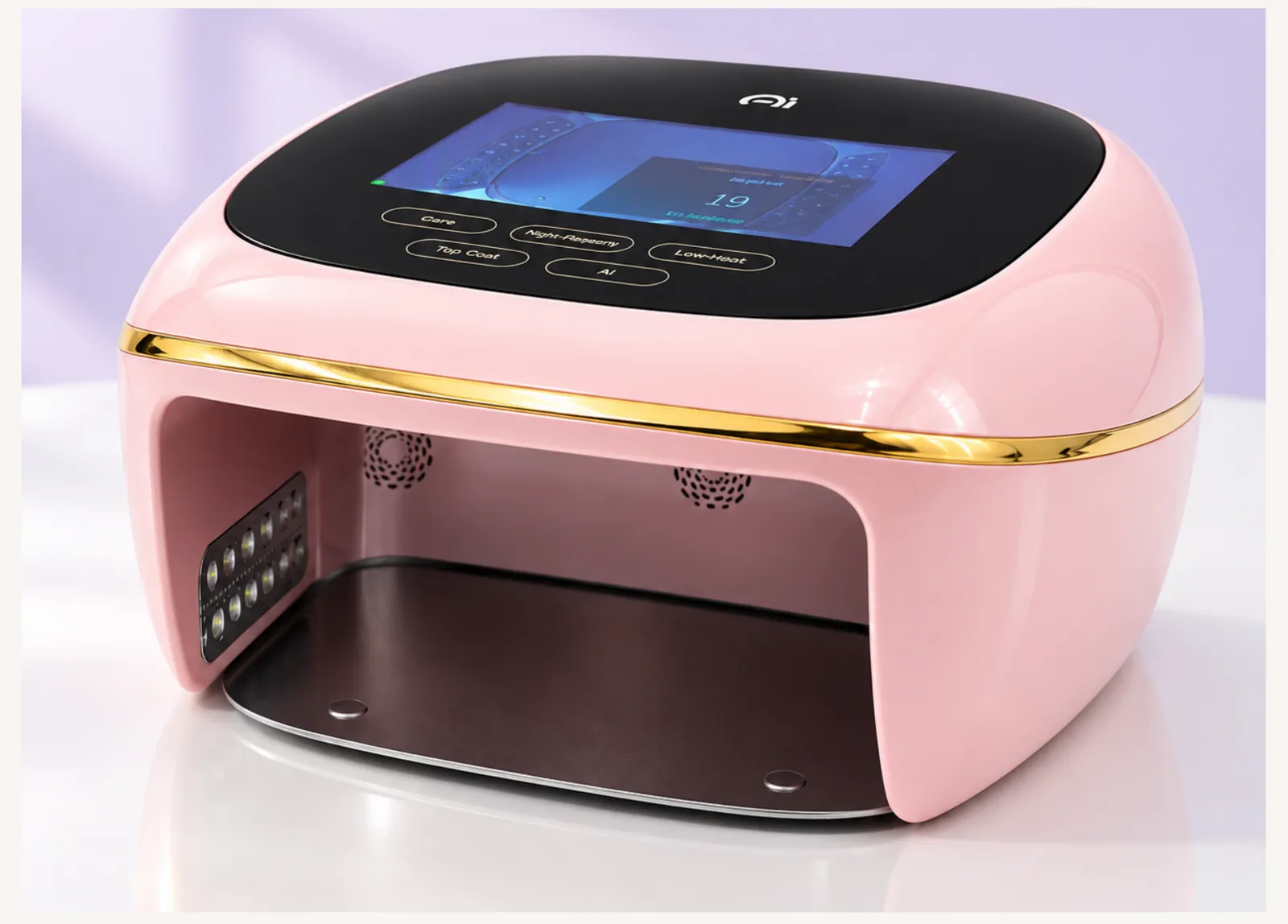
The other half of the system: 136 dual-band LEDs whose output is switched zone by zone, which is only useful if the zone map is right.
The question that separates a demo from a product
Here is the single most useful question you can put to any AI lamp supplier, including us: what does the lamp do when detection is uncertain? There are only three honest answers, and each has a commercial consequence.
Fall back to full-array emission. The cure still completes, the client is not kept waiting, and the exposure advantage is lost for that cycle. This is the safest default and the one a chain should be told about explicitly, because it means the feature is a benefit on most cycles, not a guarantee on all of them. Prompt and wait. The console asks the technician to reposition the hand. Good for accuracy, bad for throughput in a fifteen-minute service. Refuse the cycle. Almost never acceptable outside a laboratory, and a red flag if a supplier will not rule it out.
Whatever the answer, three follow-ups belong on the same page: is the fallback signalled visibly so the technician knows the advantage was lost; can the technician override deliberately; and is the detection model updatable in the field, or frozen at the firmware version that shipped. A camera that never receives an update is a camera that will meet a new gel bottle eventually and lose.
Privacy, in writing
A camera pointed at a client’s hand is still a camera. Two sentences in a supplier’s documentation resolve the whole topic: inference happens on the device, and no image is stored or transmitted. Ask for that in writing rather than in a sales call, and keep it with the technical file. It matters more, not less, if your market has data-protection expectations around client images — and it matters for a much simpler reason too: a lamp with no network connection has no network attack surface.
That also fixes the radio question. A lamp with a camera, a touchscreen and a switch-mode driver is not a radio device: in the EU the CE route is the Low Voltage Directive, the EMC Directive and RoHS, with (EU) 2019/1020 requiring an economic operator established in the Union and its details on the product or packaging; in the United States an unintentional radiator travels on an FCC Part 15 Subpart B supplier’s declaration. The moment you add Wi-Fi or Bluetooth for a chain dashboard, the file changes — RED in Europe, an FCC ID in the United States — and that is a product decision, not a paperwork one.
An afternoon test you can run in your own showroom
You do not need a laboratory to separate a measured lamp from a catalogue sentence. Take one sample unit and ten hands, and score what happens.
The ten hands: four clients with bare nails, two with dark polish, two with white or nude gel, one with long extensions, one with a hand that shakes or sits deep in the cavity. What you record per hand: whether the console confirmed detection, how long it took, whether the cycle ran as expected, and whether the technician had to reposition. Repeat after a deliberate interruption: wipe the window with a dry cloth, breathe on it, and run the same hand again. Then score it honestly. Eight clean confirmations out of ten is a product. Five is a demonstration.
Run the same ten hands on the lamp you already sell. The comparison is the entire argument, and it is one your dealers can reproduce without your engineers in the room.
What this means for a private-label program
The detection layer sits inside the enclosure, so branding it does not touch it. A logo, a shell finish or retail packaging is a branding change; changing the emitter count, the screen, the battery or the mold creates a new model identity and reopens the certification file. Keep the model string identical across nameplate, retail box, invoice, declaration of conformity and test report, and a private-label run stays inside the existing documents.
Commercially: standard units ship AC-powered without a battery, with a 6,000 mAh battery version available on request — which matters because a battery changes the transport file, not just the price. Neutral white-label units start at 3–5 pieces with single-unit samples for evaluation; full custom branding starts at 300–500 units. The enclosure is 24 × 24 × 11.5 cm with a rear power inlet, which is what lets the lamp sit on a narrow table without a cable crossing the client’s side.
Quick FAQ
Does the camera work on dark polish or dark skin tones?
If detection fails, does the client get an under-cured set?
Is a camera in a nail lamp a privacy problem for salons?
Next step
Send us the client profile your salons actually serve — polish brands, extension use, skin tones, average service length — and we will return the detection behavior your technicians should expect, a written fallback statement, and a two-page test sheet your dealers can run in their own showrooms. Contact Miro Wu, Dedicated Account Manager — email miro.wu@beautome.com or WhatsApp +86 188 1393 3019.
Related: how the curing principle compares across lamp types, what heat spikes in thick gels tell you about a data sheet, the parameter-by-parameter comparison, and the OEM/ODM process for private-label programs.