






Hard Wax Pilot Orders for Japan: Small Batches, Trade-Show Timing and the Transparent Bag
Japan rewards patience and punishes improvisation — and nowhere is that clearer than in the first order. The market is small by volume but the most paperwork-sensitive in Asia, which is why the smartest entry is not a container but a pilot order measured in 300 g bags, timed against two trade shows that anchor the whole Japanese beauty calendar. This article is about that entry path: what a pilot order contains, which show does which job, and why the unlabeled transparent bag is the format that makes small batches commercially sane.
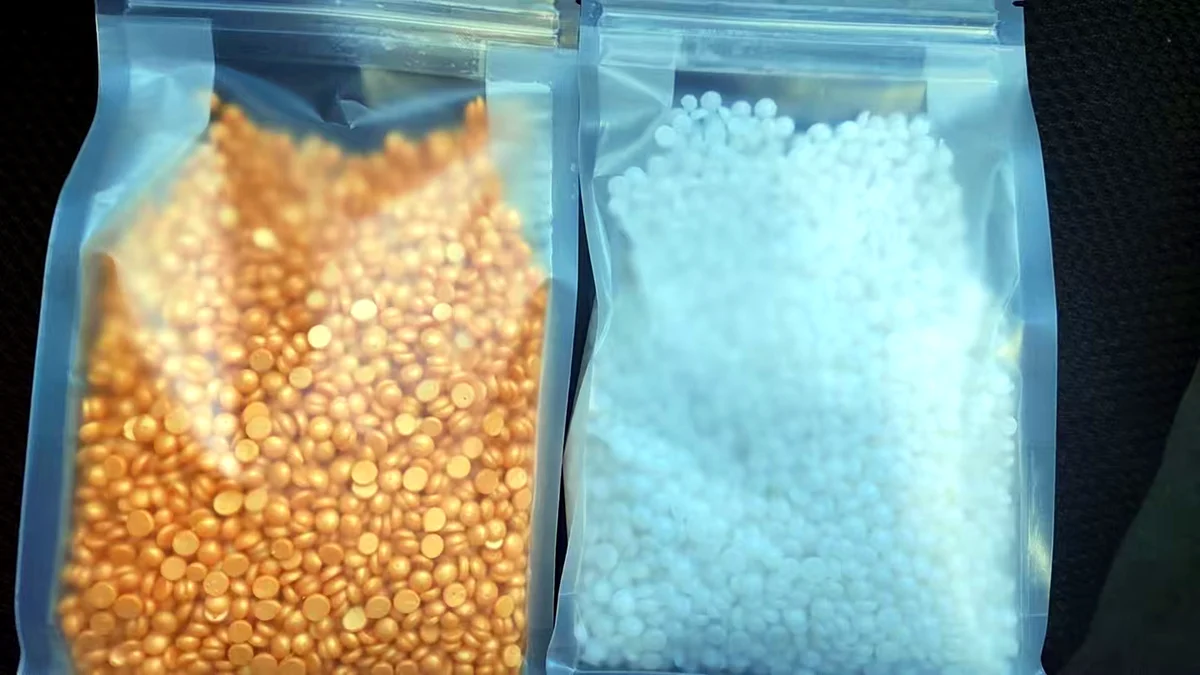
Gold and white unlabeled transparent bags — the pilot-order format. Your label goes on in Japan, after the decision, not before it.
Why a pilot, not a launch
Japan’s depilatory wax market runs at roughly USD 700 million in 2025 and is projected to hold about 12.2% of the Asia-Pacific market by 2035 (Global Market Insights) — not the region’s biggest number, but among its highest per-unit values and its strictest entry conditions. A launch-scale first order asks the buyer to commit to volumes and artwork before the two slowest clocks have started: the Japanese regulatory clock, which runs through a licensed importer, and the salon-acceptance clock, which only starts when a technician pulls the first strip of set wax. A pilot order decouples those risks. You buy small, test with real salons, and let the regulatory work proceed in parallel rather than in front.
We wrote earlier about the document checklist behind a Japanese entry and about Japanese label artwork — both are the parallel paperwork this pilot exists to fund. The pilot itself is simpler. Its questions are physical: does the wax hold its film at this salon’s room temperature, does the 45–50 °C formula feel right on first-time clients, does the technician prefer the cream-white rosin formula for short coarse hair — and does anyone complain about the bag.
Two shows, two different jobs
The Japanese beauty calendar gives an entrant two distinct windows a few months apart, and they do different jobs. COSME Week Tokyo runs 17–19 February 2027 at Tokyo Big Sight — more than 750 exhibitors and about 33,000 visitors, and its center of gravity is the supply chain: contract manufacturing, OEM, ingredients and packaging (show organizer data, 2026). If your private-label program needs sourcing conversations, formulation samples and packaging discussions, this is the window; the buyers walking the OEM halls are there precisely to start small and iterate.
Beautyworld Tokyo follows on 17–19 May 2027, also at Tokyo Big Sight — the 29th edition of Japan’s largest comprehensive beauty fair, which drew 958 exhibitors and 68,174 visitors in 2026 (Messe Frankfurt Japan). This is the professional-market window: salons, distributors and dealers. The logic of the calendar writes itself: source and spec at COSME Week in February, run the pilot through March and April, and walk into Beautyworld in May with salon-tested results instead of a brochure. Messe Frankfurt also stages Beautyworld Fukuoka (8–10 February), Nagoya (12–14 July) and Osaka (18–20 October) in 2027, which matters later — regional shows are where a proven pilot becomes a regional dealer program.
USD ~700M
Japanese depilatory wax market in 2025, projected at 12.2% of Asia-Pacific by 2035 (Global Market Insights)
17–19 Feb
COSME Week Tokyo 2027, Tokyo Big Sight — 750+ exhibitors, ~33,000 visitors; the OEM and private-label sourcing window
68,174
Visitors at Beautyworld Tokyo 2026; the 29th edition runs 17–19 May 2027 (Messe Frankfurt Japan)
What a pilot order actually contains
A working Japanese pilot fits in a courier carton. Three to six kilograms per formula, packed in 300 g bags, is enough for five to eight salons to run eight weeks of mixed menus — and 300 g is not an arbitrary size: a 450 ml heater pot takes about 400 g of beads, so one bag is one pot, one technician, roughly one working day of the target service. The pilot set mirrors the production range so the test answers a real assortment question, not a single-formula question:
Formula A1, rosin-free, 45–50 °C working window — the first-time-client and sensitive-skin formula, in the standard Gold & Pink; White is a custom color produced to order, so it usually waits for the production run. Formula A2, premium rosin, cream white — the high-flexibility bead that grips short, coarse hair on backs and chests. The consumer-grade hard wax, 55–60 °C film wax — the fast-setting workhorse for legs and arms. And the all-purpose soft wax in 450 g cans, included because in Japan more than anywhere, the soft-wax-versus-hard-wax split is a menu decision the salons will make for you if you let them. Remember the equipment consequence: two working temperatures mean two pots on the test table — a detail that quietly sells your heater line alongside the wax.
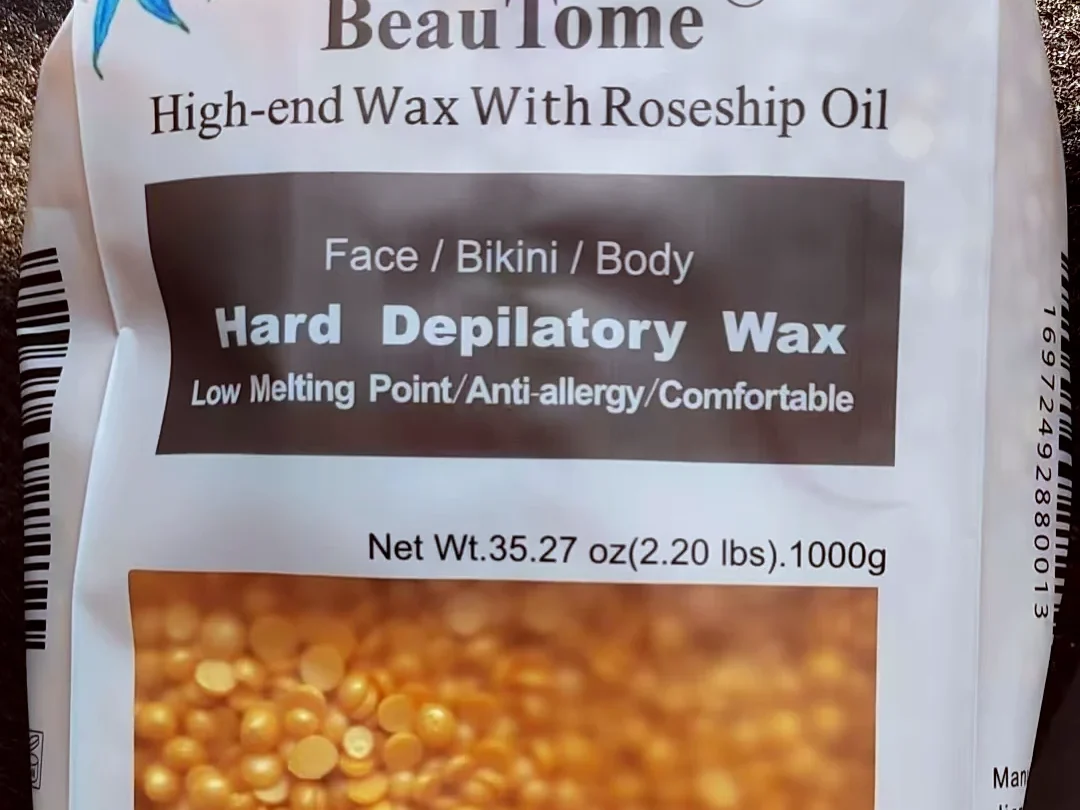
Formula A1, rosin-free, in a 45–50 °C working window — the first-time-client formula in the pilot set.
Why the transparent bag is the pilot format
Japanese labeling is a full artwork project — Japanese-language ingredient naming, mandated fields on the direct container, a licensed importer’s details — and none of that work should start before a pilot has told you which formulas survive contact with real salons. The unlabeled transparent bag resolves the sequencing: the factory prints only the batch number and production date on the bag seal, the bag carries no brand, no claims and no artwork, and your label is applied in Japan, by your licensed labeling party, once the pilot has told you what to print. Because there is no printing to order, the private-label run for the pilot carries a low MOQ with zero printing lead time — the artwork decision moves from before the order to after the data.
Two disciplines keep the format honest. First, track the batch numbers from bag seal to salon feedback sheet; a pilot whose results cannot be traced back to a production batch has learned nothing. Second, mind the season in transit: recommend storage at 15–24 °C, and in a country that has just logged successive record-hot summers, let boxes acclimate before opening to avoid condensation on the beads.
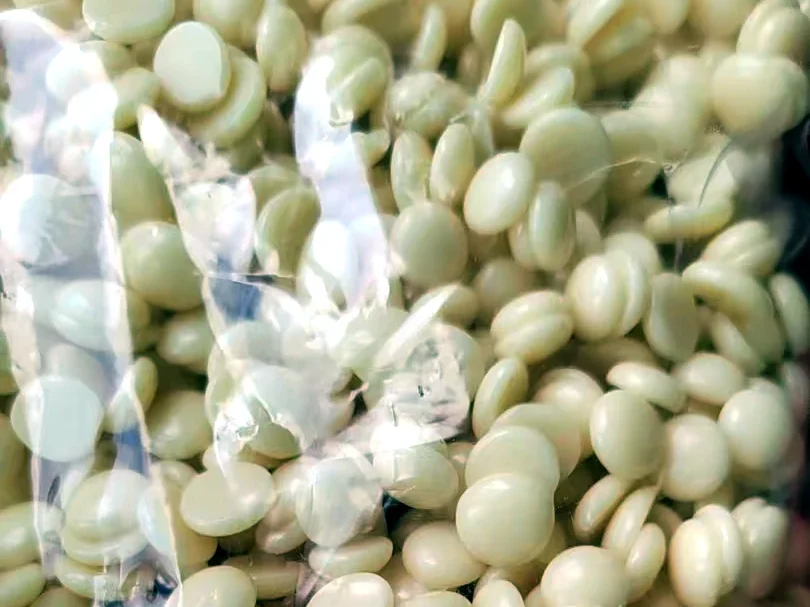
Formula A2 cream white beads — the flexibility formula for short, coarse hair in the same pilot carton.
Quick FAQ
How small can a first Japan order realistically be?
Which trade show should we attend first, COSME Week or Beautyworld Tokyo?
Do the unlabeled bags clear Japanese import rules?
Next step
Tell us which three or four formulas belong in your pilot carton and which show — COSME Week in February or Beautyworld Tokyo in May — anchors your calendar, and we will return a pilot quotation with bag sizes, batch-number format and shipping window itemized. Contact Miro Wu, Dedicated Account Manager — email miro.wu@beautome.com or WhatsApp +86 188 1393 3019.
Related: the full formula range, the Japanese document checklist that runs in parallel with any pilot, and the heater line for the two-pot test table.