







AI Smart Nail Lamp for Mobile Nail Techs: Power, Weight and the Client’s Kitchen Table
Mobile nail services in North America are on track to double over the next decade — Global Market Insights pegs the segment at roughly USD 1.6 billion in 2025, growing at about 7.4% a year toward USD 3.2 billion by 2035. Every one of those appointments is a lamp carried into a living room, a hotel suite or an office breakout room. A salon lamp earns its spec sheet in a controlled room; a mobile lamp has to earn it on someone else’s table, under someone else’s lighting, in ten minutes of setup. That is a different buying brief, and it is the one we walk distributors through here.
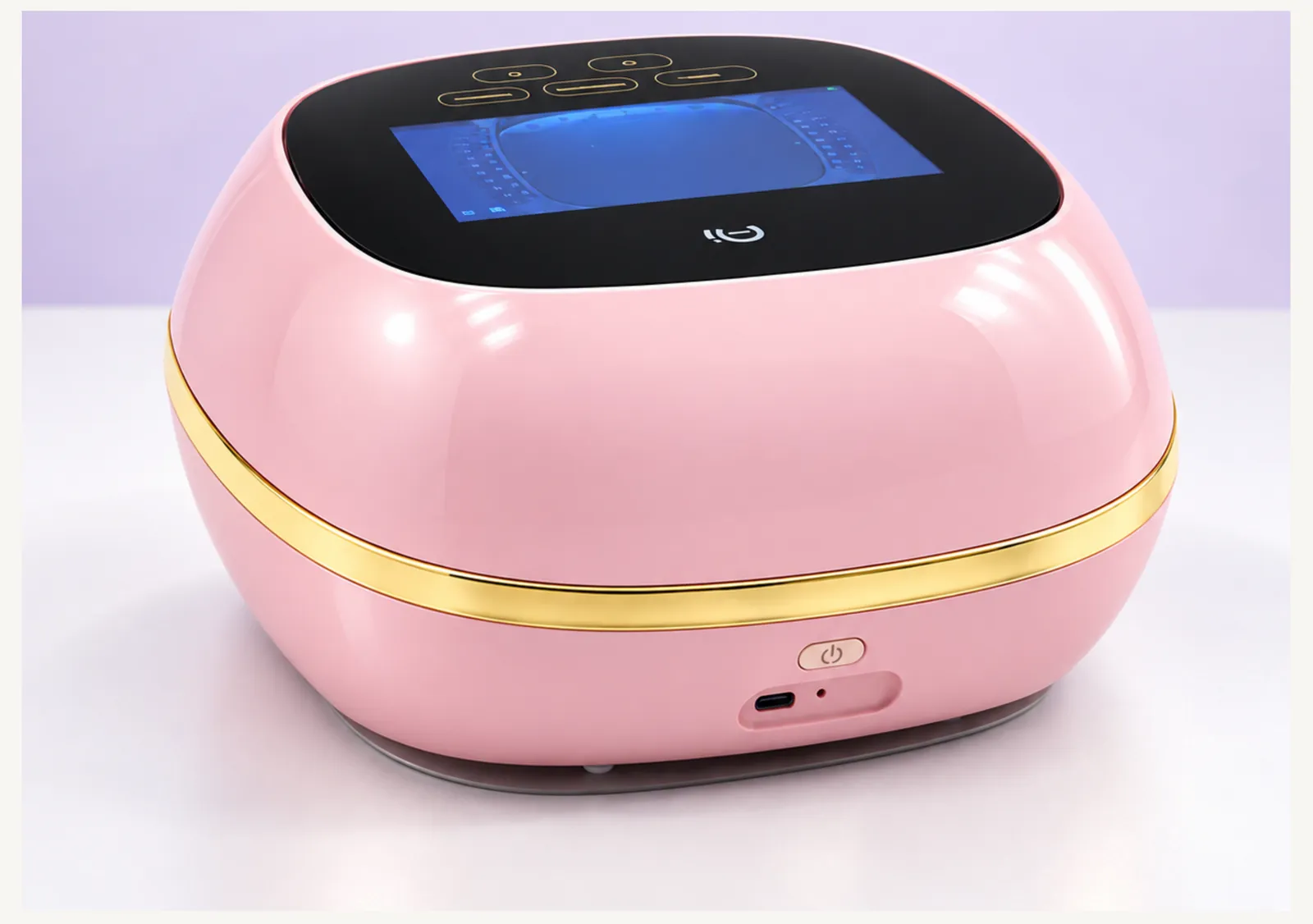
Rear-mounted power entry and a 24 × 24 × 11.5 cm footprint: the two specs a mobile technician cares about most.
The mobile brief is not the salon brief
A salon buyer asks about throughput: how many hands per hour, how the lamp fits a row of stations, how it holds up to eight hours of duty. A mobile technician buys against a different checklist, and the differences are sharp enough that a distributor who quotes the same unit the same way to both buyers will lose one of them.
Footprint and case weight. The entire working surface is whatever the client cleared off. At 24 × 24 × 11.5 cm, the lamp occupies about the area of an open magazine — small enough to share a dining table with a tool case, a lamp ring and a towel. Anything bigger, and the technician is negotiating furniture instead of setting up a service.
Power from an uncontrolled socket. The lamp plugs into whatever outlet the room offers, often shared with a phone charger, a curling iron or a vacuum. The AI Smart Nail Lamp runs from a standard AC outlet with the power entry on the rear of the body, so the cable runs behind the lamp and away from the working hand — no cord crossing the table, no client kicking it mid-service.
Unpredictable lighting. A salon has consistent ambient light. A client’s kitchen has a window on one side, a warm ceiling bulb overhead and a phone flashlight halfway through. This is where the 2 MP camera and the 0.5 TOPS onboard processor stop being a salon feature and become a mobile necessity: in about 0.2 seconds the system establishes where the nails actually are in the working area, whatever the room is doing around it, and the LED array lights in zones rather than flooding the hand. The light lands on the nail and the free edge — not on knuckles, not on the surrounding skin. That zoning also reduces unnecessary light exposure of the surrounding skin, which clients notice when the service happens two feet from their own dining chair. It is the same curing principle as every LED gel lamp on the market — LED chips emitting UVA — just aimed with more discipline.
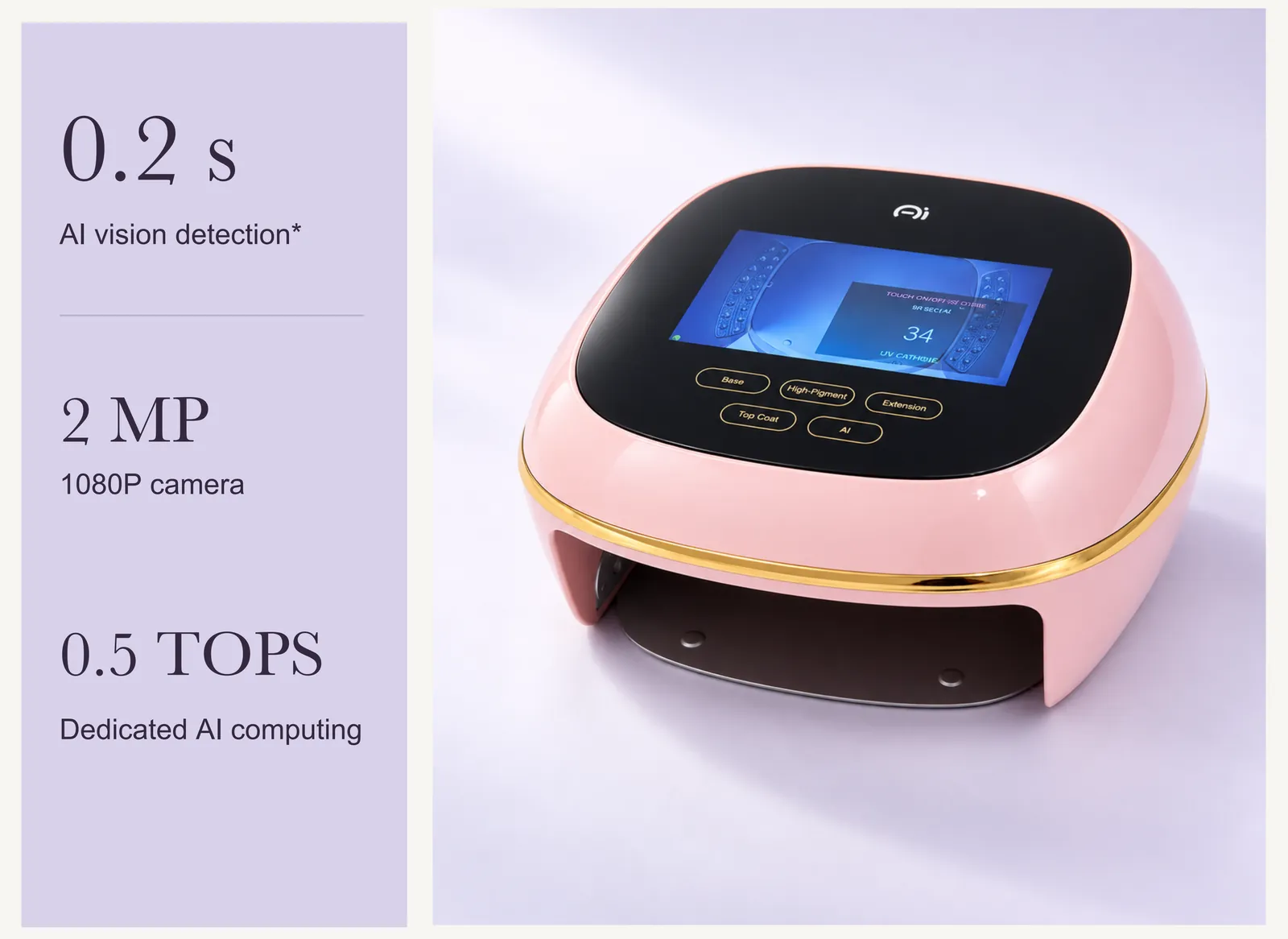
Rooms change on every appointment. The camera does the compensating, not the technician.
The battery question, answered honestly
Mobile techs ask about battery operation early, because the mental model is “wireless like my drill file.” The honest answer has two parts.
First, the standard shipping configuration is AC powered, without a battery. That is the configuration most working mobile technicians actually settle on, for one practical reason: a full gel set with extensions runs three to five curing passes per hand across a two-to-three-hour service. A lamp that carries its own charge has to budget that energy, and the technician ends up rationing light instead of using it.
Second, for the segment that genuinely needs cordless — bridal parties, in-studio pop-ups, corporate events, festival booths — a 6,000 mAh lithium battery version is available on request. It is an option, not the default, and it carries a consequence worth flagging to buyers in the same breath: adding a lithium battery changes the shipping documentation for every unit that includes it. A distributor quoting the battery version should quote the freight line at the same time, not after the PO lands.
Heat, in rooms that are not climate-controlled
Salon lamps live in 21–23 °C rooms. Mobile lamps live everywhere: a client’s kitchen in August, a garage studio, a hotel room with the AC set to 17 °C. The lamp’s intelligent heat control and light-decay monitoring matter more here than on any showroom floor, because the duty profile is a single long service with the hand in and out of the cavity, in an ambient temperature the lamp cannot predict.
The spec to point at is stability rather than peak output: consistent delivery across the two bands — 365–370 nm and 395–400 nm across the 136-diode dual-band array — through a service, not just in the first thirty seconds. A lamp that drifts as it warms will cure a first hand perfectly and a fourth hand under-cured, and the mobile tech has no backup unit in the van.
One screen, every client market
The 5.5-inch touchscreen ships with 29 interface languages. In a single-city salon that reads as a nice-to-have. For a mobile business it is closer to a business plan: the same device a technician uses in an English-speaking suburb on Tuesday works unchanged for a Mandarin-speaking client’s bridal party on Saturday, or a Spanish-speaking office booking on Monday. Distributors serving multilingual metro markets — and in North America, almost every metro is one — should treat the language list as part of the resale pitch, because the technician’s client base is more varied than any single storefront’s.
The five-line checklist for a mobile quote
When a distributor or a buying group evaluates a lamp for the mobile segment, we suggest compressing the decision into five lines:
1. Footprint and packed weight — 24 × 24 × 11.5 cm body, rear power entry, one case fits lamp plus tools.
2. Power configuration — standard AC, no battery as shipped; 6,000 mAh lithium available on request, with freight documentation noted at quote time.
3. Vision behavior in bad light — demo the lamp under a warm bulb and near a window; the 0.2-second detection should hold without the technician repositioning the hand.
4. Thermal stability, not peak power — four consecutive services back-to-back, asking whether the fourth cures like the first.
5. Interface languages and presets — 29 languages on the 5.5-inch screen, with service presets the tech can save per gel system.
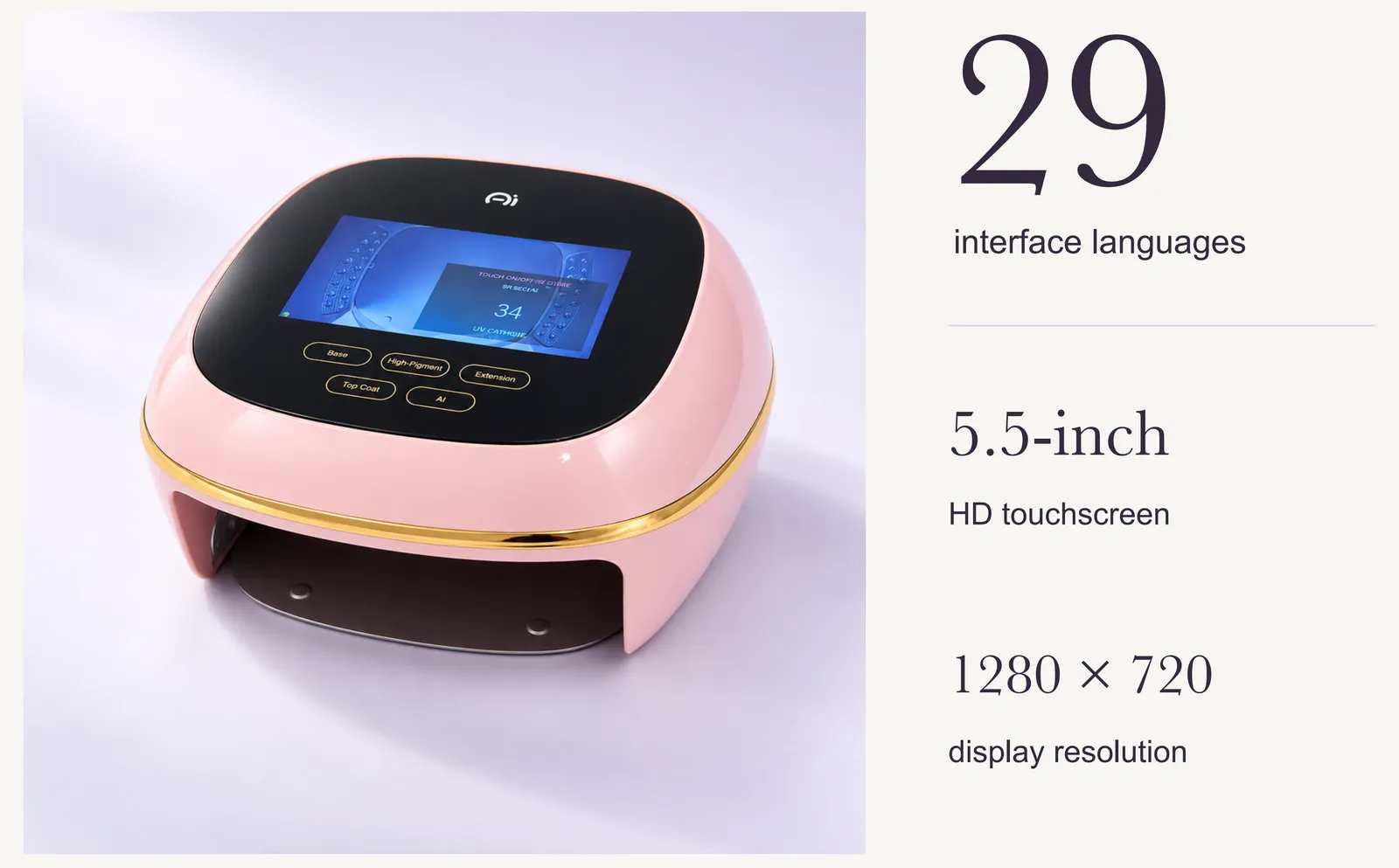
One control panel, 29 languages: the same unit serves every client market a mobile route touches.
How the commercial terms fit the mobile segment
The mobile segment is fragmented by nature — thousands of solo operators rather than a few chains — so the entry path matters more than the volume path. BeauTome ships white-label and unbranded units from 3–5 units, with a single sample unit available for evaluation, which is the right shape for a tech testing one unit before outfitting a training cohort or a booking platform’s partner list. Custom branding (logo, colors, retail packaging) starts at 300–500 units, which is where a franchise system or a national booking platform lands rather than a solo operator.
FAQ
Can the AI Smart Nail Lamp run during a full mobile shift without an outlet?
Does vision detection work in a client’s home lighting?
What is the minimum order for a mobile-focused distributor?
Contact Miro Wu, Dedicated Account Manager — miro.wu@beautome.com · WhatsApp +86 188 1393 3019. Sample units, distributor pricing and mobile-segment bundle quotes answered within one business day.