







AI Smart Nail Lamp for Nail Schools: What an Academy Bench Tests Before It Buys Twenty
A salon buys one lamp and replaces it when it dies. A nail school buys twelve to twenty at once, runs them six days a week under beginner hands, and replaces them on an intake calendar rather than a failure. That makes the education channel the most demanding reference account you can win — and the most valuable one, because every cohort that learns on your lamp specifies it again when the students rent a chair. Here is what an academy actually tests, and what to put in writing before the first bench is delivered.
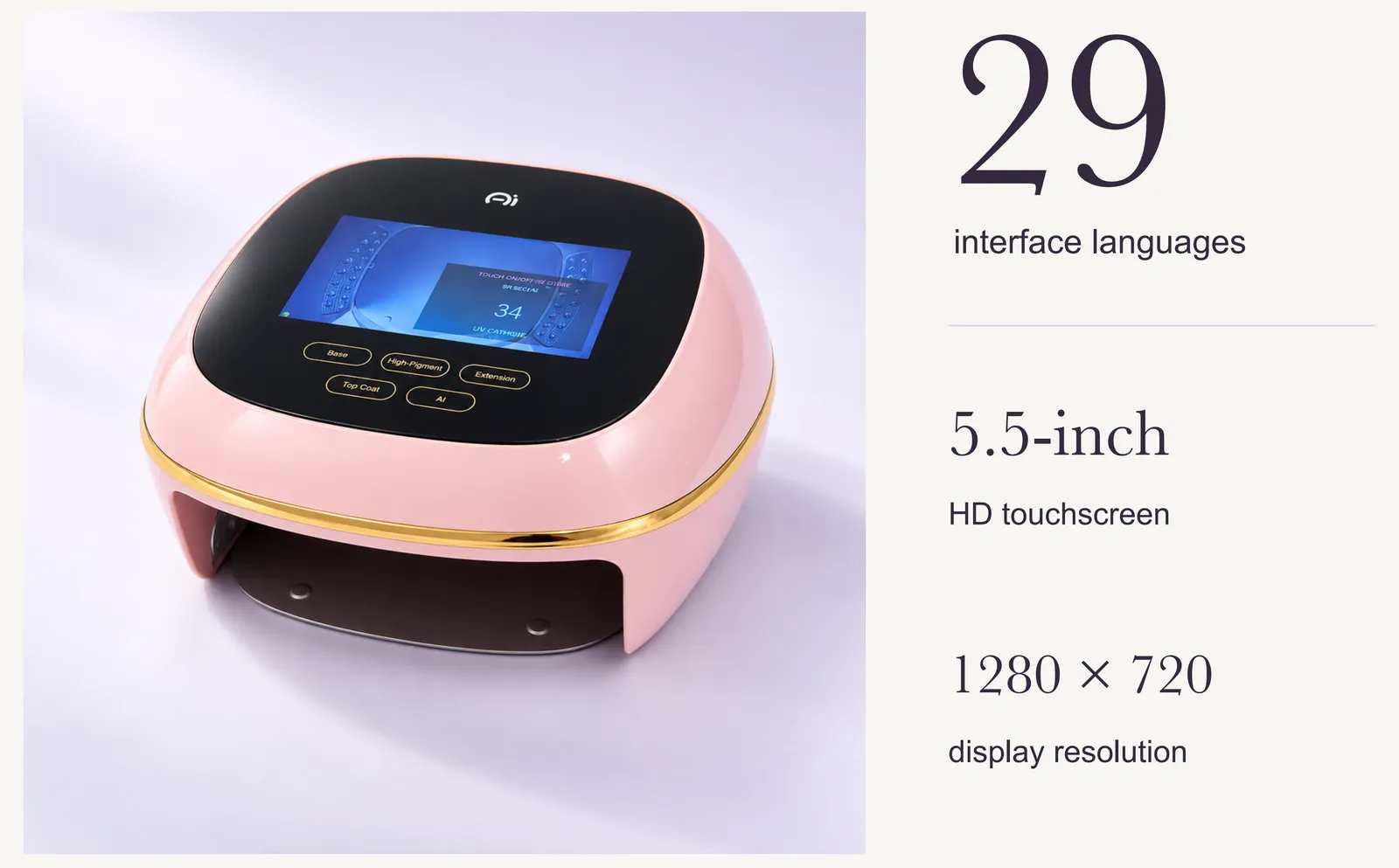
On a training bench the console is not decoration: it is the first place a student sees whether the lamp found the hand.
The buyer nobody writes a brochure for
Most lamp marketing is written for a salon owner with eight clients a day. The academy director has a different problem: a room, a timetable, and a fixed number of hands that must all be cured correctly by people who have been holding a brush for eleven days.
The size of that pipeline is not a guess. In the United States alone, manicurists and pedicurists held about 201,800 jobs in 2025, with employment projected to grow 9 percent between 2025 and 2035 and roughly 21,900 openings a year on average, according to the Bureau of Labor Statistics. Median pay was USD 17.19 an hour in May 2025, and entry requires a state-approved cosmetology or nail technician program plus a state exam. Every one of those graduates spends hundreds of hours under somebody’s lamp before they ever bill a client.
That is why an academy order is worth more than its invoice — and why a school is unforgiving: twenty lamps that hesitate in front of a class become a complaint in week two.
Six things a bench tests that a salon never will
Duty cycle. A salon lamp might run forty cycles a day. A classroom lamp runs from nine in the morning to five in the afternoon, on twenty pairs of hands, with a five-minute break between groups. Heat soak, not peak output, is what ends a training lamp’s life. Ask for the recommended continuous-use pattern and the ambient temperature it was measured at.
Beginner hand positions. Students push the hand too deep, hold it too high, clamp the fingers, and turn the hand sideways to see what they are doing. A camera that locates nails in roughly 0.2 seconds turns those mistakes into visible feedback on the console — which is a teaching tool, not a gimmick, provided the lamp says something when it is unsure.
Language switching. International cohorts are normal in most training cities. The console carries 29 interface languages on a 5.5-inch screen; the practical question is whether the language can be locked per class rather than changed by every student who passes the bench.
Bench footprint. The enclosure is 24 × 24 × 11.5 cm with the power inlet at the rear. On a 60 cm training bench shared with a hand rest, a dust extractor and a student’s kit, that footprint and a cable that leaves away from the client’s side decide whether the lamp stays where it was placed.
Cleaning between students. The window over the camera gets wiped with alcohol dozens of times a week. Ask how many wipes before it hazes, and whether the window is a replaceable part. A hazed window costs contrast, and contrast is what the detection layer works with.
The parts students touch. Window, touchscreen, cord entry, hinge. These wear out long before the LED array does, and a school cannot send a lamp away for three weeks mid-term.
What to teach now that the lamp has a screen
A vision-assisted lamp is a chance to teach specifications instead of brand claims, and academies that do it produce graduates who specify better equipment for the rest of their careers.
Dose, not wattage. What cures gel is irradiance at the nail surface in mW/cm² multiplied by time. Wattage on a box tells you almost nothing about that. Two bands, not one word. Our array runs 136 dual-band LEDs at 365–370 nm and 395–400 nm; a photoinitiator system that absorbs at one band and not the other will under-cure no matter how long the cycle runs. The first thirty seconds. Ask whether output ramps or starts at full power — the answer changes how you teach flash curing.
Teach the naming honestly as well. The industry calls these UV lamps or LED lamps; both are LED emitters producing UVA, and the curing principle is the same. Students who understand that compare spectrum and dose instead of labels.
Then teach the part clients notice. Because the array emits zone by zone over the nails rather than flooding the whole hand, the skin around the fingers is under the light for less of each cycle — less unnecessary ultraviolet exposure of the surrounding skin, which is the mechanism behind hands that do not darken over a season of monthly appointments. That is a statement about where the light goes. It is not a claim that the lamp emits no ultraviolet light, and an academy that teaches the difference is doing its students a favor.
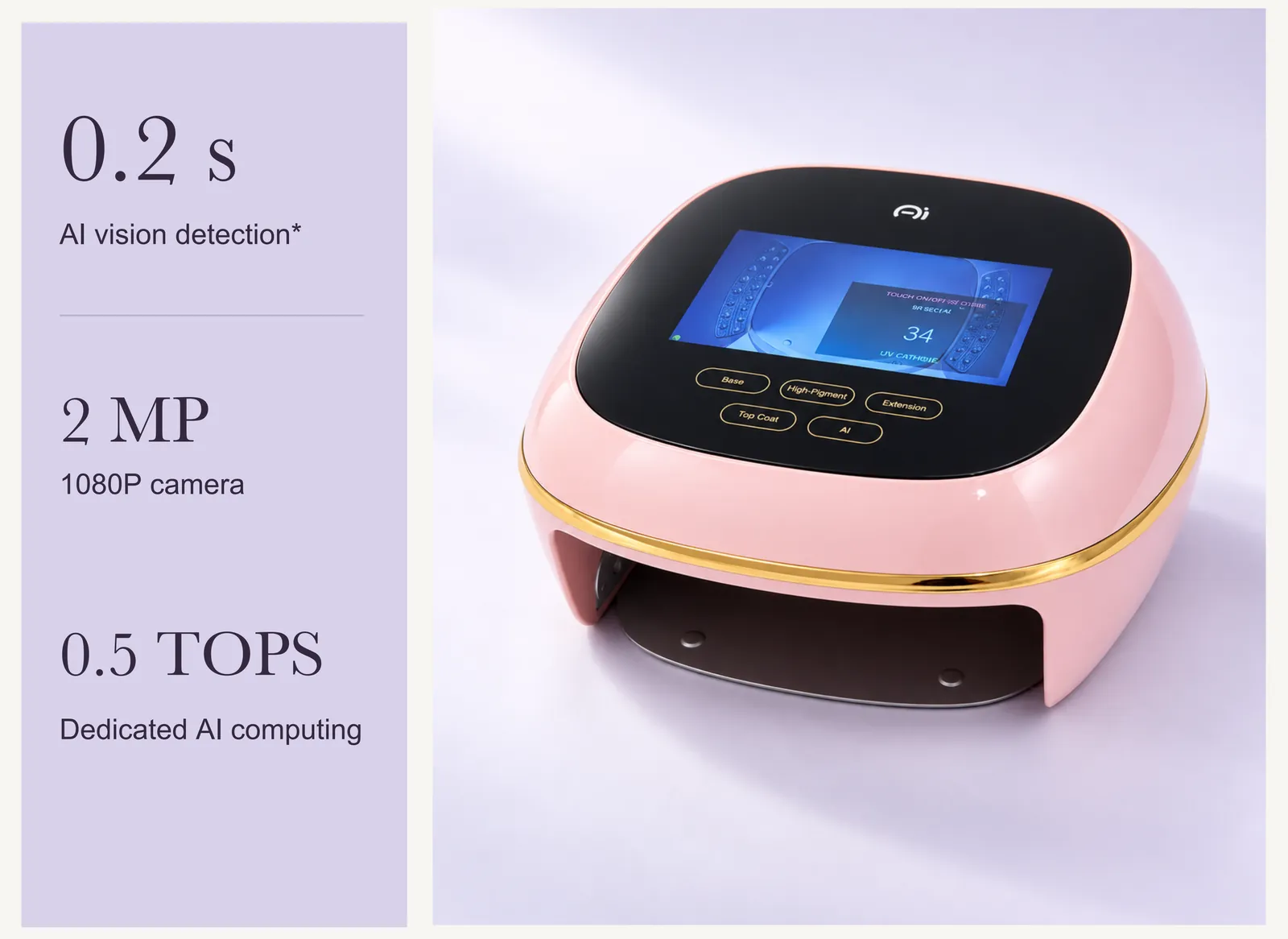
A 2 MP camera and 0.5 TOPS of on-device compute: the student sees where the light will go before the cycle starts.
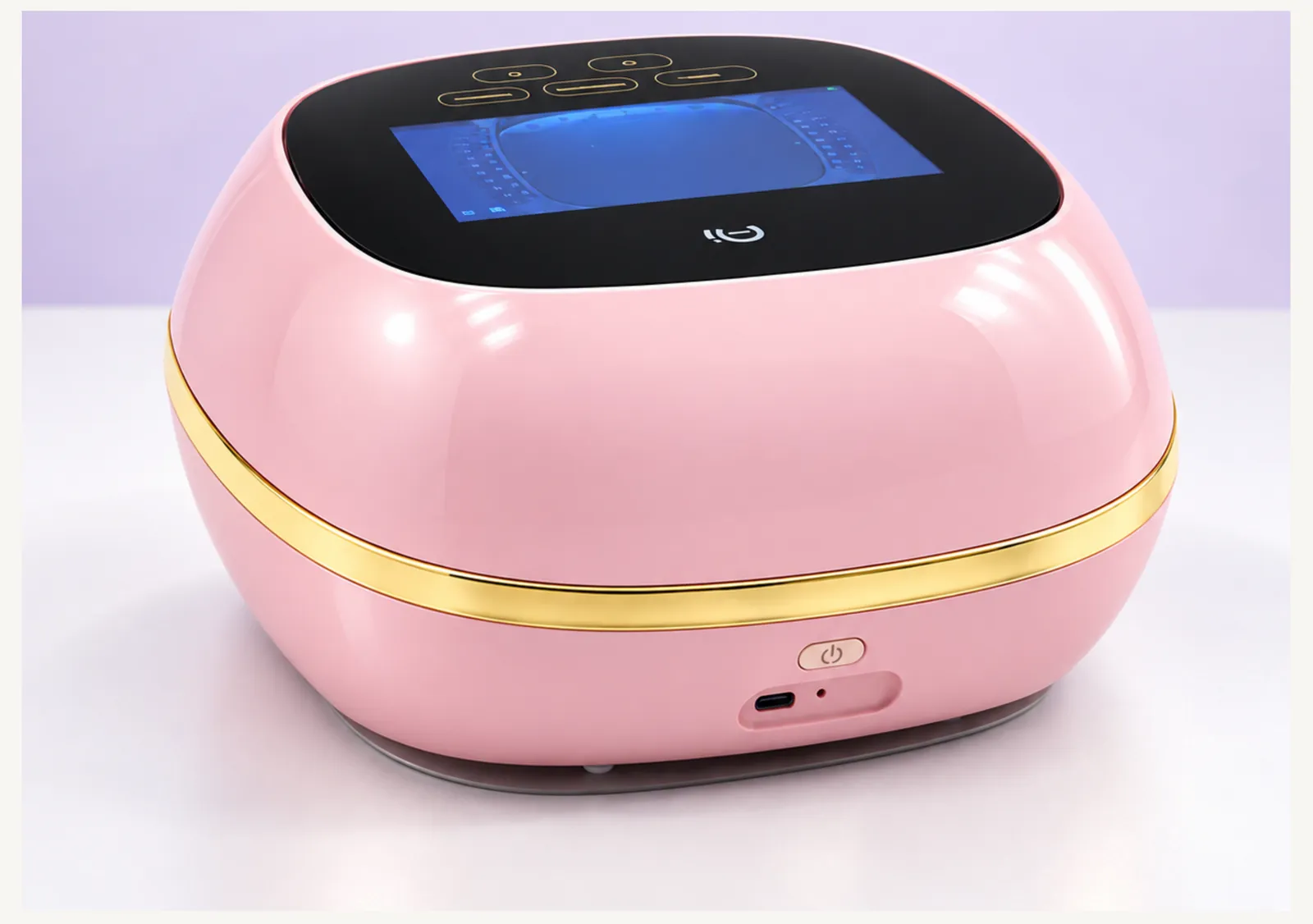
24 × 24 × 11.5 cm with a rear power inlet: the lamp fits a shared bench and the cable leaves on the technician’s side.
The classroom circuit is a specification too
Fifteen lamps on one ring main is the most common installation mistake in a training room, and it is not a lamp problem. Read the nameplate current, multiply by the number of units, and keep the total under roughly 80 percent of the breaker rating. A 16 A circuit at 230 V is nominally 3,680 W; a 15 A circuit at 120 V is nominally 1,800 W. Do not daisy-chain power strips to reach the back bench, and confirm that the room is protected by an RCD or GFCI.
The same arithmetic decides the spare. One spare lamp per room is enough for a salon and not enough for a school, because a class cannot wait for a repair.
The paper a training provider actually needs
Two documents carry most of the weight. The first is the conformity file: in the EU, the Low Voltage Directive, the EMC Directive and RoHS, with (EU) 2019/1020 requiring an economic operator established in the Union and its details on the product or packaging; in the United States, an FCC Part 15 Subpart B supplier’s declaration for an unintentional radiator. The second is the photobiological safety classification under IEC/EN 62471, together with the minimum distance and use conditions printed in the manual.
The second one matters more in a school than in a salon. A training room can have fifteen lamps running at once, with students leaning in to watch, for six hours. Whatever the classification says, the practical questions are the same: what is the stated safety distance, how long is a person expected to be at that distance, and what does the manual tell a supervisor to do. Keep the classification in the technical file and give the school a one-page classroom statement covering units per circuit, cleaning interval and expected lamp hours.
How an academy actually buys
The sequence is predictable. One evaluation unit first, run for a term on the worst bench in the building. Then neutral white-label units from 3–5 pieces to equip a second room, which is also the point where a school discovers whether it wants its own logo on the front. Then a custom-branded fleet from 300–500 units across sites, with the academy’s mark on the shell, a locked language pack and a retail box that matches the prospectus.
Two commercial details are worth putting on the quotation. Standard units ship AC-powered without a battery; a 6,000 mAh battery version is available on request, which is what a mobile training program or an exam roadshow needs. And ask for a small teaching set of cured samples — thin, thick, dark — so the class can see an under-cured tip next to a correct one before a paying client ever does.
A school that trains on a lamp for three years is not buying hardware. It is publishing a recommendation to every graduate who opens a studio, and that is the account a distributor should be chasing in every city where there is a licensing program.
Quick FAQ
Can we run fifteen lamps on one classroom circuit?
Will students damage the vision system?
Do beginners need a different lamp from professionals?
Next step
Tell us the size of your bench, the voltage and circuit layout of the room, and the languages your cohorts need, and we will send a classroom specification sheet, the conformity and photobiological documents, and a quotation for an evaluation unit plus a term-two fleet. Contact Miro Wu, Dedicated Account Manager — email miro.wu@beautome.com or WhatsApp +86 188 1393 3019.
Related: what the vision layer sees and misses, how the curing principle compares across lamp types, heat spikes in thick gels, and the OEM/ODM process for academy-branded fleets.