







How Many AI Smart Nail Lamps Does a Salon Need?
Almost every lamp enquiry starts the same way: send a sample, we will test it. Very few start with the question that decides the order — how many units does this floor actually need? The answer is not one per technician, and it is not one per chair either. It comes from three numbers a buyer can calculate before seeing any demo: lamp-minutes per client, the shape of the peak day, and the electrical capacity of the room.
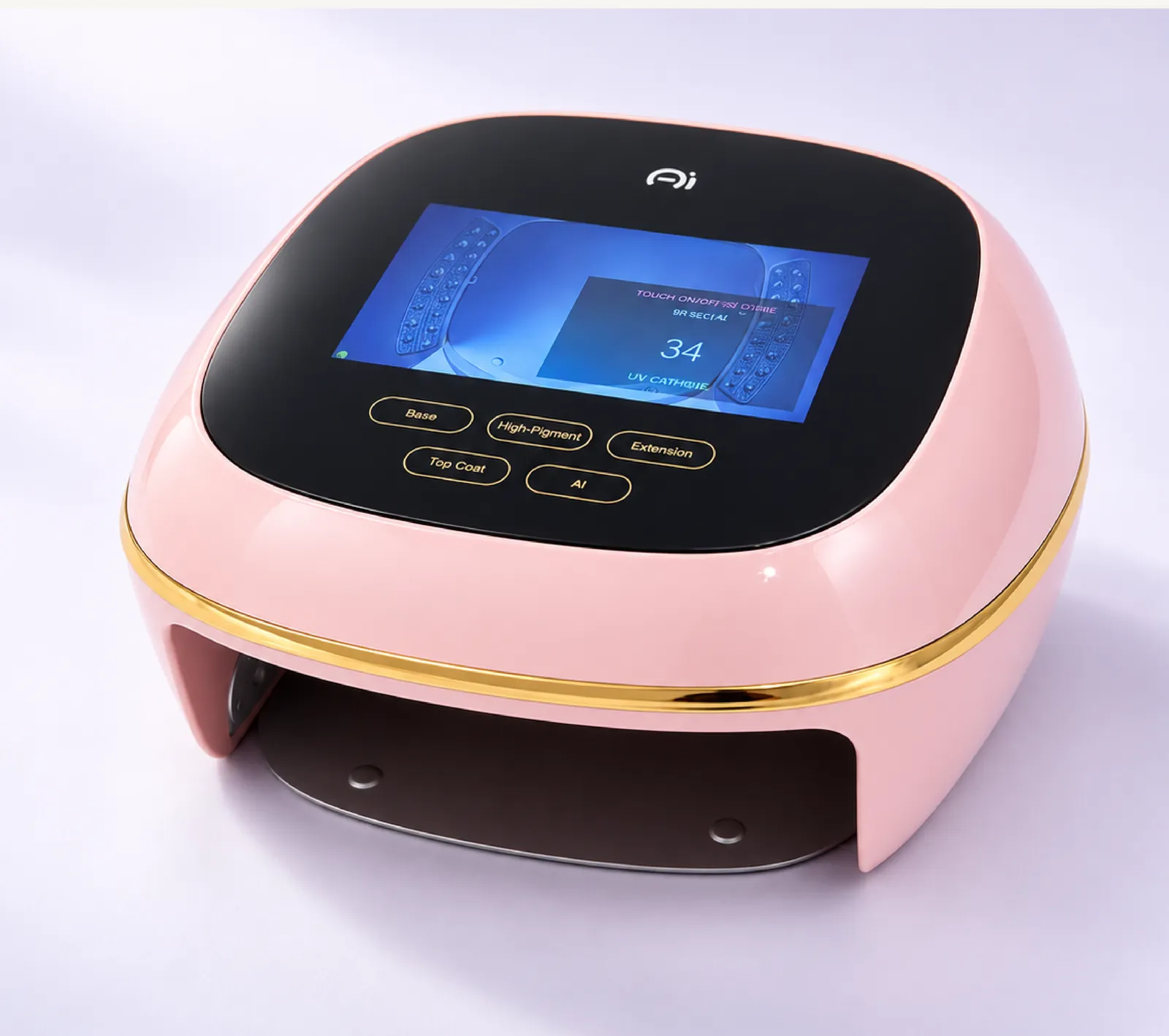
A single unit occupies 24 × 24 cm of bench and takes its power from the wall — two facts that decide far more about the order than the catalog does.
Start with lamp-minutes, not with chairs
A standard single-color gel service runs four to five cure cycles: base coat, two color coats, top coat, and often a thin builder layer underneath. At 30–60 seconds per cycle per hand, that is roughly 5 to 10 minutes of lamp time per client — two and a half to five minutes per hand. In a 60 to 90 minute appointment, the lamp is occupied for about a tenth of the visit.
That ratio is why one lamp per station has been the default for fifteen years. The technician preps one hand while the other cures, and the lamp is never the constraint. Any supplier who tells you a smart lamp changes that arithmetic by curing faster is selling you a number that does not exist: the cure time is set by the gel chemistry and the photoinitiator system, not by the lamp’s marketing. What a vision-assisted unit changes is rework — misplaced hands, partially cured sidewalls, a smile line cured at the wrong distance — and rework is where the lamp-minutes actually multiply.
So the first calculation is not “how fast” but “how often does this floor repeat a cure”. A studio doing mostly natural nail color will run the low end. A studio doing extensions, overlays and repair work will run the high end, because every rebuild adds cycles, and a rebuild that has to be redone adds them twice.
4–5
Cure cycles in a single-color gel set: base, two color coats, top — the unit of lamp demand
5–10 min
Lamp time per client, both hands, at 30–60 seconds per cycle
1 : 4–6
Spare units per working units — the ratio that keeps a peak Saturday from losing a chair
Then look at the shape of the peak, not the average
Averages hide the only thing that matters. A six-station salon booking thirty clients on a Saturday does not need six lamps because six technicians are working; it needs six lamps because six hands are curing at the same minute, and a seventh because one will fail on the busiest day of the week.
Three operating patterns push a floor past one lamp per station:
Four-hand service. Two technicians on one client — common in premium studios doing extensions — means two lamps running simultaneously at the same station, not one lamp shared.
A rebuild station. If the salon has a dedicated desk for repairs, refills and removal-plus-rebuild, that desk consumes more lamp time than any other. It is the first place a second unit pays for itself, because a rebuild that waits for a lamp is a client watching the clock.
Back-to-back peak blocks. When appointments are scheduled every 60 minutes with no buffer, a single failed cure does not delay one client, it delays the rest of the day. That is a capacity problem disguised as a quality problem, and the cheapest fix is a spare unit rather than a longer appointment slot.
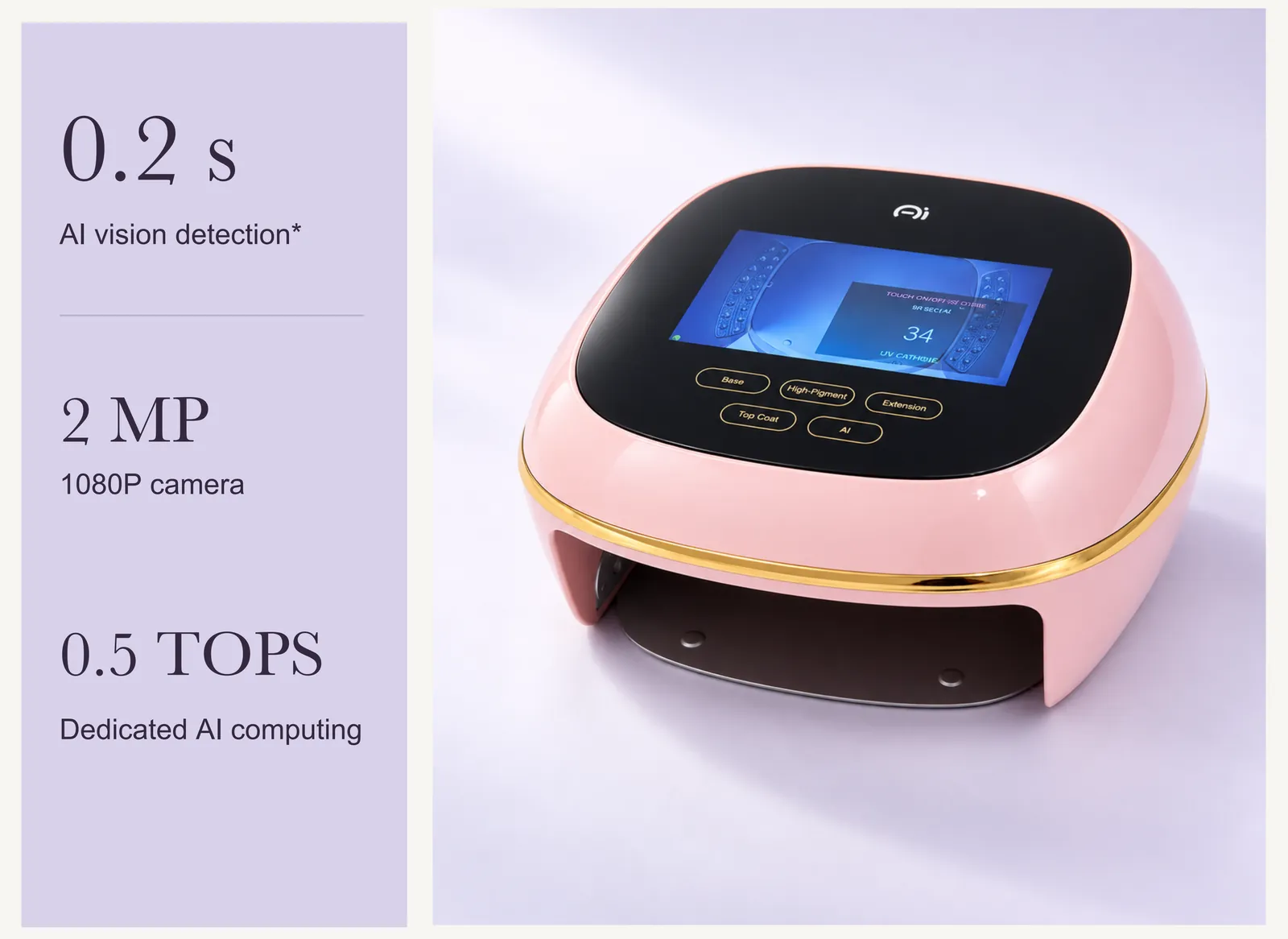
Vision detection does not shorten the cure — it shortens the rework. That is the number to count when sizing a floor.
The consequence nobody plans for: no battery means an outlet per lamp
The standard configuration of this lamp is AC powered, with no internal battery. The 6,000 mAh pack is an option, requested per order. That single specification turns a furniture question into an electrical one, and it is where most first orders go wrong.
Count outlets, not extensions. The power inlet sits at the rear of the 24 × 24 × 11.5 cm housing, so the socket has to be behind the bench, not under the client’s side of it. A four-station room with one lamp each plus a spare needs five outlets within cord reach, and a daisy-chained power strip is not a plan — it is the item an electrical inspector writes up.
Then do the load arithmetic the way an electrician would. On a 120 V, 15 A circuit the usable continuous load is about 1,440 W after the 80% rule; on 230 V, 16 A it is roughly 2,900 W. Lamps alone rarely approach that. Lamps plus a towel warmer, a dust extractor, a dryer and a ring light does. Add the nameplate current of every unit on the circuit, divide by the breaker rating, and keep the result under 80%. If the answer is above that, the order is not eight lamps — it is six lamps and a second circuit.
This is also the argument for the battery option in specific cases rather than as a default: mobile and event work, a station added for a seasonal peak, a room where the outlet is on the wrong wall. For a fixed salon bench, a corded unit with a proper outlet is the more reliable configuration, and it is cheaper per unit.
Language and console count as capacity too
A 5.5-inch console running 29 languages is not a feature list item on a multi-station floor; it is a staffing variable. In a salon where technicians rotate between rooms and shifts, a console locked to the language of the shift removes the two minutes per client that disappear into menu-hunting. Ask for the language to be set at the factory per unit, not changed per user, and write the required language into the purchase order line by line. The same applies to the vision feedback: a visible “hand not detected” prompt is worth more at 6 pm on a Saturday than any specification on a datasheet.
A worked example
Six stations, five technicians, one rebuild desk, Saturday peak of thirty clients, 230 V market.
Working lamps: six, one per station. Rebuild desk: one more, because that desk runs double cycles. Spare: one, which brings the floor to eight units for six stations — a ratio of roughly 1 : 4 on working units, and the ratio most chains settle on after their first failure on a peak day. Outlets: eight, all behind the benches. Circuit check: sum the nameplate current, confirm under 80% of each breaker, and split the room across two circuits if the towel warmer shares the run.
That is the order. Not eight because eight sounds safe, and not six because six stations exist — eight because the arithmetic produces eight, and because a spare is cheaper than an empty chair.
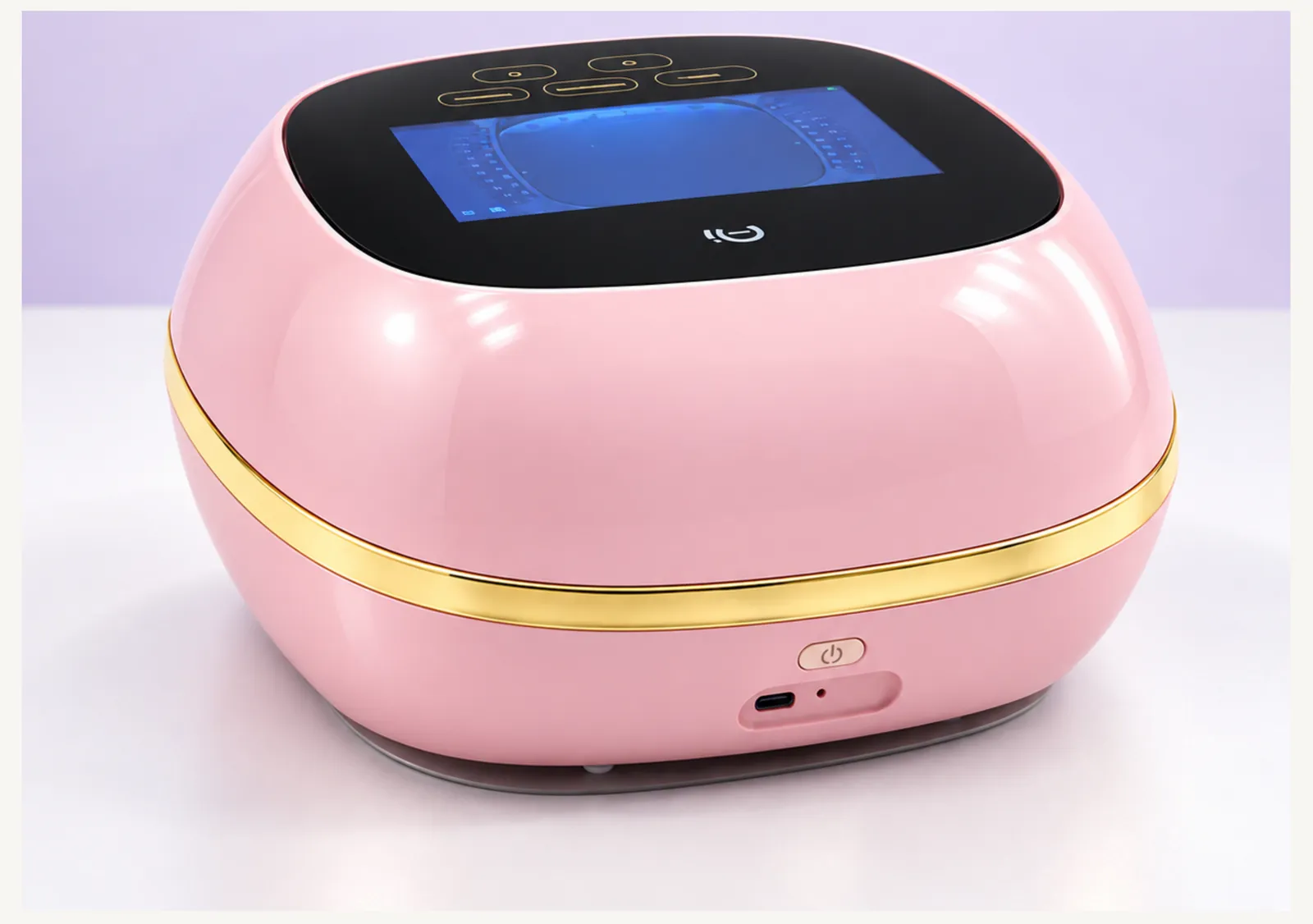
Rear cable entry, compact footprint, optional battery: three details that decide where the unit can physically go on an existing bench.
What to write into the purchase order
Size first, then specify. The purchase order should carry the unit count with its spare ratio, the outlet and circuit plan, the console language per unit, the cord and plug standard for the destination, and a spare-parts quantity that covers the parts a technician touches first. On our side, neutral white-label units can ship in small evaluation quantities — three to five units, with a single unit available as a sample — while a fully branded program with logo, colorway and retail packaging starts at 300 to 500 units.
For buyers who want the technical layer behind the number, the AI Smart Nail Lamp product page carries the full specification, and the OEM/ODM program explains what can and cannot change on an existing mold.
Quick FAQ
Is one lamp per technician enough?
Does the battery option change how many units I need?
How do I calculate the electrical load for a room of lamps?
Next step
Send us your station count, your peak-day booking pattern and your market’s voltage and plug standard, and we will return a sizing sheet: units, spare ratio, outlet plan and the circuit arithmetic for your room. Contact Miro Wu, Dedicated Account Manager — email miro.wu@beautome.com or WhatsApp +86 188 1393 3019.
Related: the curing principle compared with conventional UV/LED lamps, the full product range, and our guide to buyer topics for distributors.