







Hard Wax for Southeast Asian Barbershop Chains: When Male Grooming Adds a Wax Menu
The fastest route to male waxing in Southeast Asia is not a waxing salon. It is a barbershop chain that already has the chair, the booking app, the walk-in traffic and a customer who has been trained to come back every three weeks. Adding a wax menu to that machine is a smaller step than opening a wax bar — and it changes what a wax supplier has to deliver: two working temperatures, three pack sizes and a label that can wait.
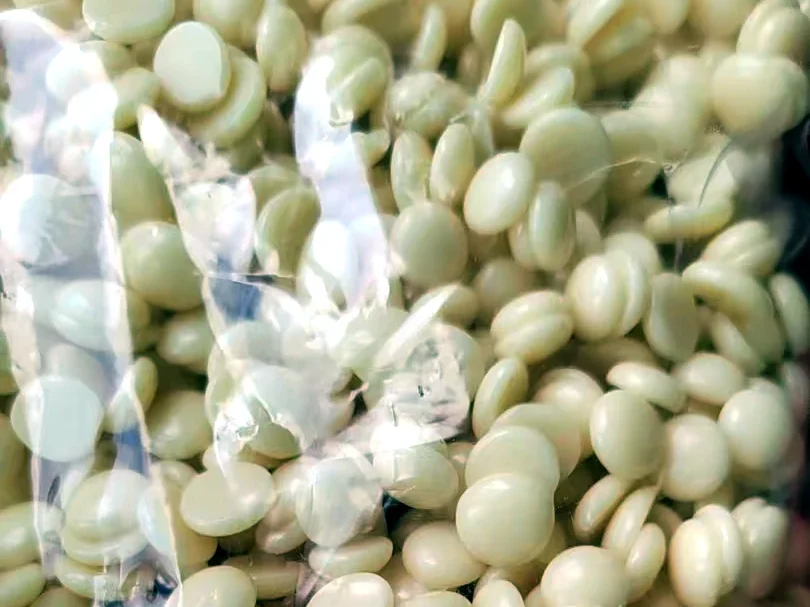
Formula A2 cream white beads — the flexibility formula that carries back and chest work in a barbershop setting.
The demand is being built by barbershops, not by wax bars
Two markets in the region show the pattern clearly. Vietnam’s men’s grooming market is put at about USD 640 million in 2026, rising to roughly USD 1,050 million by 2032 at 8.6% a year, with barbershop chains in Ho Chi Minh City and Hanoi having turned regular grooming into a social habit for younger men (Mobility Foresights, 2026). Thailand is larger and slightly faster: USD 780 million in 2026 to about USD 1,300 million by 2032, 8.9% a year, with body hair removal explicitly noted as growing among younger men (same source).
What makes this relevant to a wax supplier is the operating model behind those numbers. Chains standardize: fixed prices, app booking, trained staff, and a retail shelf by the door. 30Shine had more than 80 salons by 2023 on exactly that model, and East West Barbershop — founded in 2018 — now describes a network of more than 130 locations across Vietnam, Thailand, China, Uzbekistan and Europe with over 1,000 barbers, and announced international franchising as its next phase in September 2026 (company statements, 2026). A chain that already runs a standardized service script can add a wax service to it far faster than an independent salon can invent one.
The regional context supports it: Asia-Pacific is the largest region for male depilatory wax, at about 36.5% of global share in 2025 (Dataintelo, 2025). The buyer in front of you is therefore not a waxing specialist. It is an operations manager asking three questions: how long does the service take, what does it cost per client, and can a barber learn it in a week.
Why the barber chair converts better than the nail bar
Three structural advantages, and each one maps to a product decision. The client is already in the chair. A haircut every three weeks produces a predictable calendar slot; a back wax added to it is an attachment sale, not a new customer acquisition. The service is short and visible. Back, chest, shoulders, ears and nose are large, flat, fast areas — unlike intimate waxing, they do not require a private room, a second staff member or a change in store layout. The staff are already trained to sell. Barbers upsell styling product at the counter all day; a wax menu is one more line on the same card.
The constraint is the opposite of a wax bar’s: a barbershop has one back room, one sink and no space for a dedicated wax trolley. That is why the format that wins is a small, closed, two-temperature station rather than a full waxing setup — and why the supplier who can deliver two pots in a compact footprint wins the account.
Which formula for which service
Barbershop menus split into four jobs, and each has a different formula requirement. Getting this right is most of the technical sale:
Back and chest — Formula A2, premium rosin, cream white. Large areas of short, dense hair need elasticity rather than low temperature: the strip has to grip and release cleanly across a broad surface without breaking. A2 is the workhorse of male body waxing for exactly this reason. First-time clients, sensitive skin and intimate areas — Formula A1, rosin-free, in a 45–50 °C working window. Rosin-free chemistry and the lower window are what let a barber take a nervous first-timer through a Brazilian or an intimate service without a bad experience becoming a review. Standard colors are Gold and Pink; White is a custom color produced to order, so it belongs in a second phase, not the opening order.
Legs and arms, volume work — the consumer-grade hard wax at 55–60 °C. A film wax that sets fast and comes off without strips is the easiest thing to teach a barber who has never waxed, and it is the service that fills quiet weekday hours. Clients who prefer strips — the all-purpose soft wax in 450 g cans. Keep it as a menu option, not as the default: soft wax needs strips, a second pot and a different technique, which is a training cost a chain will only absorb if the demand is already there.
8.6%
Vietnam men’s grooming CAGR 2026–2032, USD 640M to about USD 1,050M (Mobility Foresights, 2026)
130+
Locations described by East West Barbershop across five markets, with 1,000+ barbers (company, 2026)
36.5%
Asia-Pacific share of global male depilatory wax in 2025 (Dataintelo)
Two working temperatures means two pots — and that is the equipment sale
A 45–50 °C rosin-free formula and a 55–60 °C film wax cannot share a setting. In a barbershop this is not a technicality; it is the difference between a barber switching wax mid-service and a barber refusing to offer the second service at all. The configuration that fits a back room is a double-pot station — two chambers on one base, typically 400 ml and 800 ml — or two single pots if the room has the counter space.
Size the pots off the fill, not the catalog: a 450 ml pot takes roughly 400 g of beads, which is about one technician’s day on a mixed menu. Back and chest work draws more wax per service than legs, so an 800 ml chamber at the back bar is not oversized — it is what prevents a refill in the middle of a two-hour booking block.
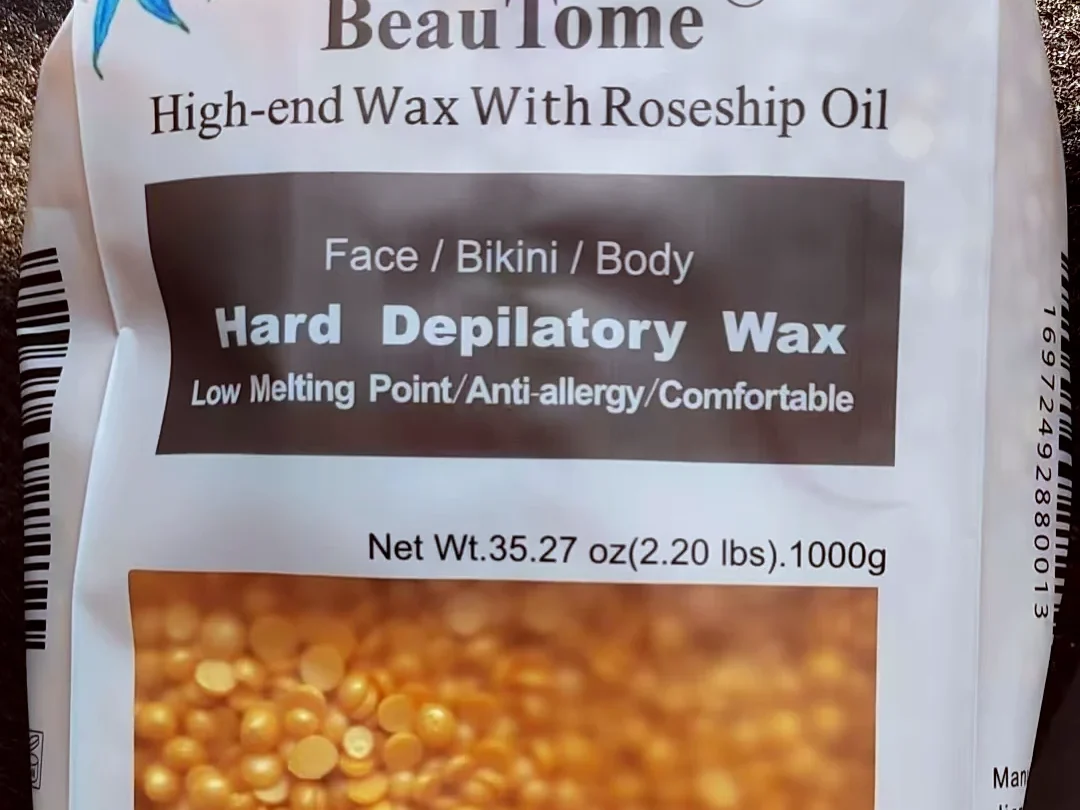
Formula A1, rosin-free, in a 45–50 °C window — the formula a chain uses to take a first-time client through an intimate service.
Three pack sizes, three jobs
A chain does not buy one format. 300 g is the satellite and kiosk format: one pot, one technician, one day, and small enough that a new store can open a menu without tying up capital. 500 g is the store standard — two weeks of a mid-volume service at roughly 50 g per client. 1,000 g belongs to the back bar of a high-traffic flagship, where the pot is refilled several times a week; in a small room it is an oxidation problem, because an opened bag sitting at 30 °C for a month is not the same product it was on arrival.
Which brings the storage note that matters most in this region: recommend 15–24 °C, dry and out of direct light, and let cartons acclimate before opening. A bag that has traveled through a 38 °C container and is opened immediately in an air-conditioned room will condense moisture onto the beads — and moisture in a hot wax is a spitting pot and an inconsistent film.
The transparent bag in a franchise system
Franchise brands change their artwork more often than they change their formulas: a new store format, a co-branded promotion, a market-specific claim. That is precisely the case for the unlabeled transparent bag. The factory prints only the batch number and production date on the seal; the bag carries no brand and no artwork; the chain’s label is applied locally, in the market, by the party responsible for it. Because there is no printing to order, a private-label run carries a low MOQ with no printing lead time, and the artwork decision moves to after the assortment is proven rather than before the first order.
Two disciplines keep it honest. Trace the batch from bag seal to store, so a complaint in one outlet can be tied to a production run instead of a rumor. And treat the bag as packaging, never as a compliance shortcut — the label is still a legal document.
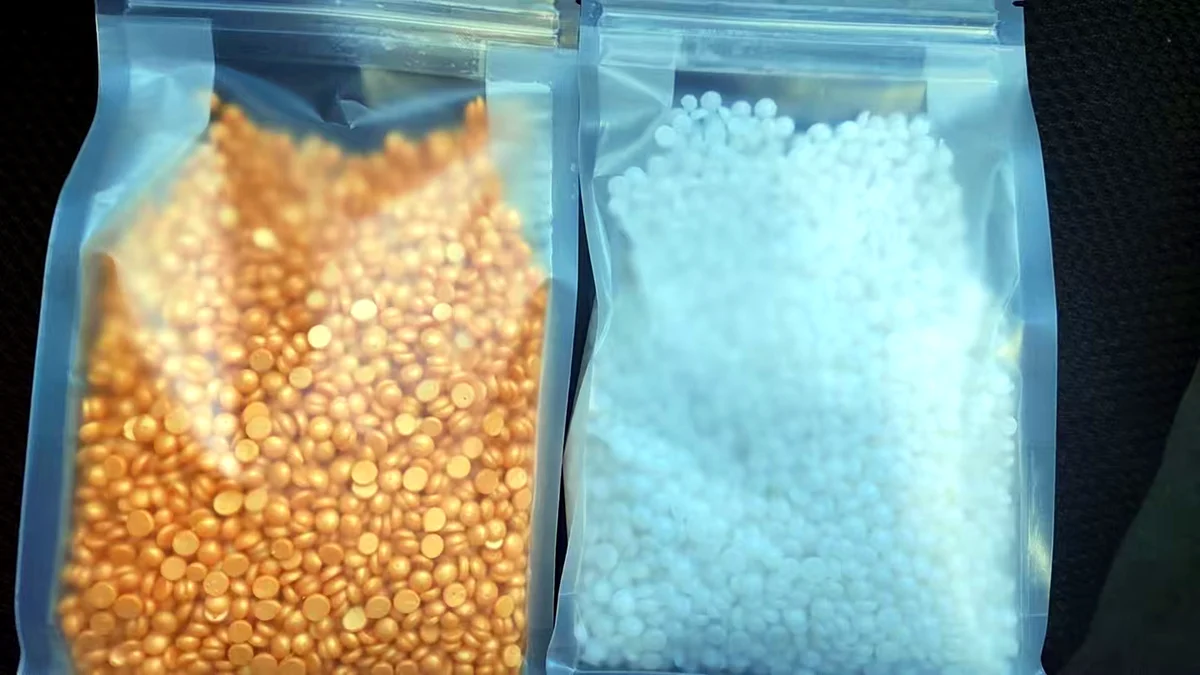
Unlabeled transparent bags with gold and white beads — the format a franchise uses to move the artwork decision after the assortment decision.
Compliance is per country, not per region
There is no ASEAN mutual recognition for cosmetic notifications, so a chain operating in three countries faces three files. Indonesia runs BPOM notification, and since October 2026 halal certification for cosmetics has become mandatory under the UU 33/2014 and PP 42/2024 framework — a separate track from BPOM, with the certificate issued per product and per manufacturing site, which we covered in detail in the halal file article. Thailand runs Thai FDA notification. Vietnam requires a product notification under Circular 06/2011/TT-BYT as amended by Circular 34/2025/TT-BYT, which took effect in August 2025, with a Vietnamese legal entity as the responsible party. Malaysia runs NPRA notification, and halal claims there fall under trade description law. The Philippines runs FDA notification.
For each market the practical questions are the same: who is the local responsible party, how long is the notification valid, what language must the label carry, and what changes require a re-notification. Ask your importer to confirm in writing before artwork goes to print — and note that a formula change or a new claim is a new filing in every one of these systems.
Quick FAQ
Which single formula should a barbershop chain start with?
How much wax does a back and chest service use?
Can a chain use one label across Vietnam, Thailand and Indonesia?
Next step
Tell us which markets your chain operates in, which services are on the menu and how many stores are opening this year, and we will send a starter assortment with pack sizes, pot configuration and the label master for your franchise brand. Contact Miro Wu, Dedicated Account Manager — email miro.wu@beautome.com or WhatsApp +86 188 1393 3019.
Related: the full formula range, the halal and notification file for Indonesia and Malaysia, and the double-pot stations that let one room run two working temperatures.