







The AI Smart Nail Lamp Margin Ladder: From One Sample to a Container
A distributor does not really buy lamps — they buy a margin structure. The question is not “what does one unit cost” but “what does each rung of the commercial ladder protect, and what turns a pilot order into a repeat container.” This brief walks the three rungs we run for the AI Smart Nail Lamp — single evaluation unit, white-label fleet, full custom branding — and the specification lines that decide whether your margin survives the first price comparison a buyer puts in front of you.
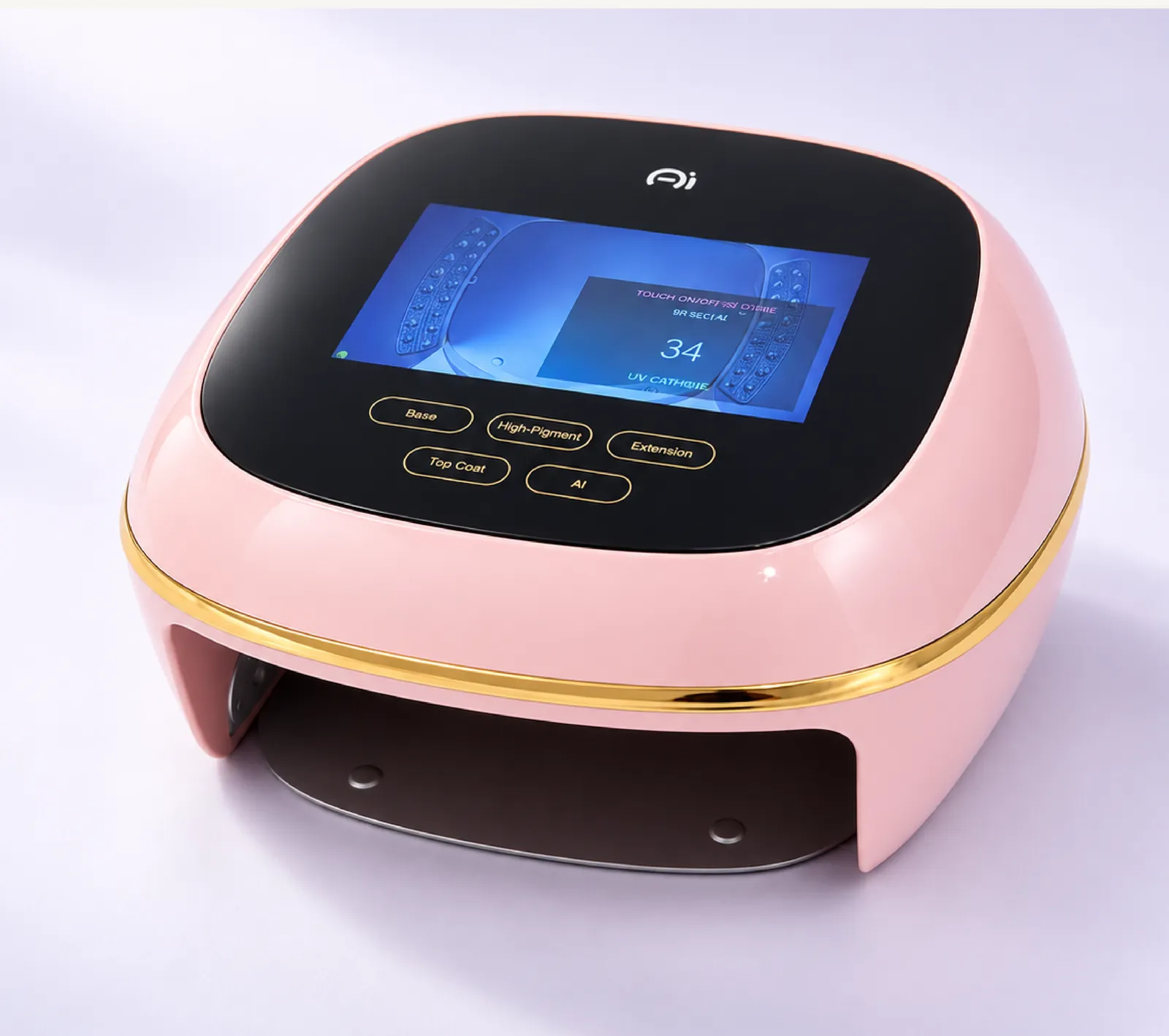
The same machine sits at every rung of the ladder — what changes is the brand, the box and the volume.
A category that pays for differentiation
The commercial backdrop is simple: nail care is one of the few beauty categories still compounding. The global nail care products market was valued at USD 23.5 billion in 2025 and is projected to reach USD 46.2 billion by 2035 at a 7.1% CAGR (Global Market Insights, 2026). Two details in the same research matter to a distributor choosing which hardware to carry: Middle East and Africa is the fastest-growing region in the forecast, and the men’s segment is projected at a 19.3% CAGR through 2035 — new buyers entering salons that were not there five years ago.
Growth like that attracts hardware. It also attracts commodity pricing: every quarter, cheaper lamps with bigger printed numbers arrive on the same trade-show shelves. The distributors who hold margin are not the ones with the lowest unit price — they are the ones whose product does something a buyer can demonstrate in ninety seconds and defend in a tender file.
USD 23.5B
Global nail care products market, 2025 (Global Market Insights, 2026)
7.1%
Forecast CAGR to USD 46.2B by 2035; MEA is the fastest-growing region (GMI, 2026)
19.3%
Projected CAGR of the men’s nail care segment through 2035 (GMI, 2026)
Three rungs, one machine
The commercial ladder we run has three rungs, and each one maps to a stage of the distributor’s own sales process:
Rung one — the evaluation unit. A single machine ships at sample terms. It exists to be demonstrated: the 2 MP camera locates the nail in about 0.2 seconds, and the console shows the detection happening live. That demo — light following the nail instead of flooding the finger — is the single most persuasive ninety seconds in the category, and it is why we let distributors start with one unit rather than asking for a container commitment first.
Rung two — white-label, unbranded units from three to five pieces. This is the pilot fleet: enough machines for the distributor’s demo counter, a first salon installation and a house spare, with no branding commitment. Unlabeled units also let a distributor test two different salon segments — say, a premium studio and a high-volume express bar — before deciding where the brand story goes.
Rung three — full custom branding from 300–500 units. Logo, colorway and retail packaging matched to the distributor’s brand book, on the same hardware and firmware as the evaluation unit. At this rung the machine stops competing on spec sheets and starts competing as a product line: your brand, your languages, your box.
Standard configuration ships AC-powered without a battery; a 6,000 mAh battery version is available on request. That is not a footnote — it is a freight decision. An AC appliance moves as ordinary general cargo; a lithium battery version can change transport handling and customs paperwork in many lanes. Decide the battery question before the quotation, not at the port.
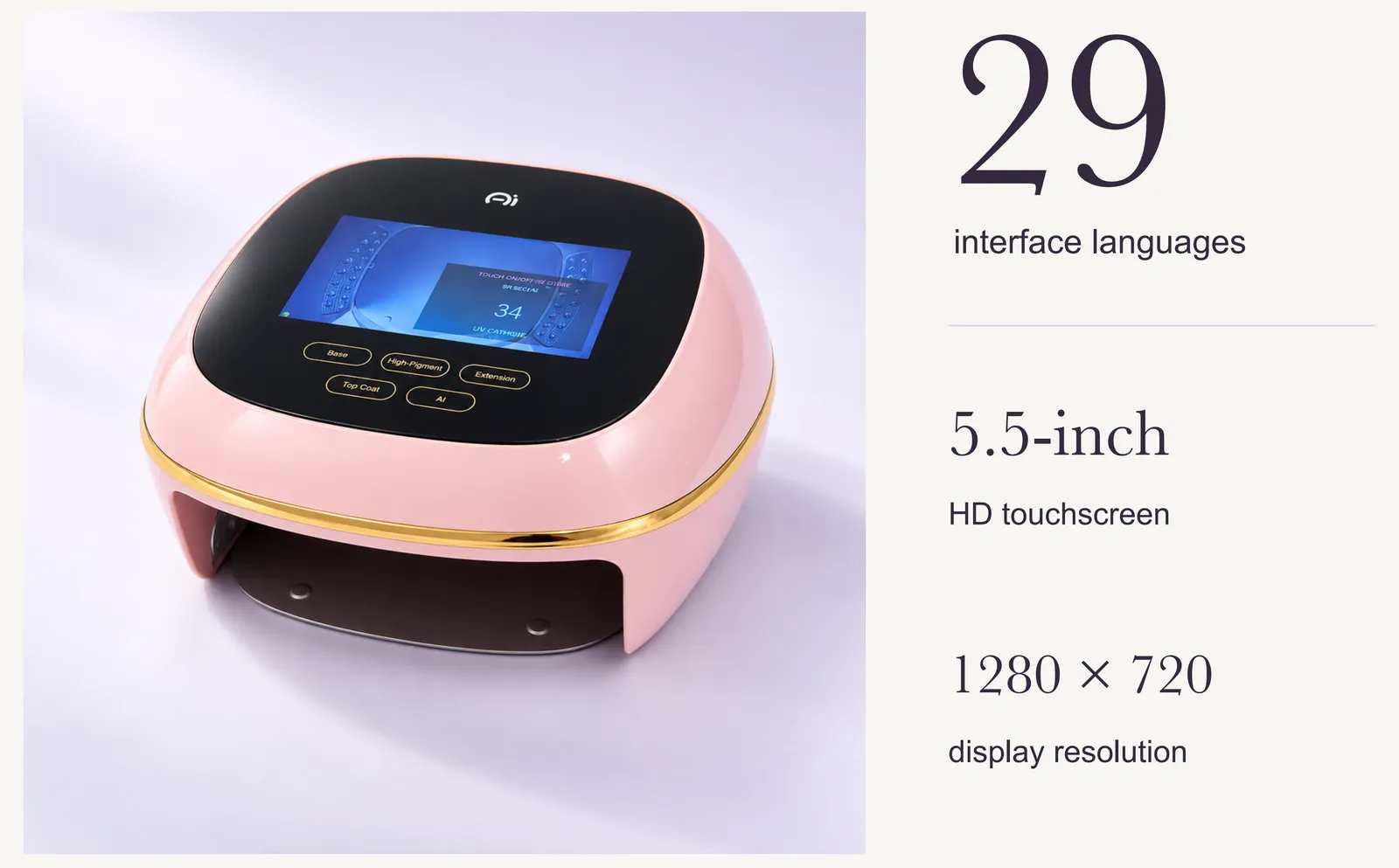
The 29-language console is the demo that closes: every market you sell into sees its own menu.
What actually defends the margin
When a salon buyer puts a cheaper basic lamp next to yours, the comparison is not decided by diode counts — it is decided by four things a basic lamp cannot copy quickly:
The vision demo. Camera-guided, zone-by-zone light delivery over the detected nail area. The curing principle itself is the same as every LED gel lamp on the market — LED diodes producing long-wave UVA that sets the gel — and we say so plainly. What the vision layer changes is control: surrounding skin receives far less unnecessary light exposure, and that is a claim a buyer can watch happen, not read about.
The language list. The 5.5-inch console runs 29 languages, locked per order. For a distributor selling across borders, that turns one SKU into a multi-market SKU without retooling.
Thermal behavior and the light-decay warning. Smart heat control keeps a full-day schedule of back-to-back services stable, and the light-decay warning turns the inevitable slow fade of LEDs into a logged maintenance prompt instead of a mid-service failure and a warranty argument. Fewer mystery failures is the quietest margin protector there is.
The conformity file. LVD, EMC and RoHS for the EU, plus the photobiological safety classification under IEC/EN 62471 — the paperwork that decides tenders, retail listings and insurance conversations. Commodity lamps rarely arrive with a complete file, which is exactly why the file is worth margin.
Four lines to demand in every quotation
Before signing a purchase order — ours or anyone’s — get these in writing: the export carton cube and pallet configuration, so container math is real instead of estimated; the exact language list loaded on the console; the conformity file named standard by standard; and spare-parts availability at roughly one set per ten units shipped, because a distributor who can service in-country is a distributor whose brand reputation compounds instead of eroding.
Quick FAQ
Can we start white-label and add our brand later?
Is the battery version the standard configuration?
A competitor quotes a cheaper basic lamp. What keeps our margin?
Next step
Tell us your markets and your target price band, and we will return the three-rung quotation — evaluation unit, white-label pilot, custom-branding volume — with the conformity file attached. Contact Miro Wu, Dedicated Account Manager — email miro.wu@beautome.com or WhatsApp +86 188 1393 3019.
Related: the AI Smart Nail Lamp product page, the OEM/ODM process, sample units and customization MOQs, and the full article index.