







AI Smart Nail Lamp Private Label for Spanish Distributors: Six Gates to a First Pallet
Spain counts 7,915 nail salons, and more than four out of five are single-owner businesses. That shape decides how a private label actually gets sold here: not through a tender, but through a distributor who needs a lamp that carries his brand, a Spanish manual, and a story his dealers can repeat in one sentence. The factory side of that order is short. The six gates between a sample and a first pallet are what stretch it — and each one is cheaper to close before artwork than after.
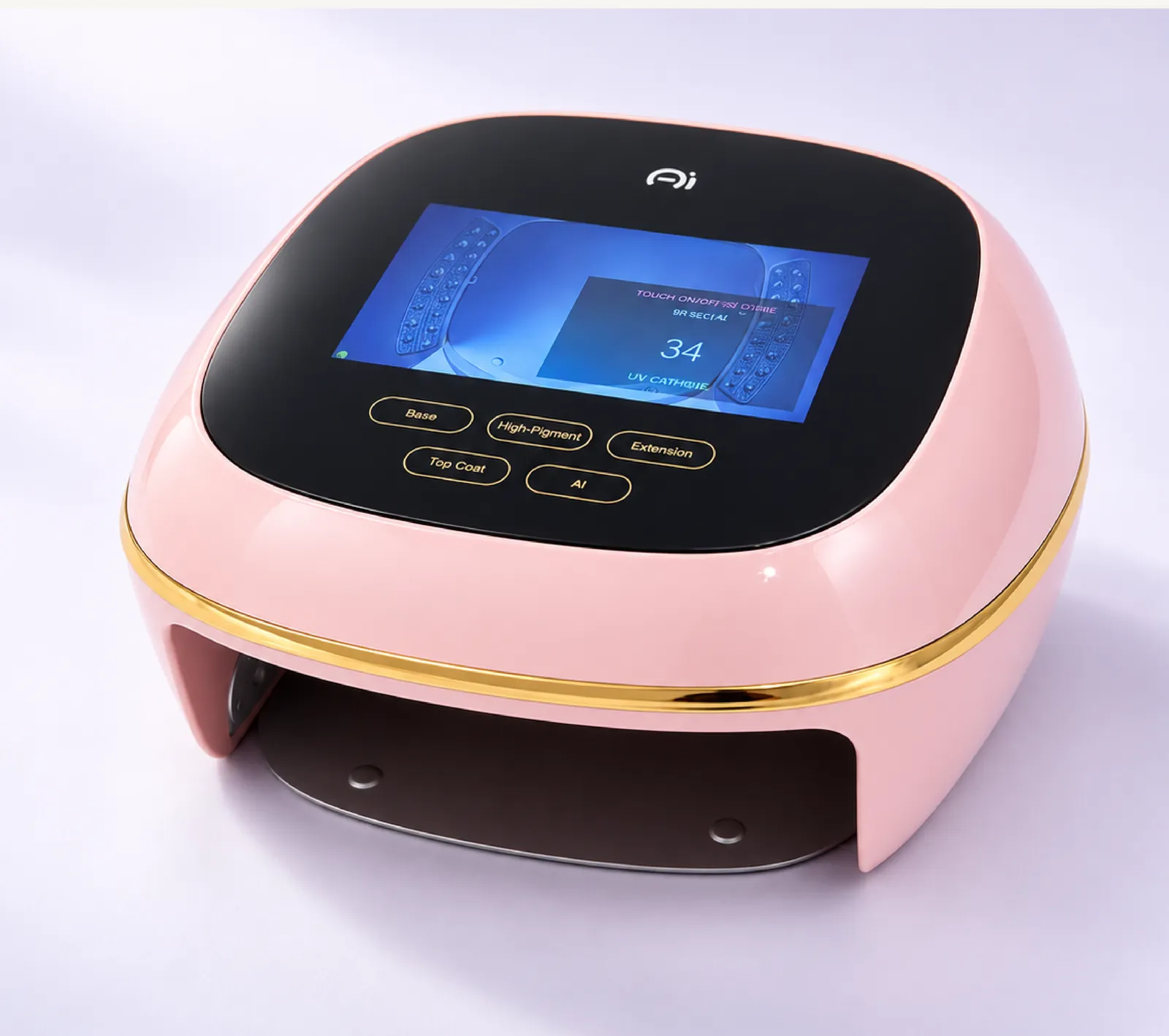
The housing is fixed tooling. Everything a Spanish distributor sells around it — brand, language, cord, box, documents — is decided in the first three weeks.
A market of owner-operators, reached through distributors
A company-registry style count put Spain at 7,915 nail salons as of 1 April 2026, up 3.15% from 2023, with 82.08% single-owner operations and an average business age of four years and eight months (Rentech Digital, 2026). Catalonia holds 1,832 of them, Andalusia 1,325 and the Community of Madrid 522 — three regions that together account for almost half the country.
The money sits in the professional channel. IndexBox’s 2026 reading of Spanish nail care puts salon and professional use at 40–45% of category value, with gel systems still taking share on durability, and nail art the fastest-growing end use at 9–11% a year. Domestic manufacturing is limited relative to consumption, so finished goods are imported. For a distributor, that is a market where the lamp is a repeat purchase by studios that replace equipment every few years — and where a branded lamp protects margin in a way an unbranded one cannot.
7,915
Nail salons in Spain, 1 April 2026 — up 3.15% from 2023 (Rentech Digital)
82.08%
Share of Spanish nail salons run by a single owner — one person signs for the equipment
40–45%
Salon and professional share of Spanish nail care value, 2026 (IndexBox)
Gate 1 — the evaluation unit, and the four numbers you write down
A private-label program starts with one unbranded unit, not a container. Our white-label configuration begins at three to five pieces, and a single evaluation unit ships before any commitment, because a distributor cannot sell a lamp he has not put in front of a technician. Put it in the busiest chair for two weeks and record four things, in writing: cure time on the salon’s own gel brand (not ours), the heat peak a client reports on thin nails, the cleaning routine the technician actually follows, and how long it takes her to find the language menu.
Those four numbers become the specification sheet your dealers quote. They are also the only sales argument that survives a Spanish studio owner who has already been shown three cheaper lamps with better-looking cartons.
Gate 2 — decide what the mold will not let you change
The 24 × 24 × 11.5 cm housing is existing tooling. A private-label program can change the shell finish, the logo, the retail box and the language pack; it cannot change the shape of the body without a new mold and a new project. Say this early, because the first artwork brief from a Spanish distributor usually includes a sketch of a slimmer housing.
What genuinely creates a new model is hardware: a different LED count or arrangement, a different screen, a battery build, a different housing. That distinction matters twice — once for the price, and once for the certificate, because a certificate covers a described product. A logo is not a new model. A 6,000 mAh battery version is.
Gate 3 — one document set, one nameplate, one model list
Every artifact has to agree: the rating plate on the housing, the retail box, the invoice, the declaration of conformity and the model list inside the test reports. A private-label lamp is usually the same hardware under a new brand name, which is fine — but the brand and model strings must be identical across all five documents before the first carton is printed.
The electrical file is the standard EU set: Low Voltage Directive 2014/35/EU, EMC Directive 2014/30/EU and RoHS 2011/65/EU, with CE marking. On top of that, Regulation (EU) 2019/1020 requires an economic operator established in the EU, with its name and contact details on the product or its packaging — for a Spanish order that is normally the importer or the brand’s Spanish entity. Instructions and safety information must be in Spanish. None of this is exotic; it is simply the part most often left until the week before shipment.
Gate 4 — the console, the manual and the one-page card
The 5.5-inch console ships in 29 languages and can be locked to Spanish at the factory, which removes a training step from every salon that buys the lamp. Two details are worth settling at this gate: that the on-screen terms match the printed manual word for word — technicians notice when the screen says one thing and page four says another — and that a one-page quick card in Spanish travels in the box. That card is what a distributor’s dealer actually leaves behind after a demo.
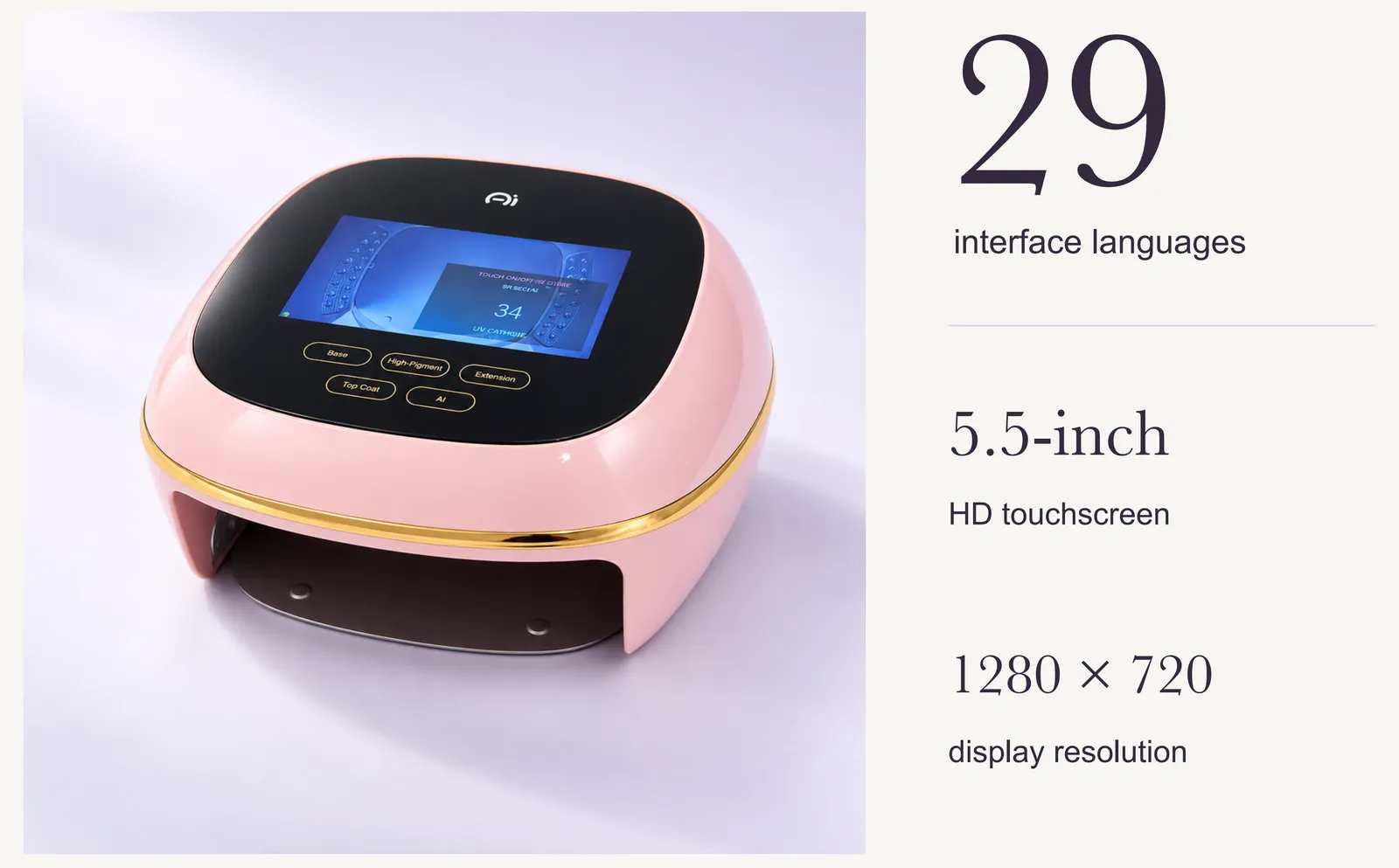
One console, 29 languages, locked at the factory. The language pack is a line on the order, not a setting the salon has to find.
Gate 5 — the cord line and the box are separate decisions
Spain runs 230 V / 50 Hz on type F (Schuko) sockets. The cord should be a moulded type F assembly, specified as its own purchase-order line, with spares at roughly one per ten units. Write the input voltage as a range on the nameplate rather than a single nominal figure, and make sure the test report covers 50 Hz — a report written for a 60 Hz market answers a different question.
The box is where Spanish private label most often gains or loses money. A retail carton carries the brand, the model, the rating information, the warnings in Spanish and — under 2019/1020 — the EU operator’s details. If the same program also sells an optional battery version, that variant needs its own warnings, its own transport documents and, for air freight, UN38.3 test evidence. Standard shipments are AC-powered with no battery; the 6,000 mAh pack is ordered on request and should never be assumed.
Gate 6 — production slot, QC and the pallet
Full custom branding — logo, colorway, retail packaging — starts at 300–500 units. Between the sample and that pallet, a realistic calendar looks like this:
- Week 0: specification frozen, model string and brand string agreed, cord and language lines written into the PO.
- Weeks 1–2: artwork for box and label, checked against the rating plate; EU operator details confirmed by the importer.
- Weeks 3–4: pre-production unit with the final shell finish, final box and locked language pack; distributor signs a golden sample.
- Weeks 5–7: production run, with functional test on every unit and a burn-in sample per batch.
- Week 8: carton marks, pallet configuration, document pack, booking.
Two things slow this down more than anything else: a logo file that arrives as a screenshot, and an importer who has not yet decided who the EU economic operator will be. Both are one email wide, and both cost a week.
What the lamp does in a Spanish studio
The AI Smart Nail Lamp uses a 2 MP camera with 0.5 TOPS of on-board processing to locate the nails in about 0.2 seconds, then drives its 136 dual-band LEDs — 365–370 nm and 395–400 nm — only over the detected zones. The curing principle is the same as any modern gel lamp: LED diodes emitting long-wave UVA to set the product. What differs is control. Because the light lands on the nail instead of flooding the whole hand, the surrounding skin receives far less unnecessary light exposure — the mechanism behind the “dark hands” complaint that long-term gel clients raise.
Smart heat control softens the exotherm spike that makes clients flinch, and the light-decay warning turns a slow output drop into a maintenance prompt rather than a month of under-cured sets. For a market where most studios run one to three chairs, that is the difference between a lamp the owner replaces and a lamp the distributor services.
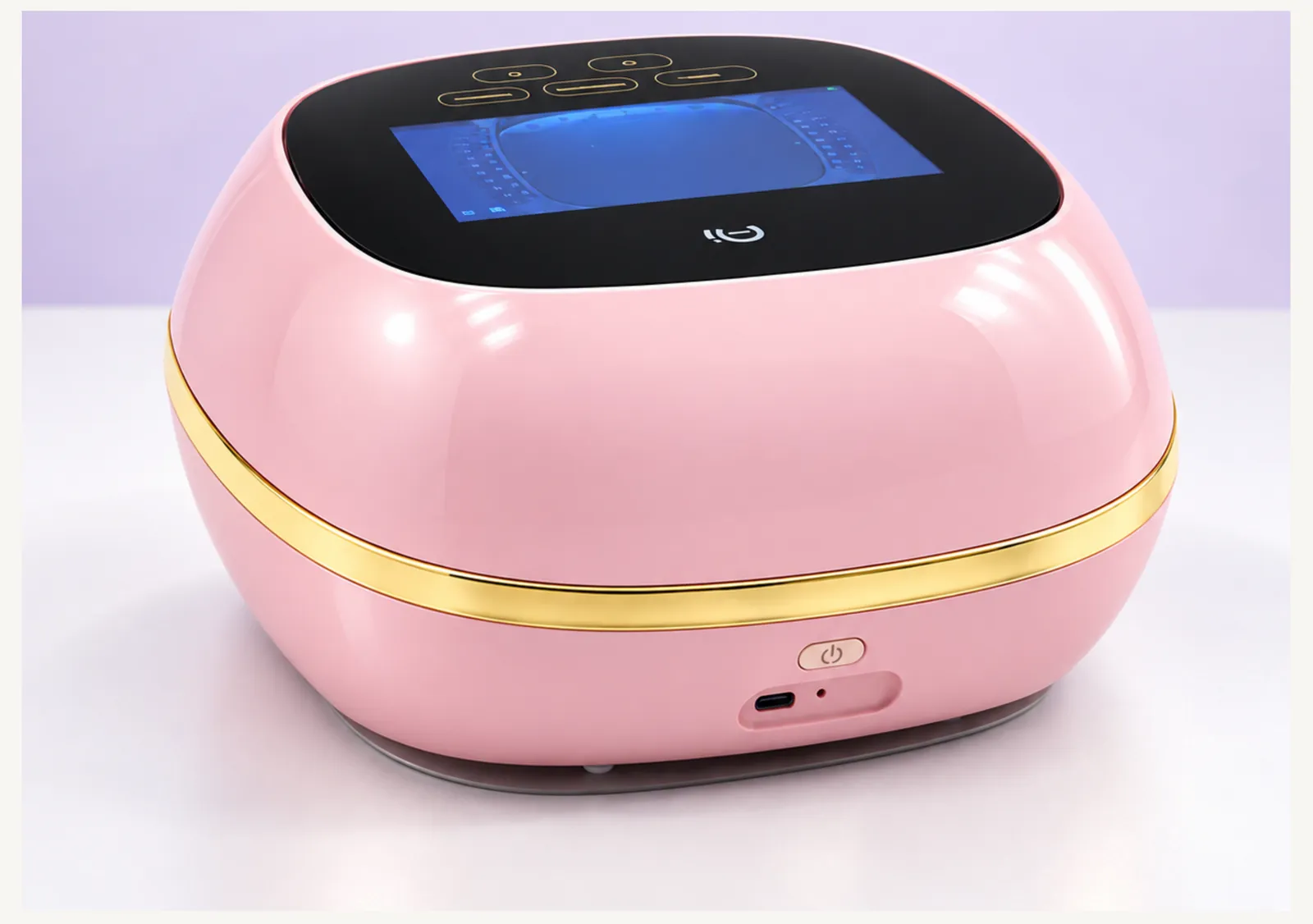
Rear cable entry and a compact footprint suit the small studios that make up most of the Spanish market. The battery build stays optional.
Quick FAQ
Can we start private label with fewer than 300 units?
Does a Spanish brand name change the certificate?
Who is responsible for the EU paperwork on a private-label order?
Next step
Send us the chair count you expect to equip in the first year and whether the program starts as white label or full custom, and we will return a quotation with the six gates priced as line items — including which documents ship with the goods and which belong to your entity. Contact Miro Wu, Dedicated Account Manager — email miro.wu@beautome.com or WhatsApp +86 188 1393 3019.
Related: the AI Smart Nail Lamp specification, the OEM and ODM program, and a parameter-by-parameter comparison you can send to a buying committee.