







What Fails First in an AI Smart Nail Lamp
A distributor’s margin does not disappear on the invoice. It disappears on the return. And the part that fails is almost never the mold or the LED die — it is the fan mat, the camera window, or the cable pulled sideways at the back of the bench. The service plan is written before the first container ships, and it comes down to four decisions: which assemblies are field-replaceable, what sits in the spare kit, how the warranty is worded, and what the salon is taught on delivery day.
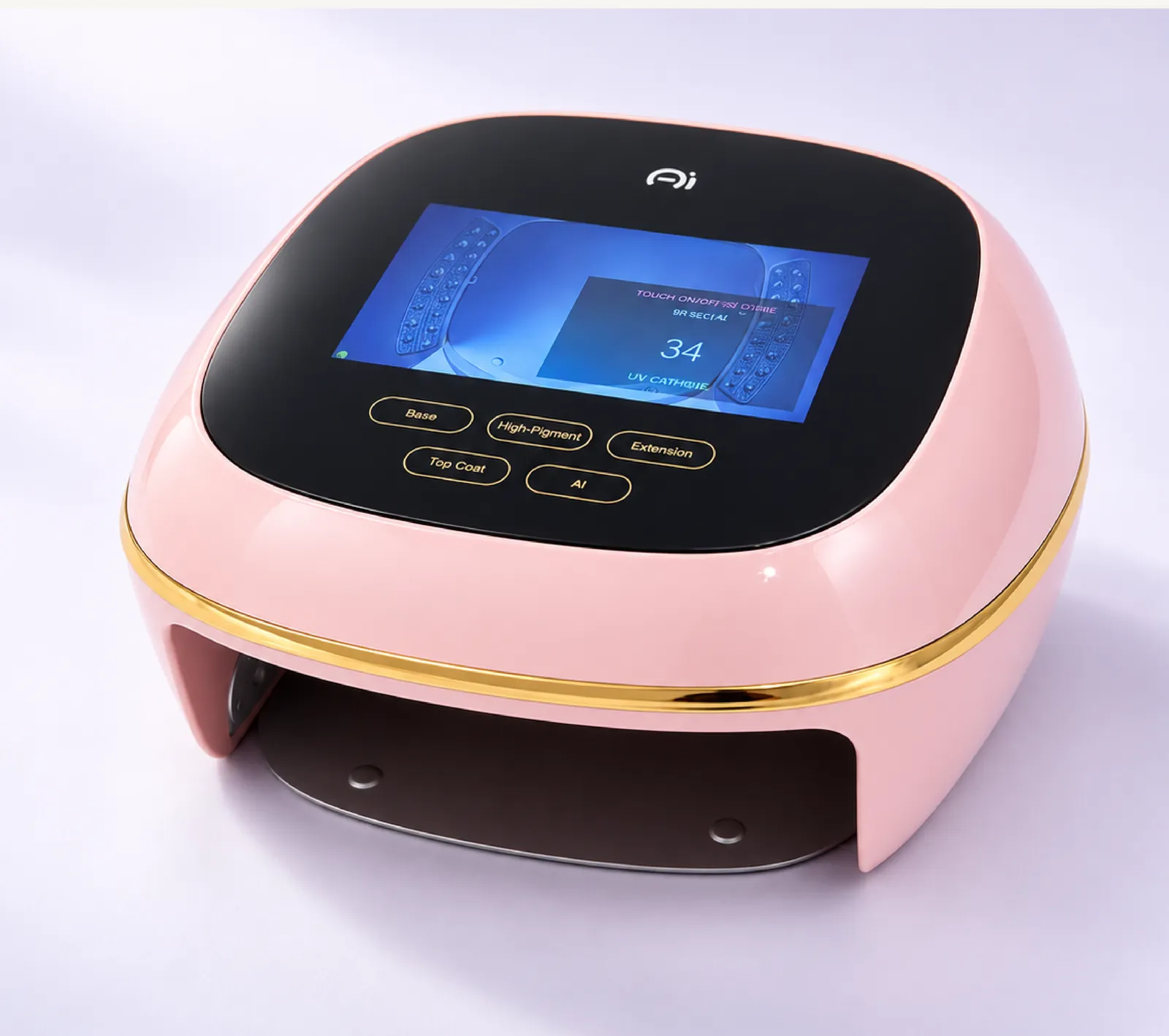
The service universe of an AI Smart Nail Lamp is six assemblies, not six hundred parts — and that is what makes a field service kit possible at distributor scale.
Six assemblies, and nothing else worth stocking
Strip the marketing away and an AI smart nail lamp is six assemblies: a dual-band LED array of 136 emitters across 365–370 nm and 395–400 nm, the heatsink and fan behind it, a 2-megapixel camera sitting behind an optical window, the on-device compute board that runs 0.5 TOPS and returns a detection in 0.2 seconds, a 5.5-inch console running 29 languages, and the power path — a rear inlet, a cord set and, only if the buyer ordered it, a 6,000 mAh battery pack.
Everything else is housing, hinge and feet. That is the entire service universe, and it is deliberately small: the fewer assemblies a distributor has to carry, the less capital is parked in spares and the faster a bench goes back to work. When a supplier cannot give you a parts list of this length, the honest reading is not that their lamp never fails — it is that they have not designed for service yet.
Four failure signatures, and the questions that identify each
A salon never calls to report a part number. It calls to report a symptom, usually in the middle of a Saturday. These are the four that account for most of the traffic, and the three questions that separate a part failure from an operating problem before anyone books a courier.
The cure looks fine, then the gel lifts at the sidewall three days later
This is the signature most buyers miss, because the lamp still looks bright. A dual-band array can lose one band and stay visually unchanged: the 395–400 nm emitters and the 365–370 nm emitters are both violet-blue to the eye, and a partially dark array reads as “working” on any bench in any salon. The gel, however, is formulated around both — surface cure and through-cure are not the same reaction.
Ask three things: does the lift happen on both hands or only one; does the console still report a successful detection; and does the same gel behave on a second unit in the same room. If the second unit cures it, you have a lamp problem and probably a band problem — which is exactly what the light-decay warning in the firmware is there to catch, and why the warning should never be dismissed as a nuisance message.
The console keeps saying it cannot find the hand
Nine times in ten this is the camera window, not the camera. Acetone and isopropyl mist settle on the glass through a working week; detection confidence falls before the module fails, and the symptom arrives as repeated “hand not detected” prompts rather than a dead screen. The tenth time it is a ring light aimed straight into the window, which floods the exposure the same way a window does.
Ask: wipe the window with a dry microfiber — not acetone, which is the cause — and retest. If it recovers for a day and hazes again, the cleaning routine is the fault and a spare window will not fix it. If it does not recover at all, replace the window before you replace the module; the window is a consumable and should be priced like one.
It gets hot and the output drops after twenty minutes
A dust mat on the fan intake and heatsink. The thermal derating is a protection, not a defect, but by the time the light-decay warning fires the derating has already begun — so the warning is a symptom of a blocked airway, not a fault in the array. In rooms where the unit runs eight hours beside a dust extractor, this is a monthly maintenance item, and it belongs on the salon’s opening checklist rather than in the warranty file.
No power, or it cuts out when the bench is moved
The inlet sits at the rear of a 24 × 24 × 11.5 cm housing. In rooms where the socket is under the client’s side of the bench, the cord is pulled at a hard angle every time the unit is repositioned; the strain relief takes the load and the inlet joint goes first. Ask whether the fault only appears after the unit is moved, and whether wiggling the connector reproduces it. Both answers point at the inlet, not at the board.
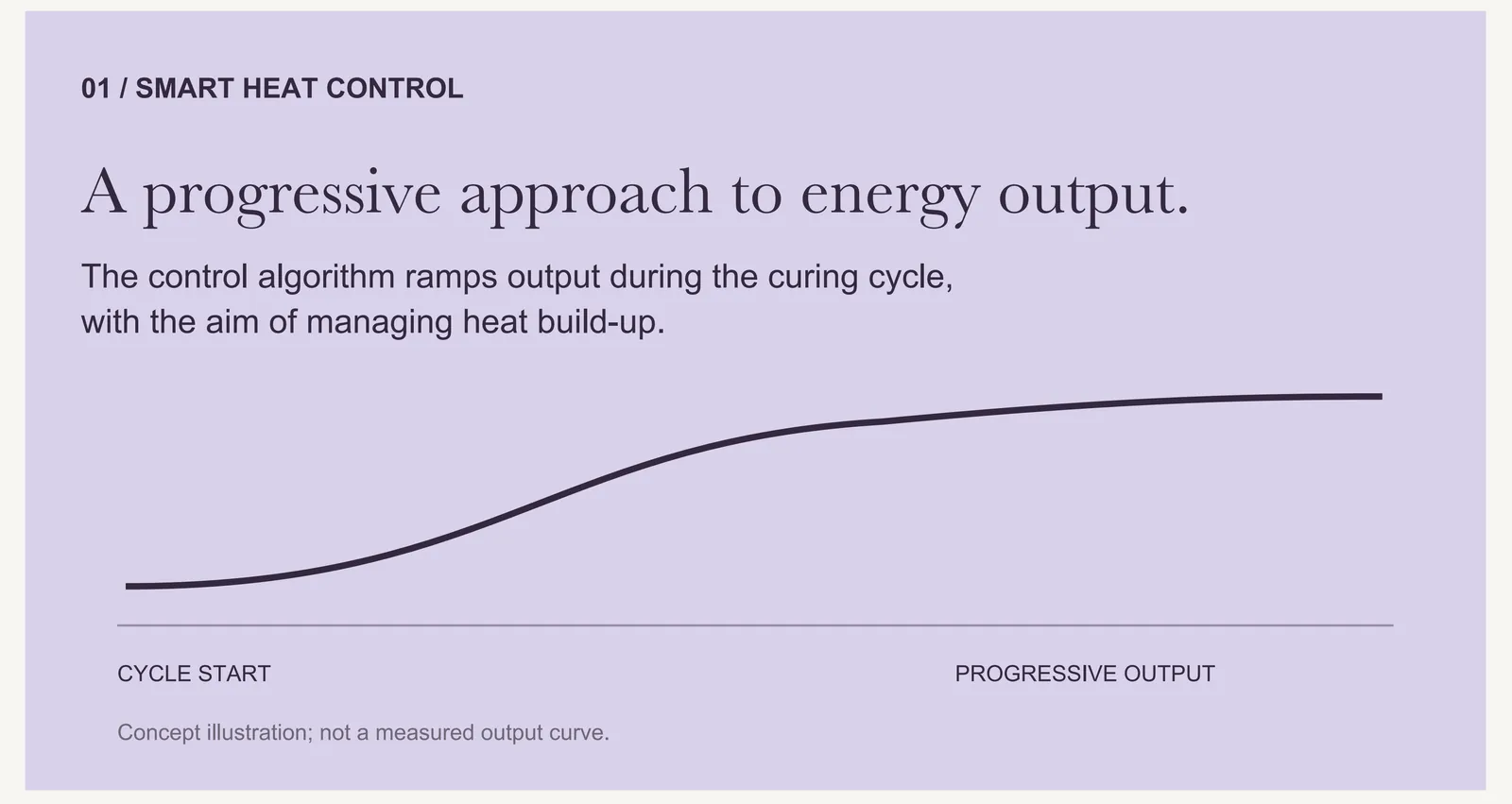
Thermal derating protects the array. The warning that follows it is a maintenance prompt wearing the costume of a fault code.
Field-replaceable, or it is not a service part
The test is simple and should be applied to every assembly before it enters a spare kit: can a salon manager replace it with a screwdriver, fifteen minutes and one page of instructions? If the answer requires opening the optical path or recalibrating the array, the part belongs in the return flow, not in the kit.
The economics only run one way. A lamp returned to the factory crosses a border twice, waits for a repair slot and leaves a chair idle for weeks — and the customer remembers the weeks, not the part. Against that, a fan, an inlet cord or a camera window is a rounding error on the invoice. Design the service around the part, not the unit; it is also the strongest argument for keeping the housing modular in the first place.
Four questions to put to any supplier before signing: which assemblies are field-replaceable; what the part numbers are; whether the firmware accepts a replacement module without a service tool; and how long the parts list is guaranteed after the model changes.
The kit: 1:10 on wear items, 1:25 on modules
Split the list by how the part fails, not by how it is priced. Wear items — fan, camera window, inlet cord set, fuses, feet — move at roughly one per ten units in the field per year and should be stocked at that ratio. Modules — LED array, console, compute board — move far more slowly, so one per twenty-five units is enough at a regional hub, and a single unit per country is often sufficient for a first year.
Two rules that distributors learn the hard way. First, spares ship with the first container, not the second: a distributor who waits for the first failure to order a fan has already lost the customer they were trying to keep. Second, keep a serial registry — serial number, salon, delivery date — because without it every warranty conversation becomes an argument about dates that nobody can win.
Warranty wording that prevents the argument
Three clauses do most of the work. A written dead-on-arrival definition and window, so a unit that fails in week one is not treated as a repair. A wear-item list that names the fan, the window and the cord set explicitly, so nobody discovers the exclusion after the fact. And a returns form that asks for the symptom, the serial and a photo of the console message — the photo is what turns “it doesn’t work” into a diagnosis in one exchange instead of five.
Equally important is what should not void a warranty: a console language changed at the salon, a cosmetic scuff on the housing, a gel brand the factory has never heard of. What should void it: an opened optical path, an array replaced without a service tool, water ingress from a wet bench. Draw that line in writing and both sides stop guessing.

Rear inlet, USB-C and the optional battery bay: three details that decide which spares matter for a given order.
Twenty minutes of onboarding saves a quarter of the returns
Most units returned inside the first ninety days are not defective. They are hazed windows, dusty fans and cords pulled sideways. A twenty-minute handover at delivery — where the window is, how to clean it, where not to lift the unit, how to route the cable behind the bench — costs less than any spare part and prevents most of them.
Put it on one A4 sheet, in the language of the salon. The console runs 29 languages; the cleaning card should match whatever the console is set to. A card in the wrong language is the same as no card.
What goes into the purchase order
Unit count with the spare ratio; the field-replaceable list with part numbers; the spare quantity per container; the DOA definition and window; the language of the cleaning card; where the warranty line sits between wear items and modules; and whether the battery is in the order at all. The standard configuration is AC powered with no battery, so a battery service kit only matters to buyers who requested the 6,000 mAh option — and for everyone else, that line simply disappears from the spare budget.
For buyers who want the technical layer behind the list, the AI Smart Nail Lamp product page carries the full specification, and the OEM/ODM program explains which of these assemblies can change on an existing mold and which cannot. Distributors evaluating the detection layer itself will find the limits of the camera covered in our note on what the camera sees and what it misses.
Quick FAQ
Which single spare should a new distributor stock first?
Is the LED array a consumable?
Can the console language be changed without returning the unit?
Next step
Send us your planned unit count, the markets you serve and the failure symptoms you are already seeing in the field, and we will return a service kit proposal: the field-replaceable list with part numbers, a spare ratio for your first container, and a one-page cleaning card in the language your salons actually run. Contact Miro Wu, Dedicated Account Manager — email miro.wu@beautome.com or WhatsApp +86 188 1393 3019.
Related: all buyer topics for distributors, the full product range, and the curing principle compared with conventional UV/LED lamps.