







What an AI Smart Nail Lamp Costs to Run: Watts, Duty Cycles and the Utility Bill
Every lamp quotation eventually meets the same question from a careful buyer: how much electricity does it actually use? It is a fair question — and the honest answer is that energy is almost never the line that decides the purchase. But a distributor who can run the arithmetic in front of the client wins the credibility, and a supplier whose spec sheet cannot support the arithmetic loses the order. Here is the calculation, the numbers behind it, and the four questions worth putting on the spec sheet before you sign.
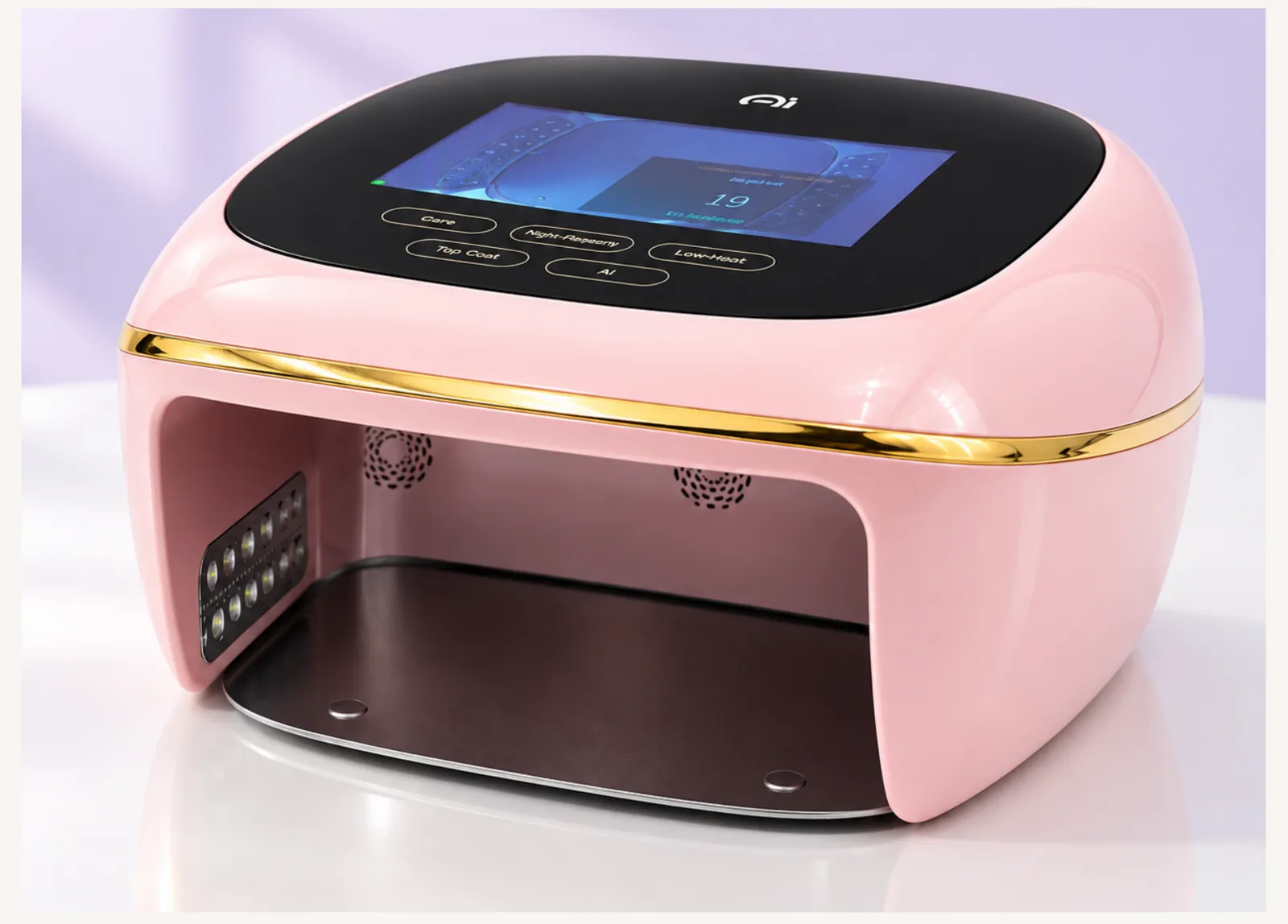
The LED array is the only part of the lamp that consumes meaningful power — and only while a cycle is actually running.
The price of a kilowatt-hour, in the markets you sell to
Start with what the client pays, because the arithmetic is meaningless without it. In the United States, commercial customers paid an average of 13.4 cents per kilowatt-hour in 2025, with roughly 14.0 cents forecast for 2026, according to the Energy Information Administration’s Electric Power Monthly and Short-Term Energy Outlook. Across much of the European Union the commercial band runs higher: Eurostat’s 2026 first-half data for small non-household consumers put Spain around €0.16 and Portugal around €0.17 per kilowatt-hour, with taxes and network fees included. Salons sit in that commercial band almost everywhere, and in several markets they pay more than the shops next door because evening opening pushes them into peak tariff windows.
None of those numbers is alarming on its own. What makes the buyer ask is the feeling that a device with 136 LEDs and a camera must be power-hungry. The next section shows why the feeling is wrong.
The duty cycle does the work, not the wattage
A curing lamp is not a kettle. It does not draw its nameplate power all day; it draws it in bursts of thirty to sixty seconds while a hand is under the light. That is why the useful figure is duty cycle — the share of operating hours in which LEDs are actually emitting.
Take a worked example. Suppose a professional unit lists 50 W on the nameplate — check the real figure on the spec sheet of whatever you buy. A salon station runs ten hours a day, and a busy manicurist performs four to five curing cycles per service, which works out to roughly 35 percent duty. That is 50 W × 0.35 × 10 h = 0.175 kWh per station per day. Over a 26-day month, about 4.6 kWh; over a year, about 55 kWh — roughly USD 8 at 14 cents, or about €9 at 16 euro-cents. A six-station salon spends less per year on lamp energy than on one bottle of gel polish.
This is the sentence a salesperson should be able to say out loud: even at European commercial tariffs, an occupied lamp costs a handful of euros a month. The buyer who pushes hardest on the electricity question is rarely worried about the utility bill. They are worried about what the power is doing — heat on the skin, heat inside the housing, and whether the lamp will still be running in year three.
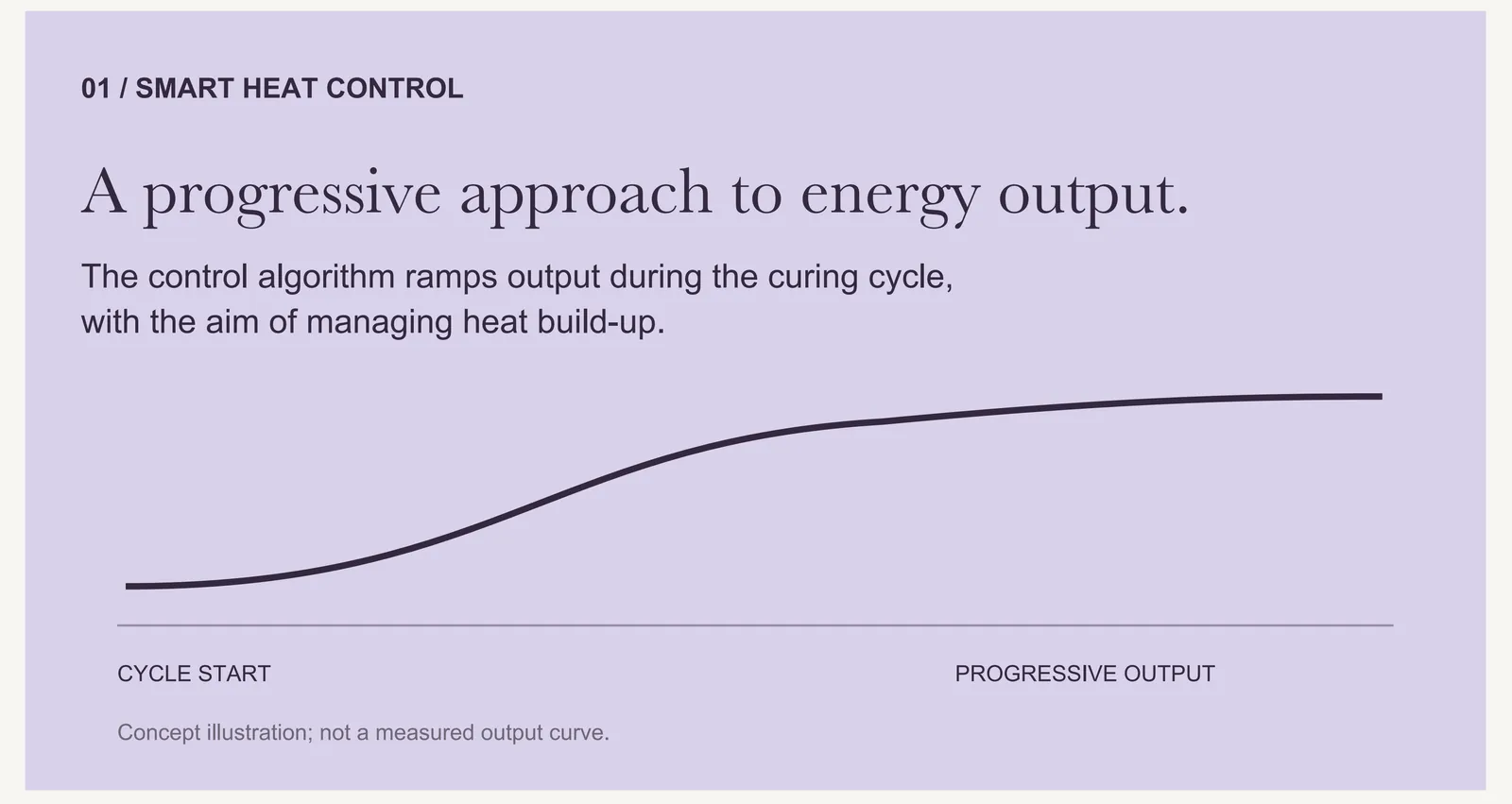
Heat control matters more than raw wattage: output that holds steady across a ten-hour day beats output that fades after lunch.
Where wasted energy actually goes
Three places consume energy without producing a cured nail, and each one is a specification question.
Heat. Every watt that becomes heat inside the housing is a watt that does not reach the gel — and it ages the electronics. This is why the smart heat management and the light-decay warning matter commercially: a lamp that monitors its own output tells you when the array is drifting before a technician notices under-cured tips and blames the gel. Ask for the 30-minute thermal stability figure — the output drop after half an hour of continuous cycling — and for what the console does when it detects the drift.
Light that misses the nail. An array that floods the whole hand spends energy on skin that needs none of it. Our lamp carries a 2 MP camera with 0.5 TOPS of on-device compute that locates the nails in roughly 0.2 seconds and emits zone by zone, so the light goes where the work is. The curing principle is the same one every LED lamp on the market uses — LED emitters producing UVA to set the gel — but where the light goes is a design choice. Zoned emission means less unnecessary light exposure of the surrounding skin, which is the mechanism behind hands that do not darken over a season of monthly appointments.
Redo cycles. A re-cure costs the client minutes and the salon a rebooked slot — those minutes cost ten times what the lamp spends on electricity in a month. An under-cured tip from a single-band array at a band the photoinitiator does not absorb is the expensive failure mode, and it is why our array runs two bands, 365–370 nm and 395–400 nm, instead of one.
The question almost nobody asks: standby
The lamp spends more hours switched on than emitting, which makes the idle draw worth one line on the quotation. A screen, a controller and a standby circuit can together consume a few watts continuously, and over a year a fleet of lamps multiplies that into a figure a facilities manager will eventually ask about. Ask the supplier for the standby power figure and the auto-sleep behavior — whether the lamp drops to sleep after a set idle period and how fast it wakes. A lamp with a 5.5-inch console that sleeps properly between clients costs less to leave on than one that keeps the display lit all afternoon.
The fleet version of the same arithmetic
For a twenty-unit chain the numbers scale linearly and stay small: twenty lamps at the worked example above use roughly 1,100 kWh a year — under USD 160 at the 2025 US commercial average. Compare that with the heater bank or the HVAC load in the same room and the lamp disappears from the bill entirely.
Which is the real point: energy is not the decision item on an AI Smart Nail Lamp. The decision items are cure quality across both bands, output stability over a full day, detection that behaves predictably with real hands, and the parts plan behind the unit. The electricity question is a trust question — the buyer wants to see that the supplier knows its own numbers.
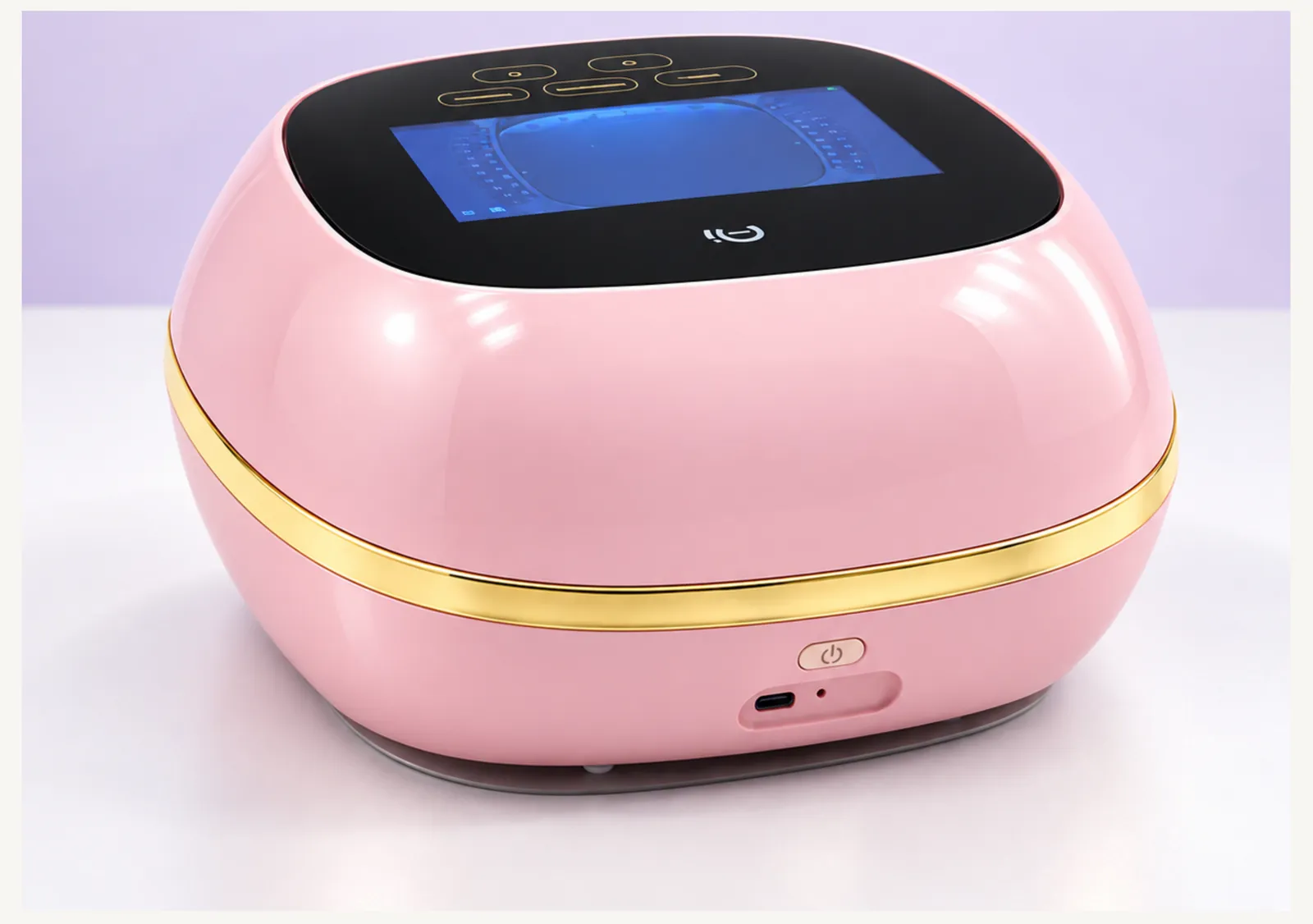
Standard units ship AC-powered without a battery; a 6,000 mAh battery version is available on request for mobile work.
Four lines to put on the spec sheet
Before the quotation is signed, get these in writing:
Nameplate power at the destination voltage. A lamp rated for 230 V markets and shipped to a 120 V region without the right power stage will not deliver its rated output — ask for the figure measured at your voltage, not a datasheet from another grid. Standby draw and sleep behavior. One number, plus how the console behaves overnight. Thermal stability. The output drop after 30 minutes of continuous cycling, and the console’s warning behavior when drift is detected. Circuit math. Nameplate current times units per room against 80 percent of the breaker — the same rule that decides how many lamps a salon can run, and worth restating in any chain order.
Two commercial notes belong on the same page. Standard units ship AC-powered without a battery; a 6,000 mAh battery version is available on request, and choosing it changes the shipping documentation, not the running cost. And the conformity file — LVD, EMC and RoHS in the EU, plus the photobiological safety classification under IEC/EN 62471 — travels with the lamp regardless of how little power it draws.
Quick FAQ
Does higher wattage cure gel faster?
How much standby draw is acceptable?
Should we buy the battery version to save energy?
Next step
Tell us your destination voltage and the number of stations you plan to run, and we will send the full electrical specification — nameplate power, standby draw, thermal stability figures and the conformity file — together with a sample quotation at your stage of the ladder, from a single evaluation unit to a branded fleet. Contact Miro Wu, Dedicated Account Manager — email miro.wu@beautome.com or WhatsApp +86 188 1393 3019.
Related: how many lamps a salon actually needs, the two-generation parameter comparison, heat spikes in thick gels, and the OEM/ODM process for branded fleets.