







AI Smart Nail Lamp for German and Austrian Distributors: The GPSR File, Two Years In
The General Product Safety Regulation has applied across the EU since 13 December 2024, with no transition period. Two years on, German and Austrian distributors no longer ask for a CE mark and a data sheet — they ask who the responsible economic operator is, where the traceability details sit, and whether the risk assessment file exists. For a nail lamp with a camera and on-board processing, those questions are easy to answer — if they were settled before the order, not after.
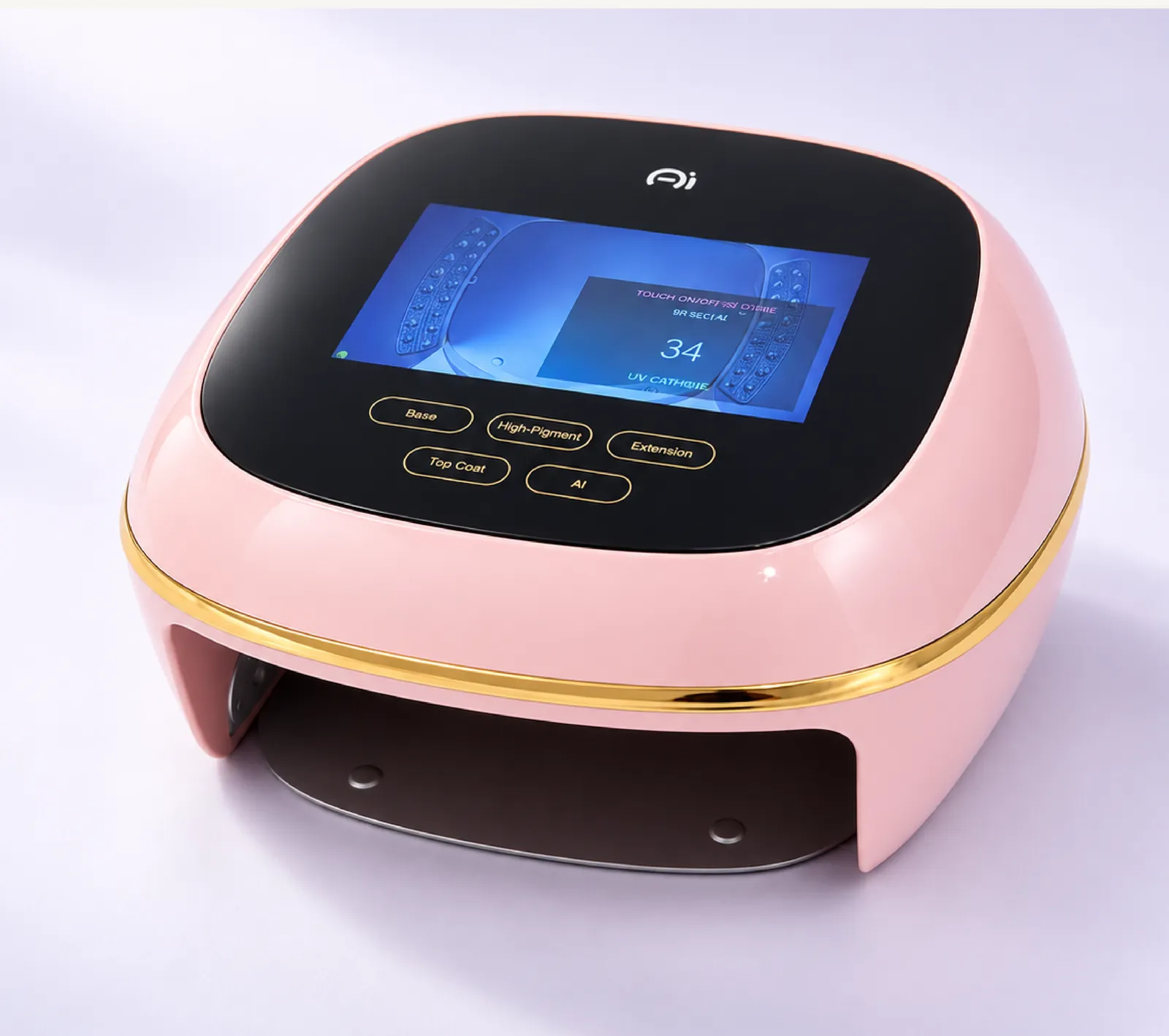
The lamp itself is not the obstacle in DACH distribution. The binder around it is — and every page of that binder has a named signer.
Two markets, counted the way distributors count them
Germany remains the largest nail market in the German-speaking region. A company-registry count put 11,360 nail styling businesses in Germany as of October 2026, classified under WZ 2008 code 9602 — with 98% operating as sole traders and effectively all of them employing one to four people (BoldData / CompanyData, 2026). Berlin leads with 511 businesses, ahead of Hamburg (219), Munich (213) and Cologne (129). A points-of-interest dataset counted 20,719 nail salon locations in April 2026 (POIData) — the gap is definitional, since POI listings include studios that registry filings classify under adjacent codes, so read the two numbers as a range, not a contradiction.
Austria is smaller and steadier: 1,355 beauty salons as of April 2026, up 4.29% from 2023, with 89.52% single-owner operations and an average business age of four years and nine months; Vienna alone holds 684 of them (Rentech Digital, 2026). The buyer in both countries is overwhelmingly the owner behind the chair — which is why the distribution conversation starts with a single unit on a trial table, not with a container.
11,360
German nail styling businesses counted in October 2026 under WZ code 9602 (BoldData / CompanyData)
98%
Share of German nail businesses operating as sole traders — the distributor’s buyer is the owner (2026)
13 Dec 2024
Date GPSR (EU) 2023/988 became directly applicable in all EU member states — no transition, no national transposition
What GPSR actually changed about who signs
Regulation (EU) 2023/988 replaced the General Product Safety Directive (2001/95/EC) and applies directly in every member state, including Austria, while also covering Northern Ireland but not Great Britain. Three of its changes reshape a German distributor’s sourcing file:
- A responsible economic operator established in the EU. A product covered by GPSR may not be placed on the market unless a manufacturer, authorized representative, importer or — failing those — a distributor established in the EU is responsible for its compliance. For a lamp shipped from a non-EU factory, the German or Austrian importer usually takes that role, and it must be a deliberate appointment, not a default.
- Traceability on the product. The responsible operator’s name, registered trade name or trademark, and postal and electronic address must appear on the product, or on its packaging or an accompanying document. Products also need a type, batch or serial number so each unit can be identified. For a private-label lamp this decides the label artwork before the housing is tooled.
- Documented safety work. Manufacturers must carry out an internal risk analysis, compile technical documentation, and run internal processes for product safety; economic operators cooperate with market surveillance authorities when a risk emerges. Online offerings must display the same manufacturer details and safety information as the physical product.
None of this replaces the harmonized legislation underneath — the Low Voltage Directive, EMC Directive and RoHS still govern the electrical file, and the CE marking stays. GPSR adds the safety-management and traceability layer on top, which is why a 2023-era document set does not satisfy a 2026 DACH compliance review.
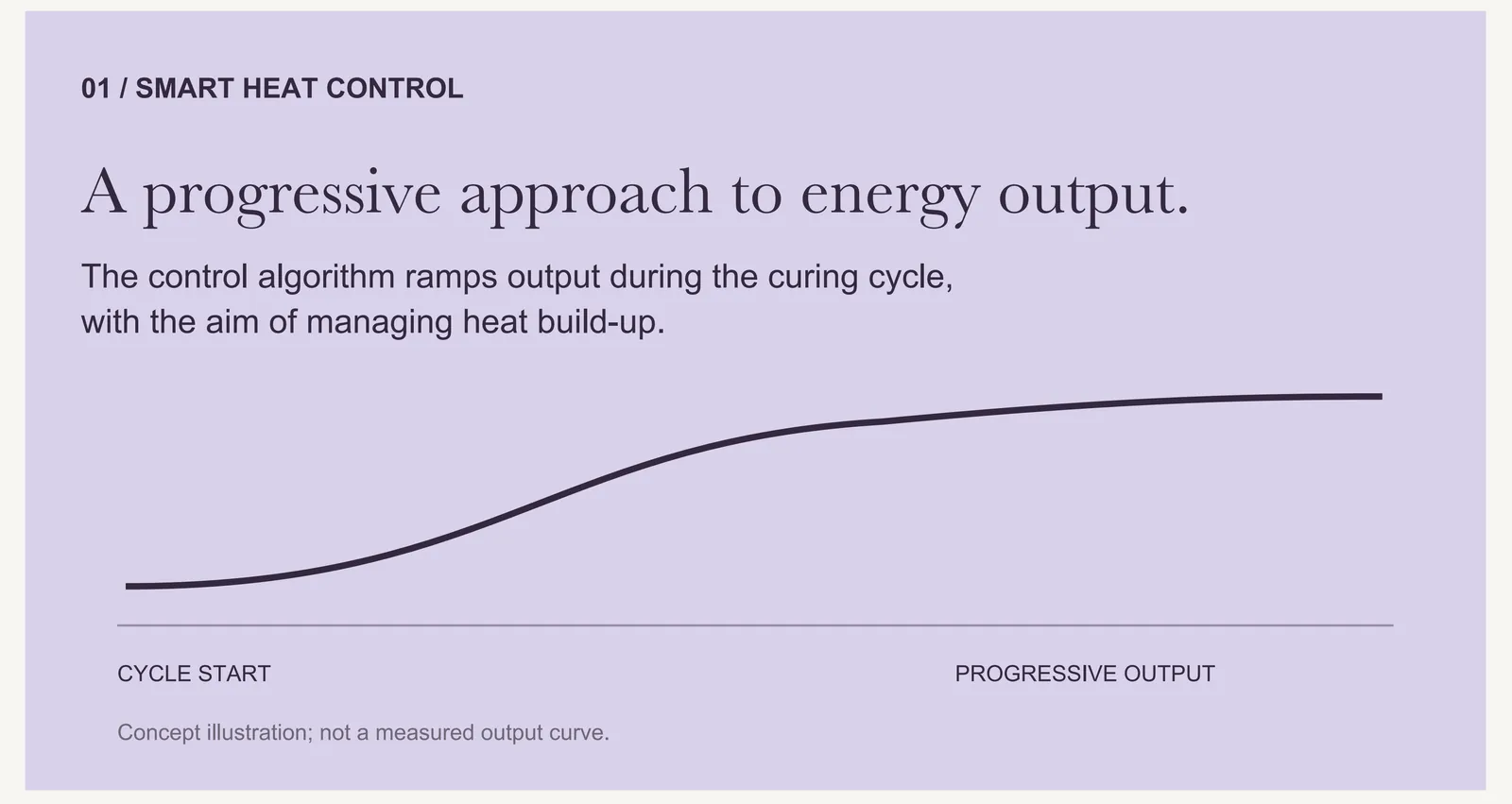
Thermal management and output monitoring are documented behaviors — exactly the kind of design rationale a risk analysis file is expected to describe.
The binder a DACH buyer asks to see
In practice, a German or Austrian distributor’s review runs through a short list: the CE declaration of conformity naming the manufacturer; the responsible economic operator’s details as they will appear on the product or packaging; the batch or serial scheme; instructions and safety information in German — for the Austrian market the same German file works, which is one of the quiet advantages of pairing the two countries in one order; and the technical documentation behind the risk assessment. Some buyers also weigh the voluntary GS mark, a German-market safety signal many retail buyers still recognize; it is optional, not a legal substitute for anything above.
One scope question should be settled in writing with the laboratory before testing: whether the lamp is assessed as a household appliance or in the lighting family, because the applicable standard follows the classification, and the classification follows intended use and marketing. Distributors who skip this step meet it again at the worst possible moment — during a customer’s audit.
230 V, Schuko, and one grid for both countries
Electrical side, the good news: Germany and Austria share a 230 V / 50 Hz grid and Schuko-style type C and F sockets, so one cord specification serves both markets. Order the 230 V/50 Hz nameplate, moulded type C/F cords, and a spare cord per ten units. Specify a driver tested at 50 Hz — a report written for a 60 Hz market answers a different question — and keep the input-voltage range on the nameplate rather than a single nominal figure.
What the lamp does for an owner-operated market
The commercial logic in a market of one-to-four-chair studios is consistency without a trainer on staff. The AI Smart Nail Lamp uses a 2 MP camera and on-board AI processing to locate the nails in about 0.2 seconds, then fires its 136 dual-band LEDs — 365–370 nm and 395–400 nm — only over the detected zones. The curing principle is the same as any modern gel lamp: LED diodes emitting long-wave UVA to set the product. What differs is control — the light lands on the nail rather than flooding the hand, so the surrounding skin receives far less unnecessary light exposure. That is the mechanism behind the “dark hands” complaint long-term gel clients raise, and it is a claim that survives a skeptical German buyer precisely because it does not overstate.
Smart heat control softens the exotherm spike that makes clients flinch, and the light-decay warning turns a slow output drop into a maintenance prompt instead of a month of under-cured sets. The 5.5-inch console ships in 29 languages and can be locked to German at the factory, so a newly hired technician needs no onboarding session to run the machine. The 24 × 24 × 11.5 cm housing with rear cable entry suits the compact stations typical of Austrian and German studio fit-outs.
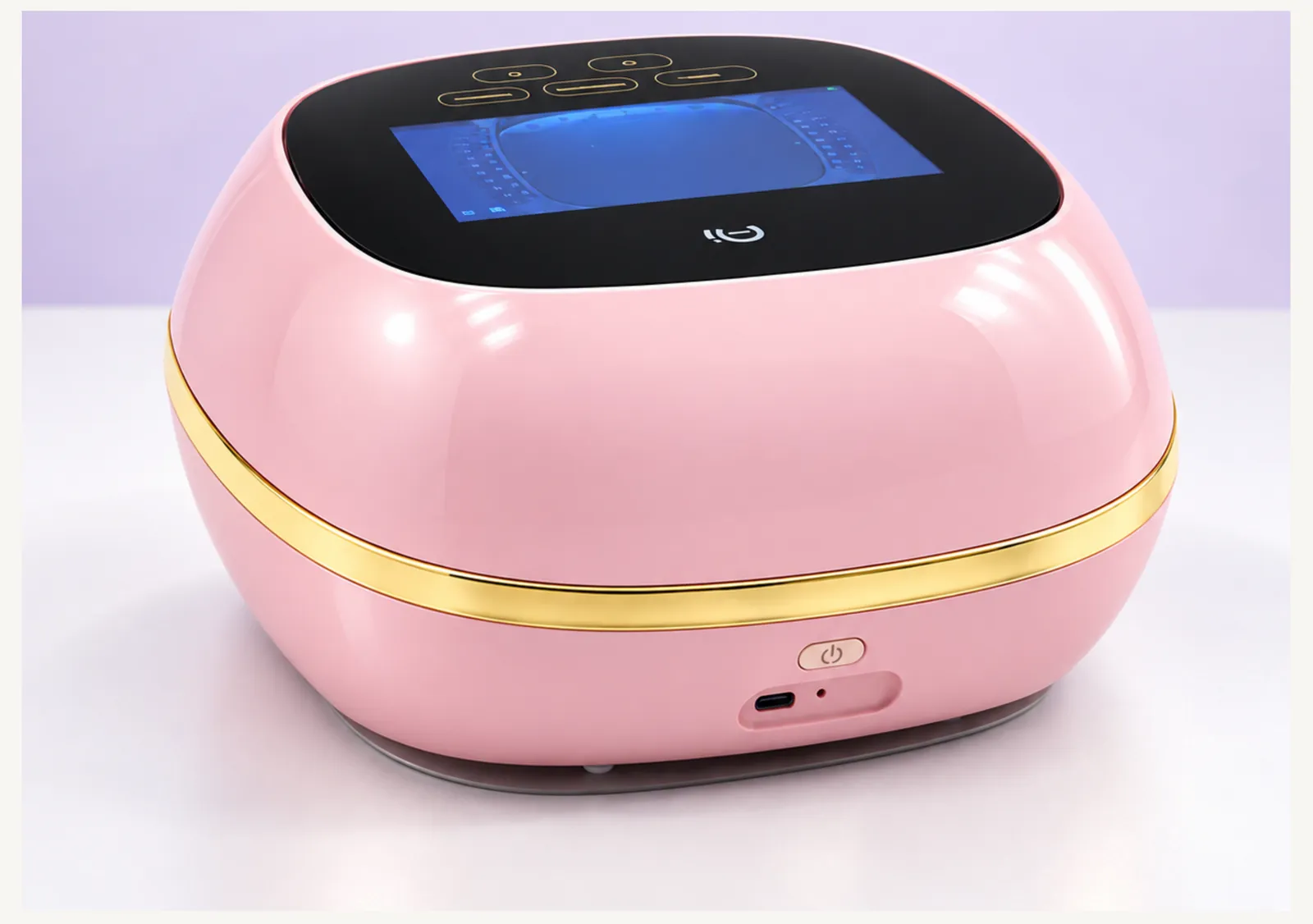
Rear cable entry, a compact footprint and an AC-standard build — the battery version stays optional, ordered only when a mobile service channel asks for it.
Order lines for a DACH program
The commercial ladder is the same one that works across the EU: white-label units without branding start at three to five pieces, and a single evaluation unit ships before any commitment — the standard pattern is a two-week trial in the owner’s busiest chair. Full custom branding — logo, colorway, retail packaging — starts at 300–500 units. For a German or Austrian order, add three lines to the purchase order: who is appointed as the EU responsible economic operator, how the batch or serial scheme will be marked on the housing or packaging, and which languages the console and the printed instructions carry. The product specification is on the AI Smart Nail Lamp page, the branding ladder under OEM and ODM, and the curing background in this comparison.
Quick FAQ
Does GPSR replace CE marking for a nail lamp?
Who should be the responsible economic operator on a private-label lamp?
Do Germany and Austria need different cords or documents?
Next step
Tell us whether the program starts with evaluation units or goes straight to private label, and we will return a quotation that names which compliance artifacts ship with the goods and which belong to your entity as the EU operator. For a quotation, contact Miro Wu, Dedicated Account Manager — email miro.wu@beautome.com or WhatsApp +86 188 1393 3019.