





Hard Wax for Gulf Hotel and Resort Spas: Four SKUs, One Label Master, Six Markets
A hotel spa in the Gulf does not buy wax the way a high-street salon does. The order comes from a pre-opening budget or a group procurement standard, the menu has to be teachable to a therapist who arrived last month, and the same product should behave identically in Dubai, Riyadh and Doha. That combination rewards a short range and punishes a long one — four formulas, one label master, and a pack size that fits a back bar rather than a warehouse.
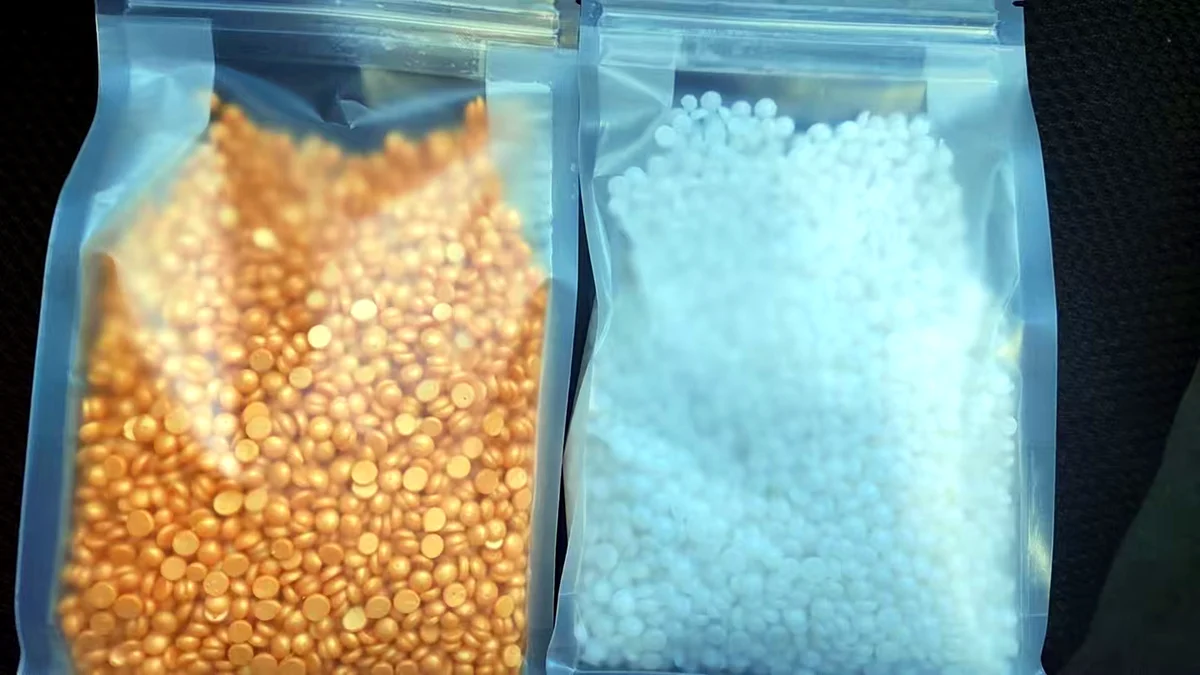
Unlabeled transparent bags let a spa group put its own brand on the bag at the point of import — after the registration file is built, not before it.
The channel that is actually growing fastest
Global Market Insights put the combined Saudi and UAE spa market at USD 2.21 billion in 2025, USD 2.40 billion in 2026, and USD 5.09 billion by 2035, an 8.7% CAGR (GMI, October 2026). The same analysis notes roughly 99,500 additional hotel keys under construction or in planning in Saudi Arabia through 2030, and 30 million international visitor arrivals in the kingdom in 2024. Hotel spas, in that reading, capture revenue through packages bundled with accommodation rather than through walk-in treatment sales.
For a wax supplier, the useful consequence is not the headline number. It is that a meaningful share of new treatment rooms will be specified before they open, by a procurement team working from a brand standard, with an FF&E budget and a fixed opening date. That is a different sales cycle from a salon owner buying a bag at a trade counter — and it is the one where a short, well-documented range wins.
USD 2.40B
Combined Saudi and UAE spa market in 2026, forecast to USD 5.09B by 2035 (GMI, October 2026)
99,500
Hotel keys under construction or in planning in Saudi Arabia through 2030 — each with spa fit-out decisions ahead of it
8.7%
Forecast CAGR for the KSA and UAE spa market, 2026–2035 (GMI, October 2026)
What a hotel spa buyer weighs that a salon owner does not
Four differences change the specification:
- Therapist turnover. Hotel spa teams rotate, and seasonal staff arrive trained on a different product. A formula that tolerates a slightly wrong temperature and a slightly thick application is worth more than one that performs best in expert hands.
- Menu consistency across properties. A group with three resorts wants the same strip on the same skin type in all three. That argues for one rosin-free formula as the default rather than a different product per property.
- Brand-neutral packaging. Many hotel spas sell treatments under the property’s own brand. Unlabeled transparent bags let the group apply its own label at the point of import — with no printing plate, no artwork approval cycle at the factory, and no carton to write off when a property is rebranded.
- A small back bar. Storage is a cupboard, not a warehouse. Three pack sizes cover it; a pallet does not.
Four SKUs, and why four is the right number
A hotel spa menu typically needs a sensitive-skin option, a firm option for larger areas, a high-volume option for legs, and a strip-wax line for arms and backs. That is four products, and each one has a job:
- Formula A1 — rosin-free hard wax, working range 45–50 °C. The sensitive-skin and first-time default: face, underarm, bikini. Standard colors are Gold and Pink; White is a custom color, made to order because it is the most demanding to run. Packed in 300 g, 500 g and 1,000 g bags.
- Formula A2 — premium rosin hard wax in cream-white beads. High elasticity and grip, built for short, dense hair on larger areas: back, chest, shoulders.
- Consumer-Grade Hard Wax — film wax, working range 55–60 °C. The high-volume leg and arm product, and the easiest to teach.
- All-Purpose Soft Wax — 450 g cans. The strip line, for spas that still run muslin on arms and legs.
Two working temperatures sit inside that range — 45–50 °C for A1 and 55–60 °C for the film wax — which means two pots per treatment room, not one pot set twice a day. A 450 ml pot holds roughly 400 g, about one therapist’s day; the 1,000 g bag belongs in a high-volume back bar, not on a bench where it will be opened and left.
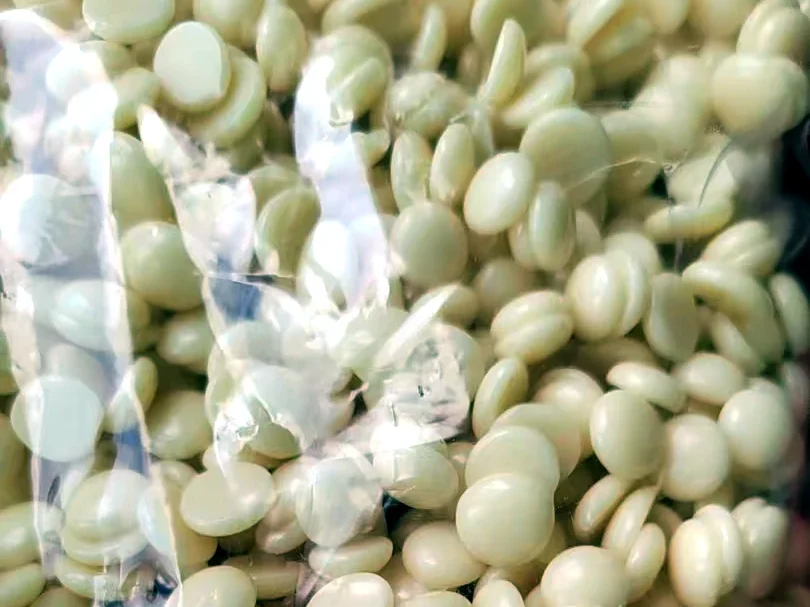
A2 cream-white beads: the body-area product in a hotel menu, where grip on dense hair matters more than a low working temperature.
One label master, six markets
The efficient way to serve a multi-country group is to build a single label master with every field any of the six GCC markets may ask for, then switch fields on or off per market. The core set is stable: product name and function, full INCI list in descending order, batch number, production date and expiry, manufacturer name and address, importer name and address, storage conditions, warnings, and the net content. Arabic is required on Gulf labels — the product function in particular must be stated in Arabic, not only in English.
Two practical points follow. First, a label master is a design, not a registration: each market still requires its own act before the product can be sold, and a notification is not an approval. In Saudi Arabia the current route is an SFDA cosmetic product notification through the unified Ghad portal, with a product notification number used at clearance through FASAH, backed by GMP or ISO 22716 evidence and an attested Free Sale Certificate; batch-level conformity is handled separately. In the UAE, registration runs through the federal health authority — historically MOHAP, with some functions reported as moving to EDE at the end of 2025 — plus Dubai Municipality’s Montaji system at emirate level. Confirm the current portal with your agent before artwork is printed, not after.
Second, the unlabeled transparent bag does not avoid any of this. What it does is move labeling to the importer’s facility, which is where the registration holder already sits — so a group can order one neutral SKU, hold it in a central store, and label per property or per market as registrations complete. That is a sequencing advantage, not a compliance shortcut.
Storage in a hotel, not in a laboratory
Hard wax in bead form is not a cold-chain product, but it is not indifferent to heat either. The working recommendation is 15–24 °C, dry and out of direct sun. A hotel receiving bay in July is well above that, and a bag that has sat in a delivery van will arrive soft, with beads fused into a block.
Three rules cover most of it: let a bag reach room temperature before opening it, because coastal humidity of 80–90% condenses on cold beads; reseal opened bags and keep them off the floor; and rotate stock so the oldest bag is used first. A spa that stores wax next to the towel warmer will report “the wax has changed” long before anything is actually wrong with the batch.
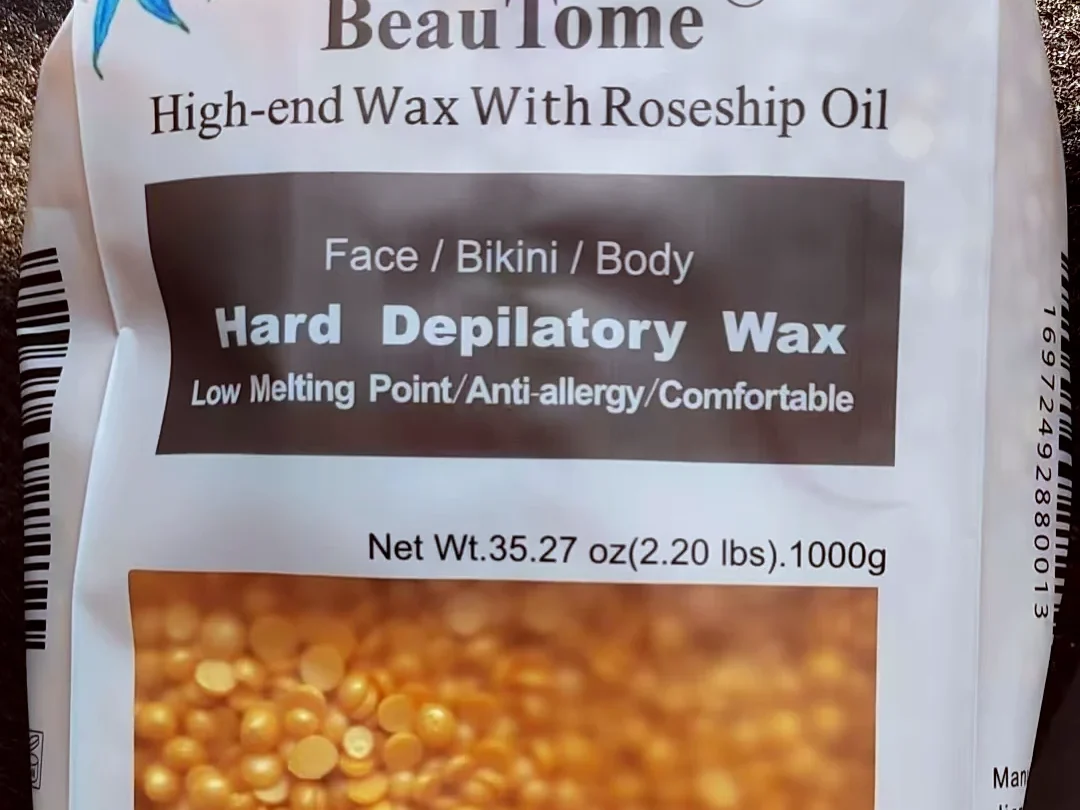
Gold and Pink are the standard A1 colors; White is made to order. The bag format is the same whether it carries a spa brand or travels unlabeled.
The pre-opening calendar
A hotel spa order is driven by an opening date, and the wax has to be on site before the therapist training week, not before the ribbon cutting. Working back from an opening:
- 12–10 weeks out: product selection from samples, four tests on site — a back strip with A2, a bikini strip with A1, film behavior on a leg with the 55–60 °C product, and a reheat test after the pot has idled for two hours.
- 10–8 weeks out: label master frozen; registration owner confirmed per market; pack sizes fixed against the back-bar plan.
- 8–4 weeks out: production and label application; the neutral-bag route means the factory run does not wait for artwork approval.
- 4–2 weeks out: delivery to the central store, then allocation to properties; training on the two working temperatures.
Private label on A1 starts at low MOQ, which is what makes a single-property pilot possible before a group standard is written. There is no printing cycle on an unlabeled bag, so the only clock that matters is production and freight.
The formulas are set out on the wax formulas page, the pots that hold the two working temperatures on the wax heaters page, and the private-label route on the OEM and ODM page.
Quick FAQ
Can a hotel group use one SKU across all six GCC markets?
Why four formulas instead of one all-purpose hard wax?
Does the unlabeled transparent bag reduce the paperwork?
Next step
Send us the property count, the markets you will register in first, and whether the label will carry the spa brand or stay neutral, and we will return a four-SKU proposal with pack sizes, a label-master field list and a production date that fits your opening. Contact Miro Wu, Dedicated Account Manager — email miro.wu@beautome.com or WhatsApp +86 188 1393 3019.