







Wax Heaters for Japanese Salons: 100 V, Two Frequencies and the PSE File
Japan is the one major market where a 230 V wax warmer cannot be “made to work” with an adapter. The grid is 100 V, the country runs on two frequencies, and the safety law divides appliances into two marks with two different procedures. A converted machine does not heat — it idles at a fifth of its rated power.
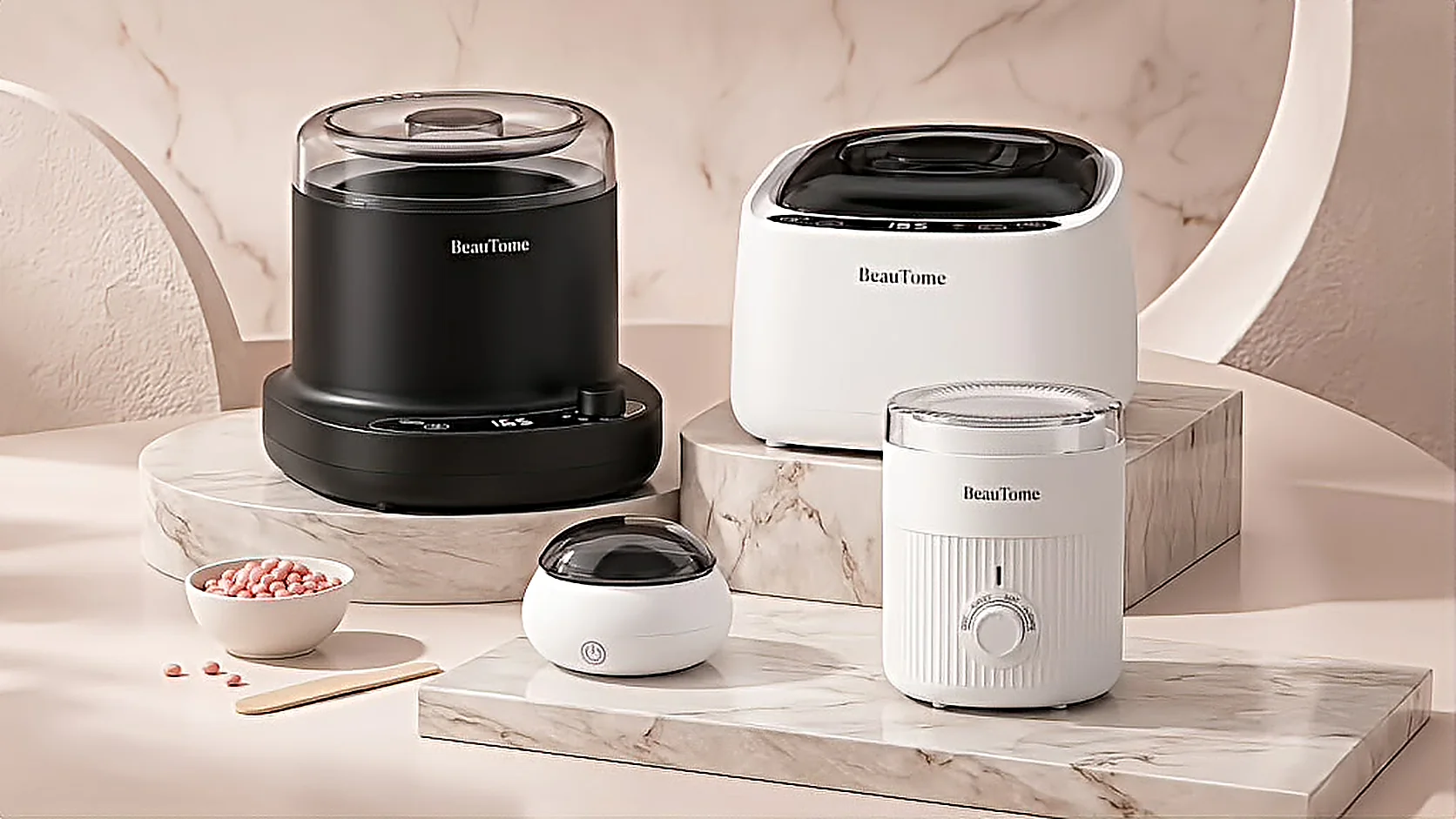
Nine models from 20 ml to 800 ml — but the specification that decides a Japanese order sits at the bottom of the sheet, not the top: element, frequency and mark.
A dense market of small rooms
Japan counted 13,266 nail salons as of 1 April 2026, up 7.12% on 2023, with 62.66% single-owner operations and an average business age of three years and eight months (Rentech Digital, 2026). Osaka leads with 1,488, ahead of Tokyo (1,128) and Saitama (931). The waxing side sits in the same buildings: the “nail and wax bar” format spreads through Japanese urban retail as it has in Seoul and Taipei, and third-party estimates put the Japanese depilatory wax market at roughly USD 700 million in 2025, with the country holding about 12.2% of Asia-Pacific value by 2035 (Global Market Insights, 2025) — modest volume, high price per treatment.
The buyer that follows is an owner-operator with two to four treatment beds, a fixed menu, a hygiene routine she is proud of, and no maintenance department. She does not want an eight-model catalogue. She wants one warmer that holds temperature, one spare element, and a Japanese manual she can hand to a new part-timer.
13,266
Nail salons in Japan, April 2026, up 7.12% on 2023 — 62.66% single-owner (Rentech)
100 V
Nominal single-phase supply, 50 Hz in the east and 60 Hz in the west — both must be covered
2 PSE marks
Circle (self-declaration) or diamond (third-party assessment) — the class decides the file
One country, two frequencies
Japan runs 100 V at 50 Hz in the east — Tokyo, Hokkaido, Tohoku — and 60 Hz in the west, including Nagoya, Kyoto, Osaka and Kyushu, with the boundary running roughly along the Itoigawa–Fuji line. A chain with rooms on both sides receives two electrical realities in one purchase order, and a distributor covering both regions cannot stock a single-frequency variant without returns.
For a resistive element the frequency changes nothing: 100 W at 50 Hz is 100 W at 60 Hz. What changes is everything around it. An AC fan motor turns about 20% faster at 60 Hz, altering airflow, noise and the thermal margin the housing was designed around. Any controller that derives timing from the mains — zero-crossing detection, a synchronous timer motor, a cheap switching design without its own oscillator — drifts or misbehaves on the other frequency. Chip-controlled warmers with their own DC supply are largely immune, but “largely” does not survive an importer’s checklist. Specify 100 V, 50/60 Hz on the nameplate and require a report naming both frequencies. A 230 V/50 Hz report with a note that the unit “also works in Japan” is not a file; it is a conversation you will have again at customs.
The arithmetic that rules out converted machines
A heating element is a resistor, and power follows the square of voltage. Take a 230 V element rated at 100 W and connect it to 100 V: the power delivered is 100 W × (100/230)², about 19 W. A 450 ml warmer that reaches working temperature in twelve minutes on 230 V will not reach it at all on 100 V; it will sit at a temperature that looks like warming and behaves like nothing. That is why “just change the plug” is the most expensive sentence in this market. The correct change is a 100 V element of the same wattage, with the harness, thermal fuse and current sensing re-checked against the new draw.
The current itself stays modest: a 100 W warmer on 100 V draws about 1 A, so an eight-bed room running two warmers and a sterilizer sits far below the 15 A rating of a standard Japanese general-purpose outlet — 1,500 W at 100 V. The constraint is never the circuit; it is the multi-tap extension lead under the bed. Put the circuit arithmetic in the Japanese manual, and put cord length in the specification: the shorter the lead, the fewer the daisy chains.
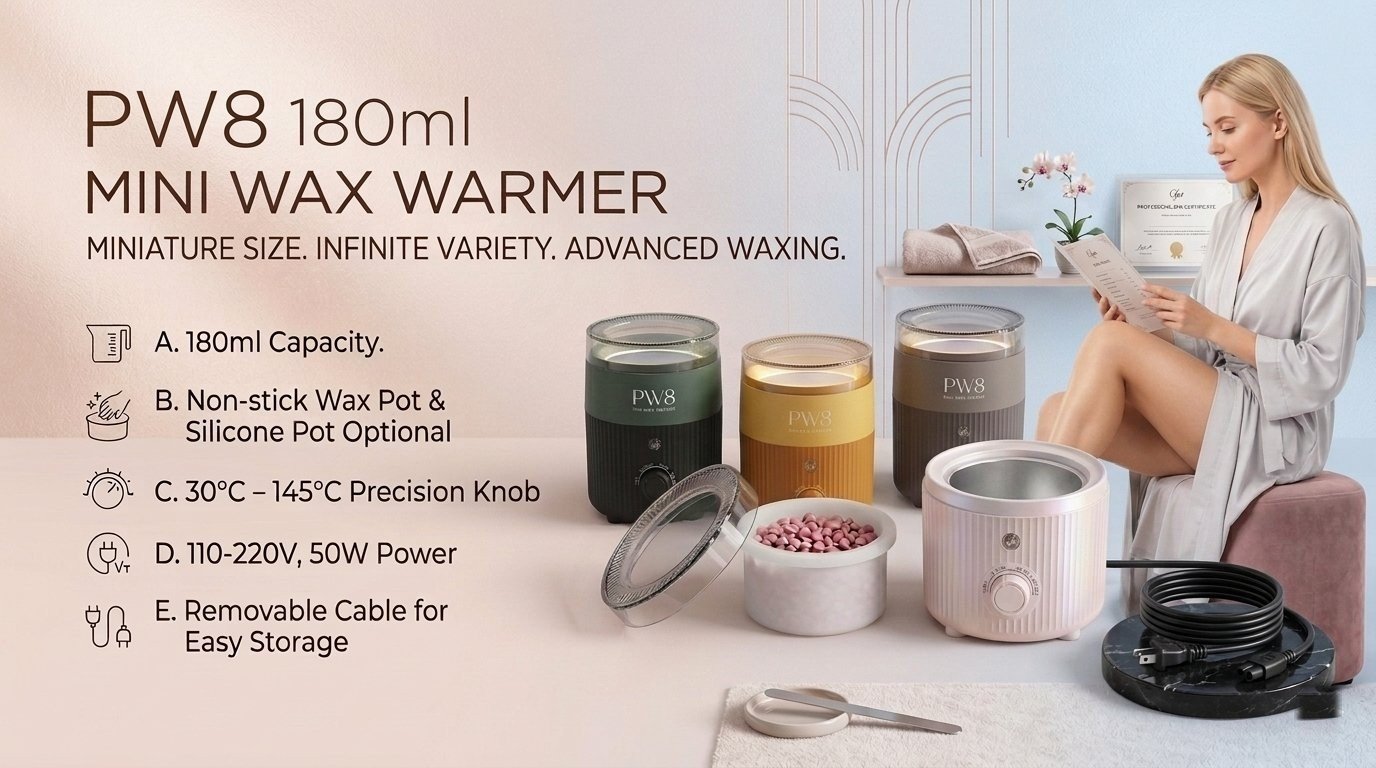
The 180 ml PW8 exists for the single-bed room — and at 100 V it is where correct element specification shows up fastest, because there is no spare capacity to hide behind.
PSE: two marks, two procedures, one registrant
The Electrical Appliances and Materials Safety Act (DENAN) splits appliances into two categories, and the split is not cosmetic. Specified appliances — the diamond mark, 165 product types including detachable AC adapters and cord sets — require conformity assessment by a registered body plus an initial factory inspection, with certificates typically valid three to seven years. Non-specified appliances — the circle mark, 341 types covering most small household appliances — are self-declared on the basis of testing, with no factory inspection. A 100–500 W warmer with a moulded cord normally lands in the circle category. The same warmer shipped with a detachable AC adapter drags a diamond-category component into the box — a separate file with a separate owner, and an easy cost to avoid by keeping the cord moulded.
Above both categories sits one requirement no factory outside Japan can satisfy alone: the business notification to METI must be filed by a registered operator established in Japan — in practice your importer. The nameplate then carries the PSE mark, rated voltage and power, model, and that operator’s name; for diamond goods, the assessment body as well. Instructions and warnings must be in Japanese, written as Japanese rather than machine-translated from an English master, and the warranty should be the importer’s. Confirm the classification in writing before nameplate artwork is released: getting it wrong means reprinting housings, not labels.
The plug, and the room behind it
Japanese general-purpose outlets take the JIS C 8303 two-blade plug: flat parallel pins, unpolarized, with insulated sleeves. Most sockets have no earth contact, which puts the burden on Class II construction — double insulation, no exposed metal tied to mains, and a housing that cannot become live through a spilled pot of wax. In a treatment room that is not theoretical: wax spills, and cleaning happens with water nearby. Order the moulded JIS C 8303 cord as its own purchase-order line with a spare per ten units, and check that the cord entry survives being pulled sideways by a trolley.
The premises side is set by the Beauty Specialists Act: a beauty salon must be notified to the prefectural governor through the public health center before opening, and the facility standards that follow are set by prefectural ordinance, so details differ by prefecture. We do not present ourselves as an authority on those local rules. What the equipment can do is make the inspection conversation short: a lid that closes so wax is never open to dust between clients, an inner pot that lifts out so the unit can be emptied and washed rather than wiped, a flat interior with no ledge where wax collects, and a temperature display a part-timer can read. Those four properties are design decisions, not accessories.
The capacity ladder, read in 100 V terms
The range runs from a 20 ml PW6 for patch tests, through 180 ml PW8 and 250 ml PW2B for a single bed, 400 ml PW1B, 450 ml W5, W6 and BWW5K as the workhorse size, 500 ml W2 with a digital display, to 800 ml SW1B and the dual-pot SW6B and SW8B. Two readings matter for Japan. First, 450 ml holds roughly 400 g of beads — about one technician’s day, the right unit for a room, the wrong unit for a chain’s central prep. Second, two working temperatures mean two pots: a shop running a rosin-free wax at 45–50 °C and a film wax at 55–60 °C cannot do both in one pot without a reset between clients. That is where the dual-pot models earn their footprint, and it is the most common upgrade in a Japanese room’s second order.
The file that decides the second order
Japanese buyers evaluate the first order on specification and the second on service. Build the first shipment with a spares kit at roughly one unit per ten installed: 100 V heating elements, inner pots, controllers, knobs and lids, and JIS C 8303 cords. Hold them with the importer, not at the factory, because a two-week wait is a two-week outage for a two-bed salon. Add a one-page Japanese fault table — does it heat, does it hold, does the reading match an external probe — so staff can triage by phone instead of shipping units back. The wax heater range page carries the specifications and the private-label route sits under OEM and ODM.
Quick FAQ
Can a 230 V warmer be sold in Japan with a plug adapter?
Does our warmer need a diamond PSE mark or a circle PSE mark?
Do we need separate 50 Hz and 60 Hz versions?
Next step
Tell us the region you cover, the number of beds and whether the room runs one or two working temperatures, and we will return a 100 V configuration with the element specification, cord type, manual language set and a first spares ratio. For a quotation, contact Miro Wu, Dedicated Account Manager — email miro.wu@beautome.com or WhatsApp +86 188 1393 3019.